QUESTION IMAGE
Question
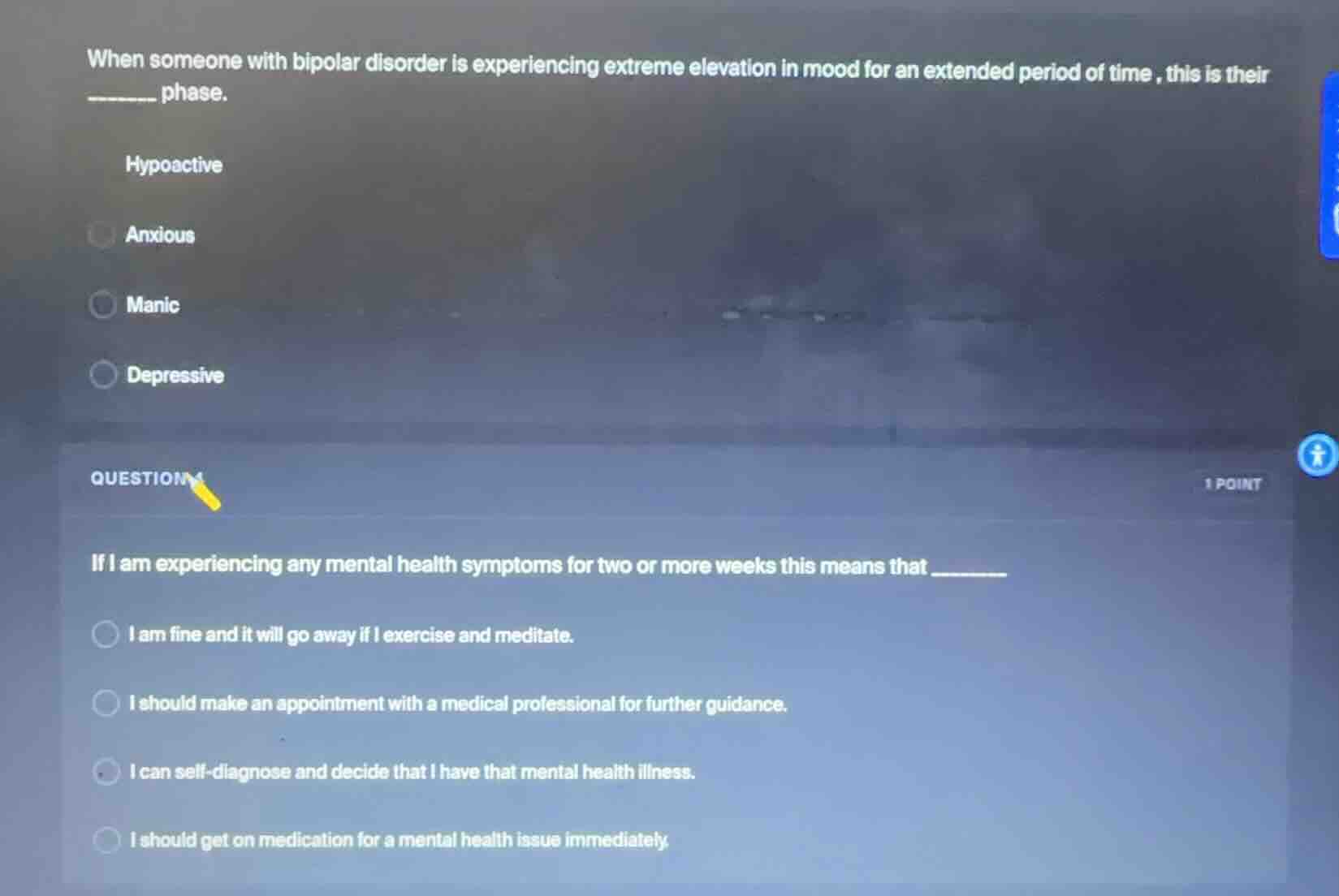
when someone with bipolar disorder is experiencing extreme elevation in mood for an extended period of time, this is their ______ phase.
hypoactive
anxious
manic
depressive
question 14
1 point
if i am experiencing any mental health symptoms for two or more weeks this means that ______.
i am fine and it will go away if i exercise and meditate.
i should make an appointment with a medical professional for further guidance.
i can self-diagnose and decide that i have that mental health illness.
i should get on medication for a mental health issue immediately.
<pre_analysis>
{
"quality": "clear",
"question_count": 2,
"skills_matched": [
"direct_cot",
"multiple_choice_formatter",
"explain_then_answer",
"quick"
],
"needs_drawing": false,
"concepts_used": [],
"new_concepts": [
"Bipolar Disorder",
"Mental Health Support"
],
"current_concepts": [
"Bipolar Disorder",
"Mental Health Support"
]
}
</pre_analysis>
<reasoning>
Identify the phase of extreme mood elevation in bipolar disorder
- Bipolar disorder is characterized by extreme shifts in mood, energy, and activity levels.
- An extended period of extreme elevation in mood, energy, and activity is clinically defined as a manic phase (mania).
- Therefore, the correct option for the first question is "Manic".
Determine the appropriate action for persistent mental health symptoms
- Experiencing mental health symptoms for two or more weeks is a common clinical threshold indicating that the symptoms are persistent and may require professional evaluation.
- Self-diagnosis, ignoring the symptoms, or immediately seeking medication without a professional assessment are not recommended or safe practices.
- The most appropriate and safe action is to consult a medical or mental health professional for proper guidance and diagnosis.
- Therefore, the correct option for the second question is "I should make an appointment with a medical professional for further guidance."
</reasoning>
<answer>
Question 1
<mcq-option>Hypoactive</mcq-option>
<mcq-option>Anxious</mcq-option>
<mcq-correct>Manic</mcq-correct>
<mcq-option>Depressive</mcq-option>
Question 2
<mcq-option>I am fine and it will go away if I exercise and meditate.</mcq-option>
<mcq-correct>I should make an appointment with a medical professional for further guidance.</mcq-correct>
<mcq-option>I can self-diagnose and decide that I have that mental health illness.</mcq-option>
<mcq-option>I should get on medication for a mental health issue immediately.</mcq-option>
</answer>
<post_analysis>
{
"subject": "Natural Science",
"question_type": "Multiple Choice",
"knowledge_point": [
"Natural Science",
"Medicine and Health",
"Mental Health Disorders"
]
}
</post_analysis>
Snap & solve any problem in the app
Get step-by-step solutions on Sovi AI
Photo-based solutions with guided steps
Explore more problems and detailed explanations
<pre_analysis>
{
"quality": "clear",
"question_count": 2,
"skills_matched": [
"direct_cot",
"multiple_choice_formatter",
"explain_then_answer",
"quick"
],
"needs_drawing": false,
"concepts_used": [],
"new_concepts": [
"Bipolar Disorder",
"Mental Health Support"
],
"current_concepts": [
"Bipolar Disorder",
"Mental Health Support"
]
}
</pre_analysis>
<reasoning>
Identify the phase of extreme mood elevation in bipolar disorder
- Bipolar disorder is characterized by extreme shifts in mood, energy, and activity levels.
- An extended period of extreme elevation in mood, energy, and activity is clinically defined as a manic phase (mania).
- Therefore, the correct option for the first question is "Manic".
Determine the appropriate action for persistent mental health symptoms
- Experiencing mental health symptoms for two or more weeks is a common clinical threshold indicating that the symptoms are persistent and may require professional evaluation.
- Self-diagnosis, ignoring the symptoms, or immediately seeking medication without a professional assessment are not recommended or safe practices.
- The most appropriate and safe action is to consult a medical or mental health professional for proper guidance and diagnosis.
- Therefore, the correct option for the second question is "I should make an appointment with a medical professional for further guidance."
</reasoning>
<answer>
Question 1
<mcq-option>Hypoactive</mcq-option>
<mcq-option>Anxious</mcq-option>
<mcq-correct>Manic</mcq-correct>
<mcq-option>Depressive</mcq-option>
Question 2
<mcq-option>I am fine and it will go away if I exercise and meditate.</mcq-option>
<mcq-correct>I should make an appointment with a medical professional for further guidance.</mcq-correct>
<mcq-option>I can self-diagnose and decide that I have that mental health illness.</mcq-option>
<mcq-option>I should get on medication for a mental health issue immediately.</mcq-option>
</answer>
<post_analysis>
{
"subject": "Natural Science",
"question_type": "Multiple Choice",
"knowledge_point": [
"Natural Science",
"Medicine and Health",
"Mental Health Disorders"
]
}
</post_analysis>