QUESTION IMAGE
Question
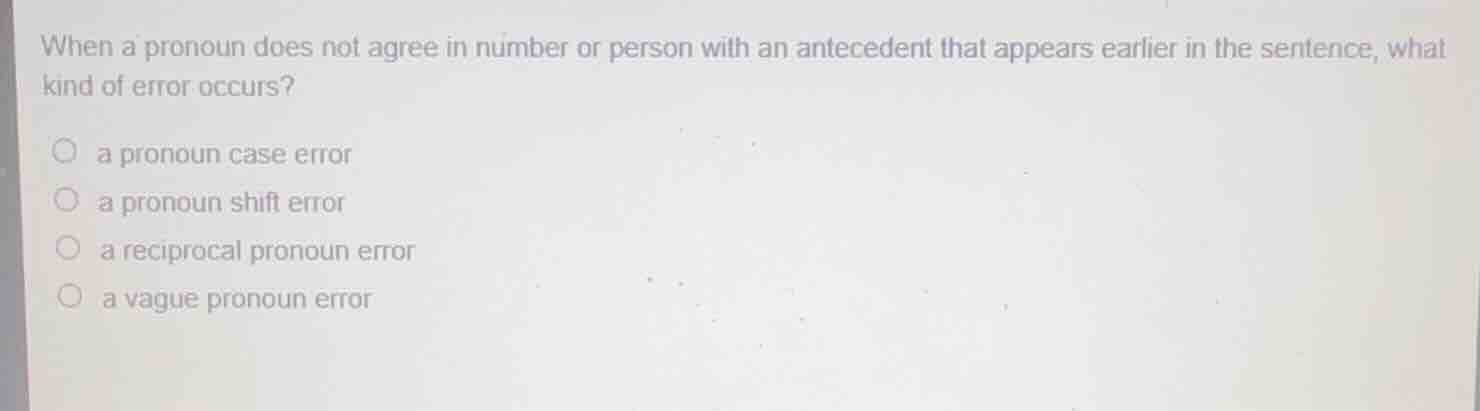
when a pronoun does not agree in number or person with an antecedent that appears earlier in the sentence, what kind of error occurs?
a pronoun case error
a pronoun shift error
a reciprocal pronoun error
a vague pronoun error
Define pronoun-antecedent agreement
Using the Pronoun Agreement knowledge point
A pronoun must agree with its antecedent in number (singular/plural) and person (first, second, or third person).
Analyze the error type
When a pronoun fails to match its antecedent's number or person, it creates an inconsistent transition or "shift" in grammatical perspective. This mismatch is specifically classified as a pronoun shift error.
Evaluate the incorrect options
- A pronoun case error involves using the wrong subjective, objective, or possessive form (e.g., using "him" instead of "he").
- A reciprocal pronoun error involves misuse of pronouns like "each other" or "one another".
- A vague pronoun error occurs when a pronoun has no clear antecedent.

Snap & solve any problem in the app
Get step-by-step solutions on Sovi AI
Photo-based solutions with guided steps
Explore more problems and detailed explanations
- a pronoun case error
- a pronoun shift error (Correct answer)
- a reciprocal pronoun error
- a vague pronoun error