QUESTION IMAGE
Question
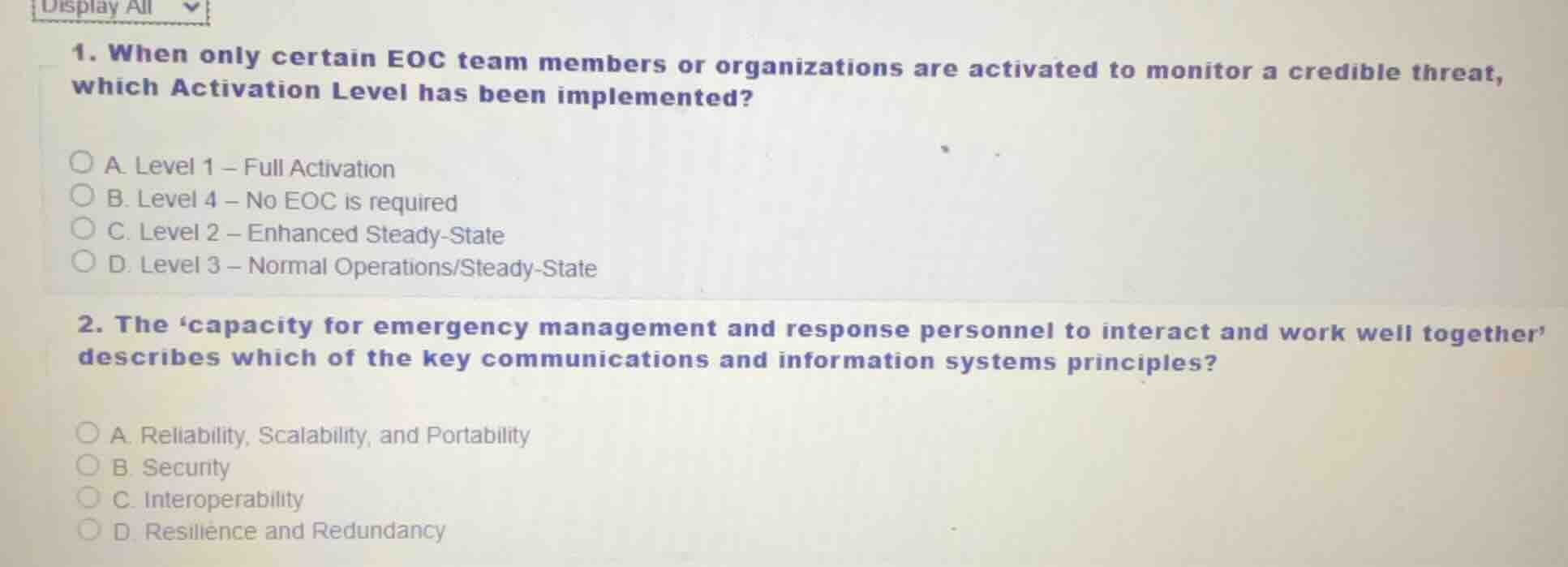
- when only certain eoc team members or organizations are activated to monitor a credible threat, which activation level has been implemented?
a. level 1 - full activation
b. level 4 - no eoc is required
c. level 2 - enhanced steady-state
d. level 3 - normal operations/steady-state
- the capacity for emergency management and response personnel to interact and work well together describes which of the key communications and information systems principles?
a. reliability, scalability, and portability
b. security
c. interoperability
d. resilience and redundancy
<pre_analysis>
{
"quality": "clear",
"question_count": 2,
"skills_matched": [
"direct_cot",
"multiple_choice_formatter",
"explain_then_answer",
"tutor",
"mastery_adaptive_brevity"
],
"needs_drawing": false,
"concepts_used": [
"EOC Activation Levels",
"NIMS Communication Characteristics"
],
"new_concepts": [],
"current_concepts": [
"EOC Activation Levels",
"NIMS Communication Characteristics"
]
}
</pre_analysis>
<reasoning>
Analyze EOC Activation Levels
Using the EOC Activation Levels knowledge point
- Level 3 (Normal Operations/Steady-State) represents daily operations.
- Level 2 (Enhanced Steady-State/Partial Activation) is implemented when only certain EOC team members or organizations are activated to monitor a credible threat.
- Level 1 (Full Activation) involves all EOC staff and resources.
- Therefore, the correct option for Question 1 is C.
Analyze NIMS Communication Principles
Using the NIMS Communication Characteristics knowledge point
- Interoperability is defined as the capacity for emergency management and response personnel to interact and work well together across different jurisdictions and disciplines.
- Therefore, the correct option for Question 2 is C.
</reasoning>
<answer>
Question 1
<mcq-option>A. Level 1 – Full Activation</mcq-option>
<mcq-option>B. Level 4 – No EOC is required</mcq-option>
<mcq-correct>C. Level 2 – Enhanced Steady-State</mcq-correct>
<mcq-option>D. Level 3 – Normal Operations/Steady-State</mcq-option>
Question 2
<mcq-option>A. Reliability, Scalability, and Portability</mcq-option>
<mcq-option>B. Security</mcq-option>
<mcq-correct>C. Interoperability</mcq-correct>
<mcq-option>D. Resilience and Redundancy</mcq-option>
</answer>
<post_analysis>
{
"subject": "Social Science",
"question_type": "Multiple Choice",
"knowledge_point": [
"Social Science",
"Others",
"Emergency Management"
]
}
</post_analysis>
Snap & solve any problem in the app
Get step-by-step solutions on Sovi AI
Photo-based solutions with guided steps
Explore more problems and detailed explanations
<pre_analysis>
{
"quality": "clear",
"question_count": 2,
"skills_matched": [
"direct_cot",
"multiple_choice_formatter",
"explain_then_answer",
"tutor",
"mastery_adaptive_brevity"
],
"needs_drawing": false,
"concepts_used": [
"EOC Activation Levels",
"NIMS Communication Characteristics"
],
"new_concepts": [],
"current_concepts": [
"EOC Activation Levels",
"NIMS Communication Characteristics"
]
}
</pre_analysis>
<reasoning>
Analyze EOC Activation Levels
Using the EOC Activation Levels knowledge point
- Level 3 (Normal Operations/Steady-State) represents daily operations.
- Level 2 (Enhanced Steady-State/Partial Activation) is implemented when only certain EOC team members or organizations are activated to monitor a credible threat.
- Level 1 (Full Activation) involves all EOC staff and resources.
- Therefore, the correct option for Question 1 is C.
Analyze NIMS Communication Principles
Using the NIMS Communication Characteristics knowledge point
- Interoperability is defined as the capacity for emergency management and response personnel to interact and work well together across different jurisdictions and disciplines.
- Therefore, the correct option for Question 2 is C.
</reasoning>
<answer>
Question 1
<mcq-option>A. Level 1 – Full Activation</mcq-option>
<mcq-option>B. Level 4 – No EOC is required</mcq-option>
<mcq-correct>C. Level 2 – Enhanced Steady-State</mcq-correct>
<mcq-option>D. Level 3 – Normal Operations/Steady-State</mcq-option>
Question 2
<mcq-option>A. Reliability, Scalability, and Portability</mcq-option>
<mcq-option>B. Security</mcq-option>
<mcq-correct>C. Interoperability</mcq-correct>
<mcq-option>D. Resilience and Redundancy</mcq-option>
</answer>
<post_analysis>
{
"subject": "Social Science",
"question_type": "Multiple Choice",
"knowledge_point": [
"Social Science",
"Others",
"Emergency Management"
]
}
</post_analysis>