QUESTION IMAGE
Question
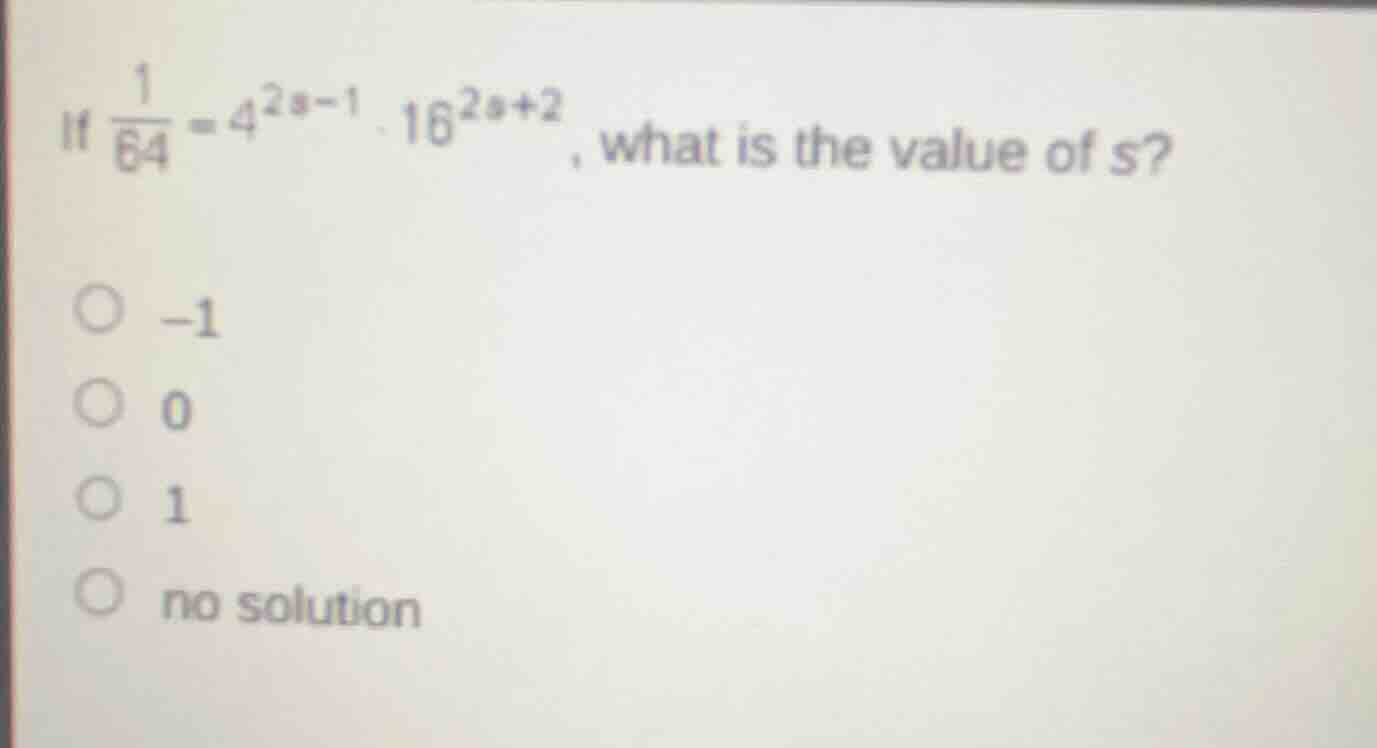
if \\(\frac{1}{64} = 4^{2s-1} \cdot 16^{2s+2}\\), what is the value of \\(s\\)?
-1
0
1
no solution
Express all terms with base 4
We rewrite each part of the equation using base 4.
Given equation:
$$ \frac{1}{64} = 4^{2s-1} \cdot 16^{2s+2} $$
We know that:
$$ 64 = 4^3 \implies \frac{1}{64} = 4^{-3} $$
$$ 16 = 4^2 \implies 16^{2s+2} = (4^2)^{2s+2} $$
Simplify the exponents
We apply exponent rules to simplify the right side.
Using the power of a power rule:
$$ (4^2)^{2s+2} = 4^{2(2s+2)} = 4^{4s+4} $$
Now, substitute these back into the equation:
$$ 4^{-3} = 4^{2s-1} \cdot 4^{4s+4} $$
Using the product rule for exponents:
$$ 4^{-3} = 4^{(2s-1) + (4s+4)} $$
$$ 4^{-3} = 4^{6s+3} $$
Solve for s
Since the bases are equal, we equate the exponents:
$$ -3 = 6s + 3 $$
Subtract 3 from both sides:
$$ -6 = 6s $$
Divide by 6:
$$ s = -1 $$

Snap & solve any problem in the app
Get step-by-step solutions on Sovi AI
Photo-based solutions with guided steps
Explore more problems and detailed explanations
- (A) -1 (Correct answer)
- (B) 0
- (C) 1
- (D) no solution