QUESTION IMAGE
Question
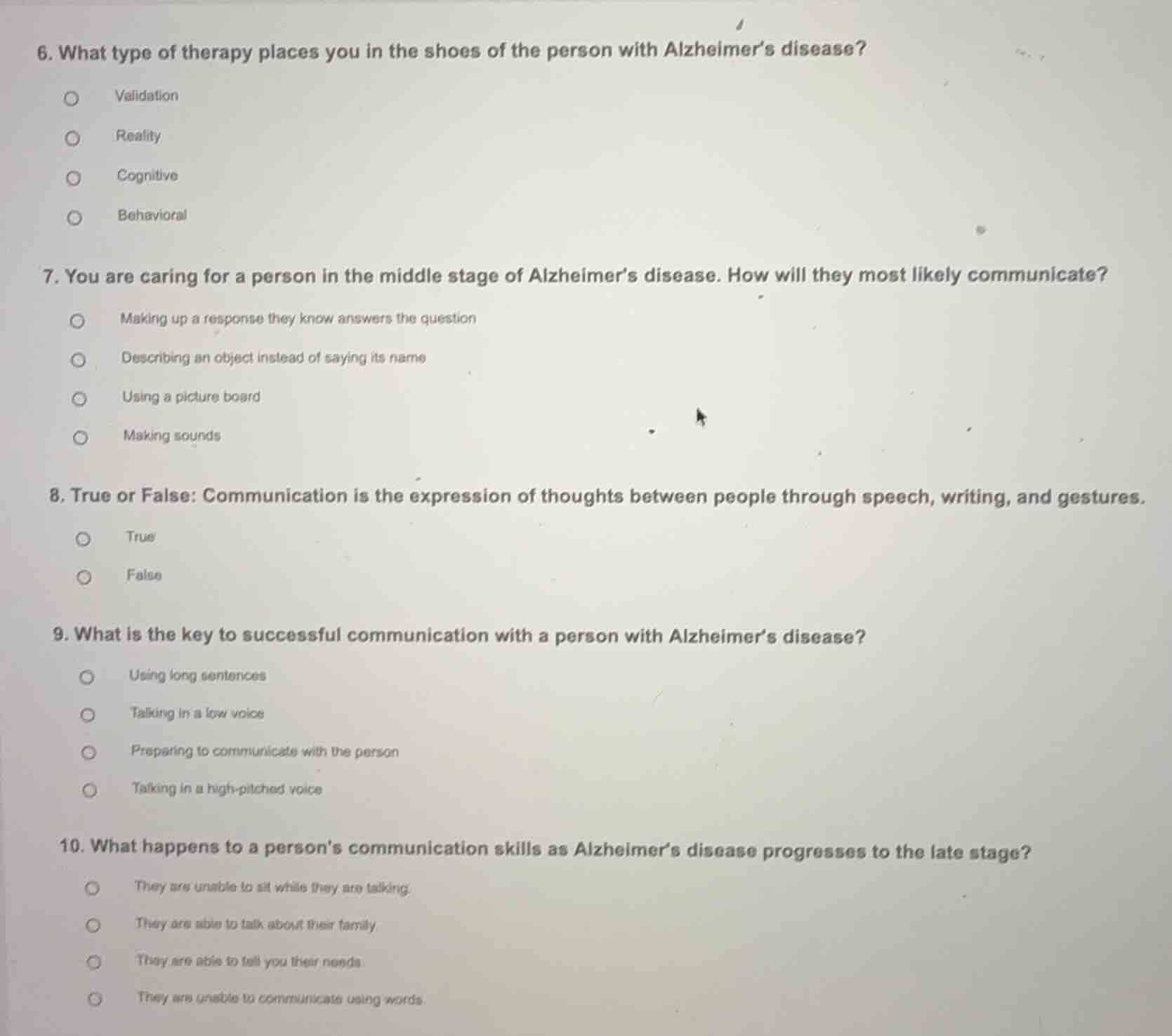
- what type of therapy places you in the shoes of the person with alzheimers disease?
validation
reality
cognitive
behavioral
- you are caring for a person in the middle stage of alzheimers disease. how will they most likely communicate?
making up a response they know answers the question
describing an object instead of saying its name
using a picture board
making sounds
- true or false: communication is the expression of thoughts between people through speech, writing, and gestures.
true
false
- what is the key to successful communication with a person with alzheimers disease?
using long sentences
talking in a low voice
preparing to communicate with the person
talking in a high-pitched voice
- what happens to a persons communication skills as alzheimers disease progresses to the late stage?
they are unable to sit while they are talking
they are able to talk about their family
they are able to tell you their needs
they are unable to communicate using words
Analyze Question 6
Validation therapy focuses on empathy and stepping into the reality of the person with Alzheimer's disease.
Analyze Question 7
In the middle stage of Alzheimer's disease, individuals often experience anomia (difficulty finding words) and frequently describe an object (circumlocution) rather than naming it.
Analyze Question 8
Communication is defined as the exchange or expression of thoughts, messages, or information through speech, signals, writing, or behavior.
Analyze Question 9
Successful communication requires preparation, minimizing distractions, and focusing attention on the individual before starting.
Analyze Question 10
In the late stage of Alzheimer's disease, verbal communication is severely compromised, and individuals generally lose the ability to speak or communicate using words.

Snap & solve any problem in the app
Get step-by-step solutions on Sovi AI
Photo-based solutions with guided steps
Explore more problems and detailed explanations
Question 6
- Validation (Correct answer)
- Reality
- Cognitive
- Behavioral
Question 7
- Making up a response they know answers the question
- Describing an object instead of saying its name (Correct answer)
- Using a picture board
- Making sounds
Question 8
- True (Correct answer)
- False
Question 9
- Using long sentences
- Talking in a low voice
- Preparing to communicate with the person (Correct answer)
- Talking in a high-pitched voice
Question 10
- They are unable to sit while they are talking
- They are able to talk about their family
- They are able to tell you their needs
- They are unable to communicate using words (Correct answer)