QUESTION IMAGE
Question
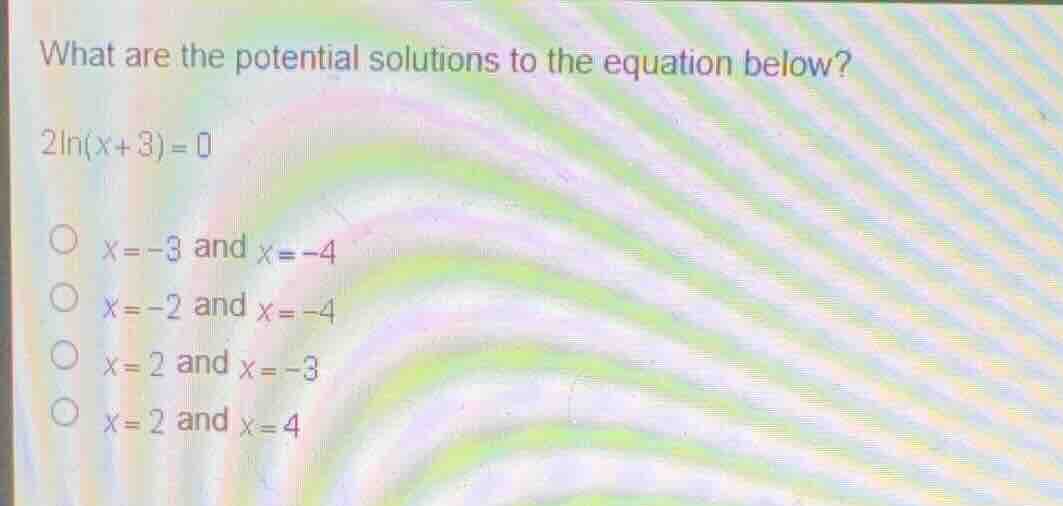
what are the potential solutions to the equation below?
(2ln(x+3) = 0)
- (x = -3) and (x = -4)
- (x = -2) and (x = -4)
- (x = 2) and (x = -3)
- (x = 2) and (x = 4)
Isolate the logarithmic term
Using the Solving Logarithmic Equations knowledge point
Convert to exponential form
Using the Solving Logarithmic Equations knowledge point
Solve for x
Using the Solving Logarithmic Equations knowledge point
Analyze the given options
Using the Solving Logarithmic Equations knowledge point
The algebraic solution is \(x = -2\). However, looking closely at the provided multiple-choice options, none of them list \(x = -2\) as the sole solution. Instead, they list pairs of potential solutions:
- \(x = -3\) and \(x = -4\)
- \(x = -2\) and \(x = -4\)
- \(x = 2\) and \(x = -3\)
- \(x = 2\) and \(x = 4\)
The only option containing the correct mathematical solution \(x = -2\) is the second option: "\(x = -2\) and \(x = -4\)". In many algebraic contexts, solving an equation rewritten using logarithmic properties (such as \(\ln(x+3)^2 = 0\)) can introduce extraneous solutions like \(x = -4\). Let's verify this path:
Thus, the potential solutions derived from applying the power rule of logarithms are \(x = -2\) and \(x = -4\).

Snap & solve any problem in the app
Get step-by-step solutions on Sovi AI
Photo-based solutions with guided steps
Explore more problems and detailed explanations
- (A) \(x = -3\) and \(x = -4\)
- (B) \(x = -2\) and \(x = -4\) (Correct answer)
- (C) \(x = 2\) and \(x = -3\)
- (D) \(x = 2\) and \(x = 4\)