QUESTION IMAGE
Question
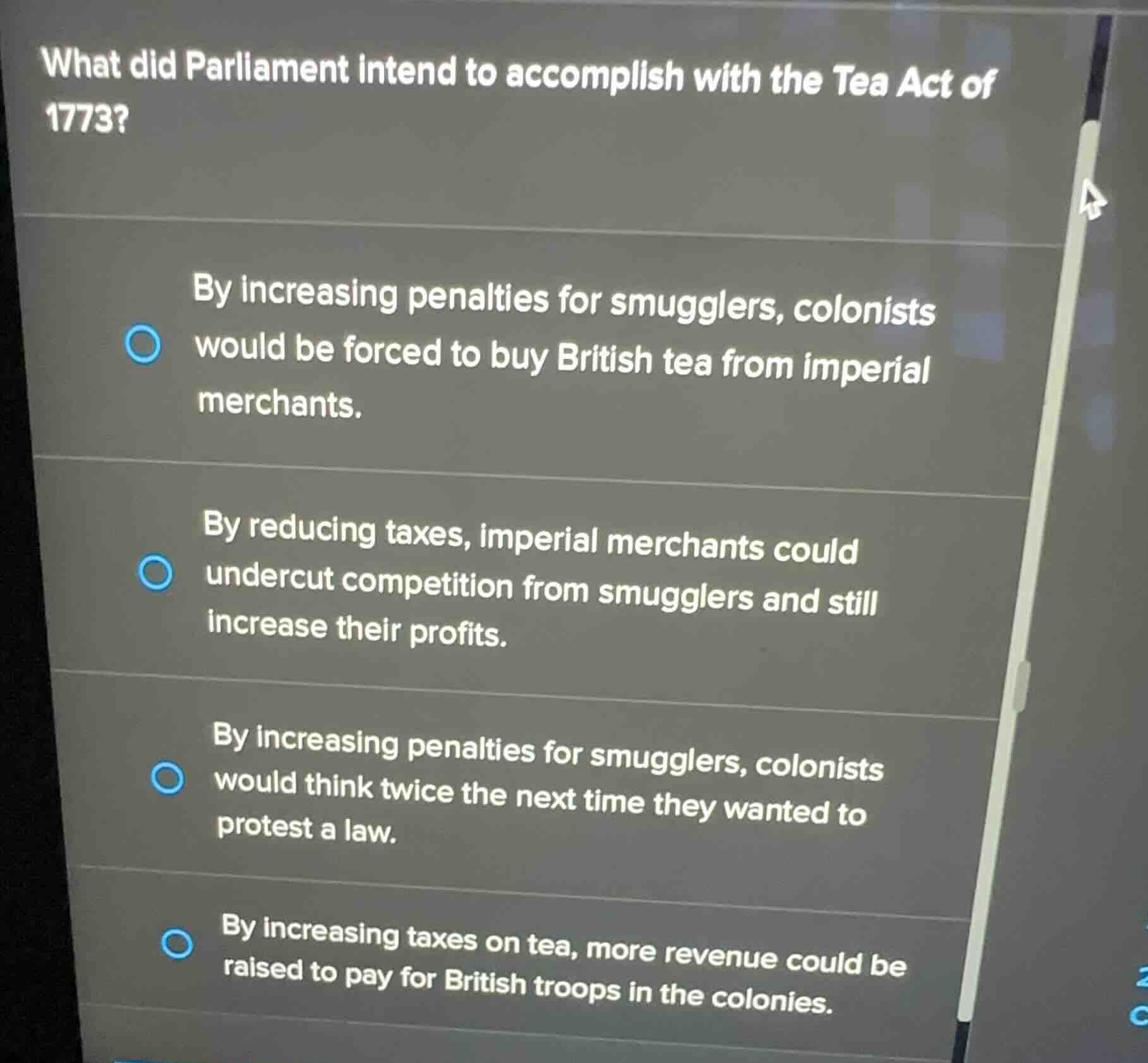
what did parliament intend to accomplish with the tea act of 1773?
by increasing penalties for smugglers, colonists would be forced to buy british tea from imperial merchants.
by reducing taxes, imperial merchants could undercut competition from smugglers and still increase their profits.
by increasing penalties for smugglers, colonists would think twice the next time they wanted to protest a law.
by increasing taxes on tea, more revenue could be raised to pay for british troops in the colonies.
Analyze the purpose of the Tea Act of 1773
Using the Tea Act of 1773 and British East India Company knowledge points:
- The British East India Company was facing severe financial distress and held massive surplus stocks of tea.
- To assist the company, Parliament passed the Tea Act of 1773, which allowed the company to export its tea directly to the American colonies without paying the usual export duties in Britain.
- By eliminating these middleman duties, the company could sell its tea at a significantly lower price, undercutting the smuggled Dutch tea that dominated the colonial market, while still retaining a profit and collecting the Townshend duty on tea.
Evaluate the given options
- Option 1: Focuses on increasing penalties for smugglers to force purchases. While smuggling was an issue, the mechanism of the Tea Act was economic rather than purely punitive.
- Option 2: Correctly identifies that by reducing the effective tax burden/duties on the East India Company's tea, the British could undercut smuggled Dutch tea prices and still generate profits.
- Option 3: Focuses on punitive measures to deter protests, which does not align with the economic design of the Act.
- Option 4: Incorrectly states that the Act increased taxes on tea; it actually lowered the cost of British tea in the colonies.

Snap & solve any problem in the app
Get step-by-step solutions on Sovi AI
Photo-based solutions with guided steps
Explore more problems and detailed explanations
- By increasing penalties for smugglers, colonists would be forced to buy British tea from imperial merchants.
- (B) By reducing taxes, imperial merchants could undercut competition from smugglers and still increase their profits. (Correct answer)
- By increasing penalties for smugglers, colonists would think twice the next time they wanted to protest a law.
- By increasing taxes on tea, more revenue could be raised to pay for British troops in the colonies.