QUESTION IMAGE
Question
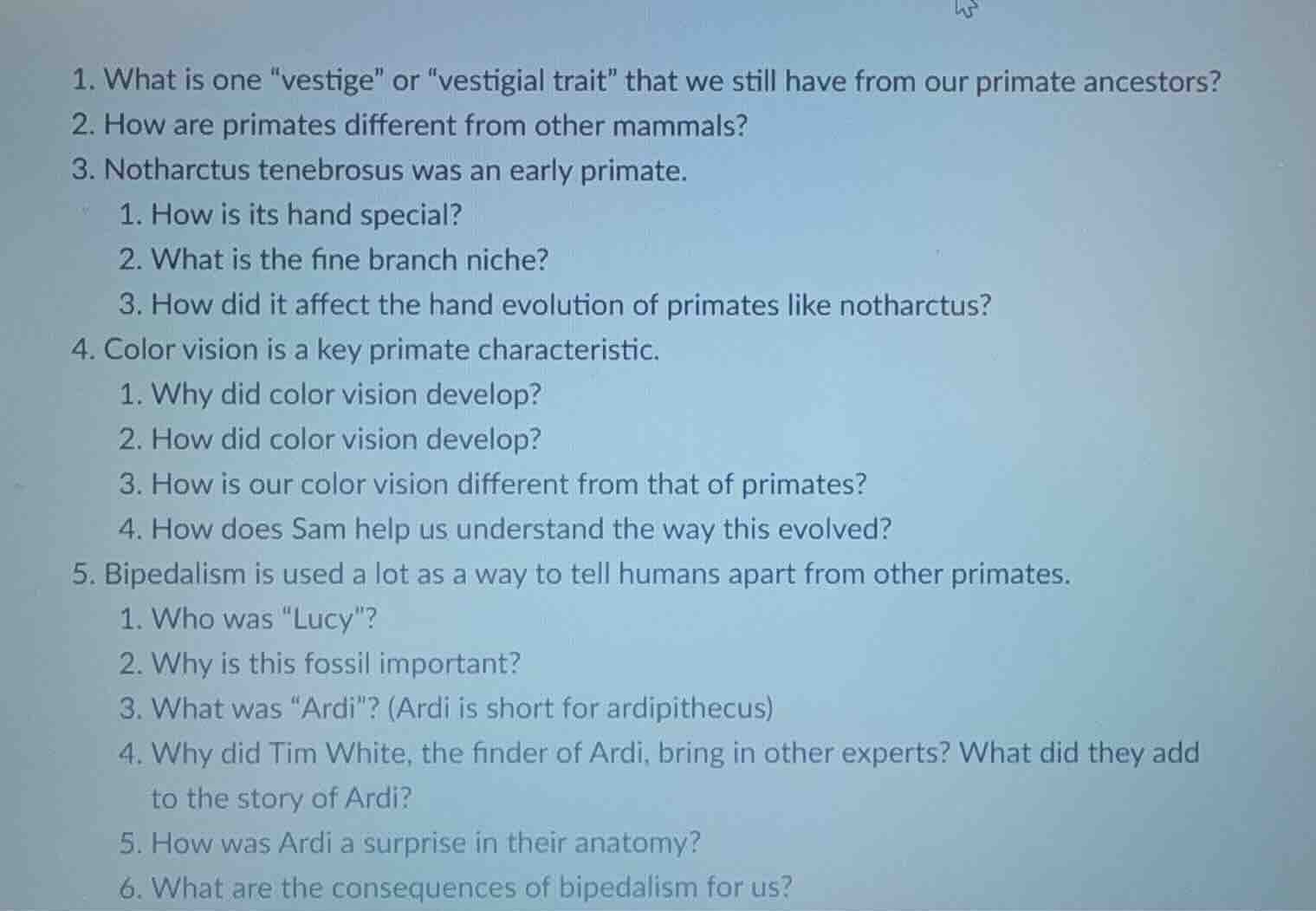
- what is one \vestige\ or \vestigial trait\ that we still have from our primate ancestors?
- how are primates different from other mammals?
- notharctus tenebrosus was an early primate.
- how is its hand special?
- what is the fine branch niche?
- how did it affect the hand evolution of primates like notharctus?
- color vision is a key primate characteristic.
- why did color vision develop?
- how did color vision develop?
- how is our color vision different from that of primates?
- how does sam help us understand the way this evolved?
- bipedalism is used a lot as a way to tell humans apart from other primates.
- who was \lucy\?
- why is this fossil important?
- what was \ardi\? (ardi is short for ardipithecus)
- why did tim white, the finder of ardi, bring in other experts? what did they add to the story of ardi?
- how was ardi a surprise in their anatomy?
- what are the consequences of bipedalism for us?
Vestigial traits in humans
A vestigial trait is an anatomical feature or behavior that has lost all or most of its original function through evolution. One prominent example we share with our primate ancestors is the coccyx (tailbone), which is the remnant of a lost tail. Other examples include the arrector pili muscles (which cause goosebumps) and the appendix.
Primate characteristics
Primates are distinguished from other mammals by a suite of adaptations related to an arboreal (tree-dwelling) lifestyle. Key differences include:
- Grasping hands and feet with opposable thumbs/big toes.
- Nails instead of claws on the digits.
- Forward-facing eyes providing stereoscopic, binocular vision (depth perception).
- Large brains relative to body size and complex social behaviors.
Notharctus hand and niche
Notharctus tenebrosus was an early Eocene primate whose hand featured an elongated, opposable thumb, allowing for a precise power grip on branches. The "fine branch niche" refers to the terminal ends of tree branches where nutritious flowers, fruits, and insects are located. This niche drove primate hand evolution by selecting for grasping hands with nails instead of claws, allowing early primates to safely navigate and forage on thin, unstable branches.
Evolution of color vision
Color vision (specifically trichromacy) developed in primates to help locate ripe fruits and nutritious young leaves among dense green foliage. It evolved via gene duplication of the opsin genes on the X chromosome. While most primates are trichromats, some species exhibit variation (e.g., some New World monkeys have dichromatic males and trichromatic females). "Sam" (a research monkey, often a reference to studies on color vision gene therapy or evolutionary models) helps us understand that introducing a single opsin gene can immediately enable trichromatic vision, demonstrating how a simple genetic mutation could drive this evolutionary leap.
Bipedalism and hominin fossils
"Lucy" is the famous, highly complete \(3.2\)-million-year-old fossil of Australopithecus afarensis discovered in Ethiopia, proving that upright walking (bipedalism) evolved before large brain sizes. "Ardi" (Ardipithecus ramidus) is a \(4.4\)-million-year-old fossil that is crucial because she possessed a mosaic anatomy: she was bipedal on the ground but had an opposable big toe for climbing trees. Tim White brought in a multidisciplinary team of international experts to meticulously reconstruct the crushed fossils and analyze the ancient environment, revealing that bipedalism evolved in a woodland habitat rather than an open savanna. The consequences of bipedalism for humans include freed hands for tool use, but also physical trade-offs like back pain, knee injuries, and a narrowed birth canal.

Snap & solve any problem in the app
Get step-by-step solutions on Sovi AI
Photo-based solutions with guided steps
Explore more problems and detailed explanations
Question 1
One vestigial trait we still have from our primate ancestors is the coccyx (tailbone), which is the evolutionary remnant of a tail.
Question 2
Primates differ from other mammals by having grasping hands and feet with opposable digits, nails instead of claws, forward-facing eyes for depth perception, and larger brains relative to body size.
Question 3
- Hand Specialization: Notharctus had an elongated, opposable thumb and long fingers adapted for grasping branches securely.
- Fine Branch Niche: This is the habitat at the very ends of tree branches where fruits, flowers, and insects are abundant.
- Evolutionary Effect: Navigating this niche selected for grasping hands, opposable thumbs, and nails instead of claws to prevent slipping while foraging on thin twigs.
Question 4
- Why it developed: Color vision developed to help primates easily distinguish ripe fruits and tender, nutritious young leaves from green foliage.
- How it developed: It developed through a genetic mutation involving the duplication and divergence of opsin (photoreceptor) genes.
- Difference: Humans and many Old World primates are trichromats (three-color vision), whereas many other mammals and some New World primates are dichromats (two-color vision).
- Sam's Role: "Sam" (the monkey in color vision experiments) demonstrated that adding a third opsin gene via gene therapy can instantly allow the brain to process trichromatic color, showing how a simple genetic change could drive the evolution of color vision.
Question 5
- Lucy: Lucy is a \(3.2\)-million-year-old fossil of Australopithecus afarensis discovered in 1974 in Ethiopia.
- Importance: She proved that bipedalism (upright walking) evolved long before large brains developed in human ancestors.
- Ardi: Ardi is a \(4.4\)-million-year-old fossil of Ardipithecus ramidus, representing one of our earliest known hominin ancestors.
- Tim White's Team: Tim White brought in experts from various fields (paleoanthropologists, geologists, botanists) to carefully reconstruct Ardi's fragile, crushed bones and reconstruct her ancient environment, proving she lived in a woodland rather than a savanna.
- Anatomical Surprise: Ardi was a surprise because she was fully capable of walking upright on two legs, yet still possessed a fully opposable big toe adapted for climbing trees.
- Consequences of Bipedalism: Bipedalism freed our hands to carry food, offspring, and tools, but it also resulted in anatomical compromises such as lower back pain, knee strain, and a narrower birth canal making childbirth more difficult.