QUESTION IMAGE
Question
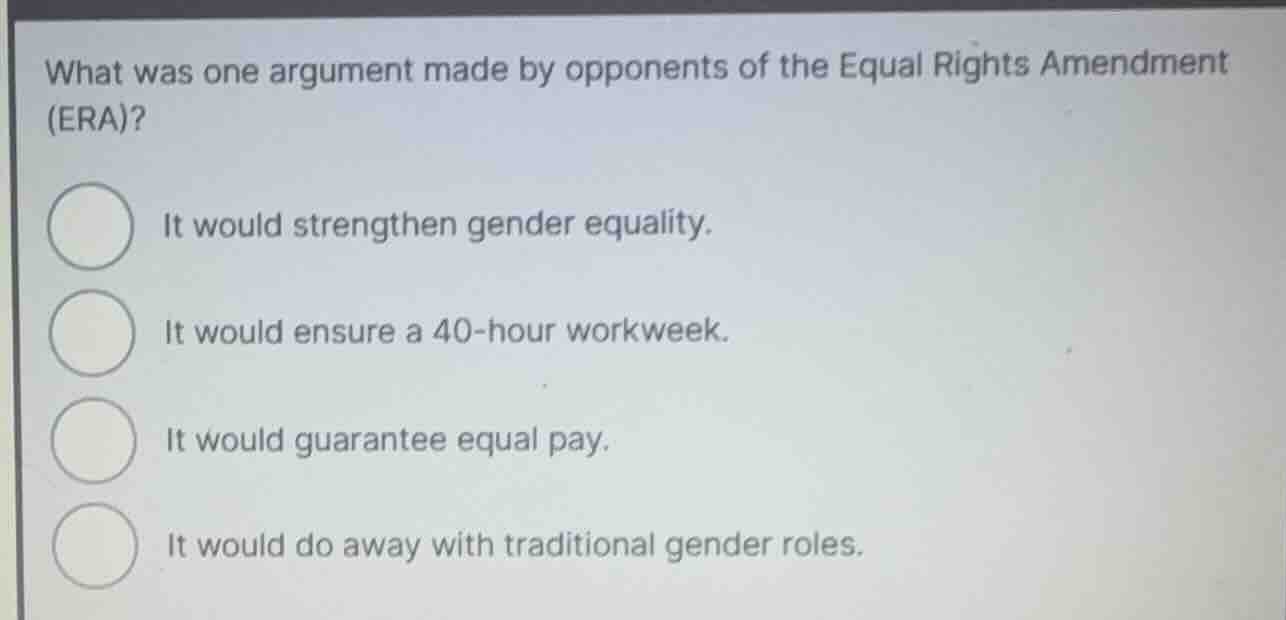
what was one argument made by opponents of the equal rights amendment (era)?
it would strengthen gender equality.
it would ensure a 40-hour workweek.
it would guarantee equal pay.
it would do away with traditional gender roles.
Identify the core question
The question asks for one argument made by opponents of the Equal Rights Amendment (ERA) during the 20th century.
Analyze the historical context
The Equal Rights Amendment (ERA) was proposed to guarantee equal legal rights for all American citizens regardless of sex. Opponents, led prominently by conservative activist Phyllis Schlafly and her "STOP ERA" campaign, argued that the amendment would disadvantage housewives, eliminate protective labor laws for women, lead to women being drafted into the military, and dismantle traditional family structures.
Evaluate the given options
- "It would strengthen gender equality." This is an argument made by proponents of the ERA, not opponents.
- "It would ensure a 40-hour workweek." This is unrelated to the core debates surrounding the ERA.
- "It would guarantee equal pay." This is a goal of proponents of women's rights and the ERA, not an argument used by its opponents.
- "It would do away with traditional gender roles." Opponents argued that the ERA would disrupt the traditional family structure, eliminate gender-specific privileges (such as alimony or exemption from the military draft), and erase the distinct traditional roles of men and women in society. This matches their actual historical arguments.
Connect to student knowledge
Building on your understanding of Womens Rights, the opposition to the ERA represented a conservative backlash that sought to preserve traditional social structures against the rapid changes of the feminist movement.

Snap & solve any problem in the app
Get step-by-step solutions on Sovi AI
Photo-based solutions with guided steps
Explore more problems and detailed explanations
- (A) It would strengthen gender equality.
- (B) It would ensure a 40-hour workweek.
- (C) It would guarantee equal pay.
- (D) It would do away with traditional gender roles. (Correct answer)