QUESTION IMAGE
Question
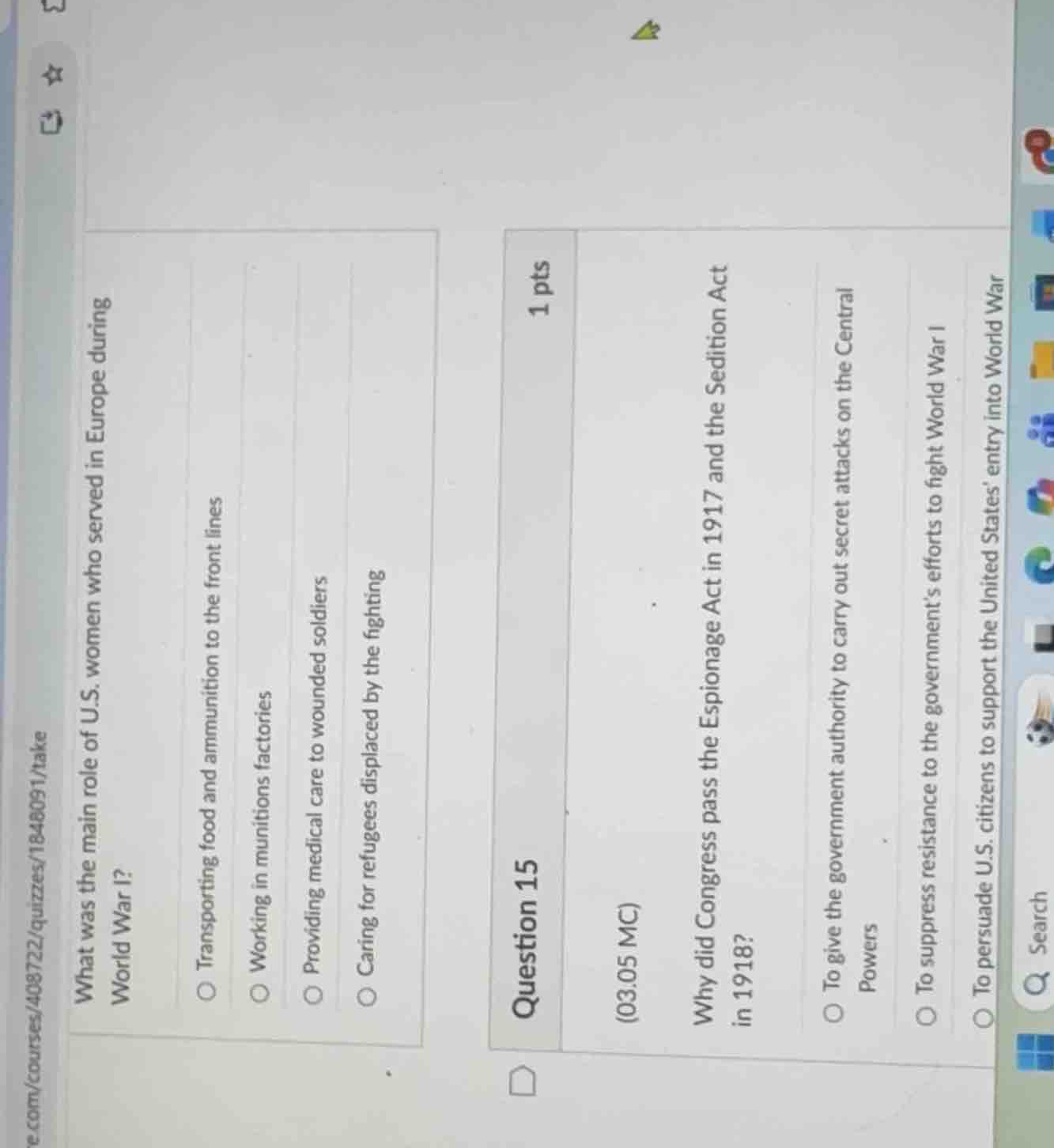
what was the main role of u.s. women who served in europe during world war i?
- transporting food and ammunition to the front lines
- working in munitions factories
- providing medical care to wounded soldiers
- caring for refugees displaced by the fighting
question 15
1 pts
(03.05 mc)
why did congress pass the espionage act in 1917 and the sedition act in 1918?
- to give the government authority to carry out secret attacks on the central powers
- to suppress resistance to the governments efforts to fight world war i
- to persuade u.s. citizens to support the united states entry into world war i
Analyze the role of U.S. women in Europe during WWI
Using the WWI Home Front knowledge point, we examine the first question. While many American women supported the war effort domestically by working in munitions factories, those who served directly in Europe primarily worked in supportive, humanitarian, and medical capacities. The most prominent role for American women overseas was serving as nurses and physicians with the American Red Cross or the military, providing critical medical care to wounded soldiers near the front lines.
Evaluate the options for the first question
- Transporting food and ammunition to the front lines: This was primarily handled by military logistics units, which did not deploy female soldiers to combat zones for transport.
- Working in munitions factories: This was a major domestic contribution on the home front, not in Europe.
- Providing medical care to wounded soldiers: This is correct, as thousands of American women served in Europe as nurses, ambulance drivers, and medical staff.
- Caring for refugees displaced by the fighting: While some did humanitarian work, the primary, organized military-adjacent role in Europe was medical care.
Analyze the purpose of the Espionage and Sedition Acts
During World War I, the Wilson administration sought to ensure absolute unity and suppress any domestic opposition to the war effort. Congress passed the Espionage Act of 1917 and the Sedition Act of 1918 to criminalize interference with military operations, draft resistance, and any "disloyal, profane, scurrilous, or abusive language" about the U.S. government or military. The primary objective was to suppress anti-war dissent and resistance to federal wartime policies.
Evaluate the options for the second question
- To give the government authority to carry out secret attacks on the Central Powers: Incorrect, as these acts targeted domestic speech and actions, not foreign military operations.
- To suppress resistance to the government's efforts to fight World War I: Correct, as these laws were explicitly designed to silence socialists, pacifists, and other anti-war critics who opposed the draft or war funding.
- To persuade U.S. citizens to support the United States' entry into World War I: Incorrect, as persuasion was the role of the Committee on Public Information (CPI); these acts were punitive laws designed to punish opposition rather than persuade.

Snap & solve any problem in the app
Get step-by-step solutions on Sovi AI
Photo-based solutions with guided steps
Explore more problems and detailed explanations
Question 1
- (A) Transporting food and ammunition to the front lines
- (B) Working in munitions factories
- (C) Providing medical care to wounded soldiers (Correct answer)
- (D) Caring for refugees displaced by the fighting
Question 2
- (A) To give the government authority to carry out secret attacks on the Central Powers
- (B) To suppress resistance to the government's efforts to fight World War I (Correct answer)
- (C) To persuade U.S. citizens to support the United States' entry into World War I