QUESTION IMAGE
Question
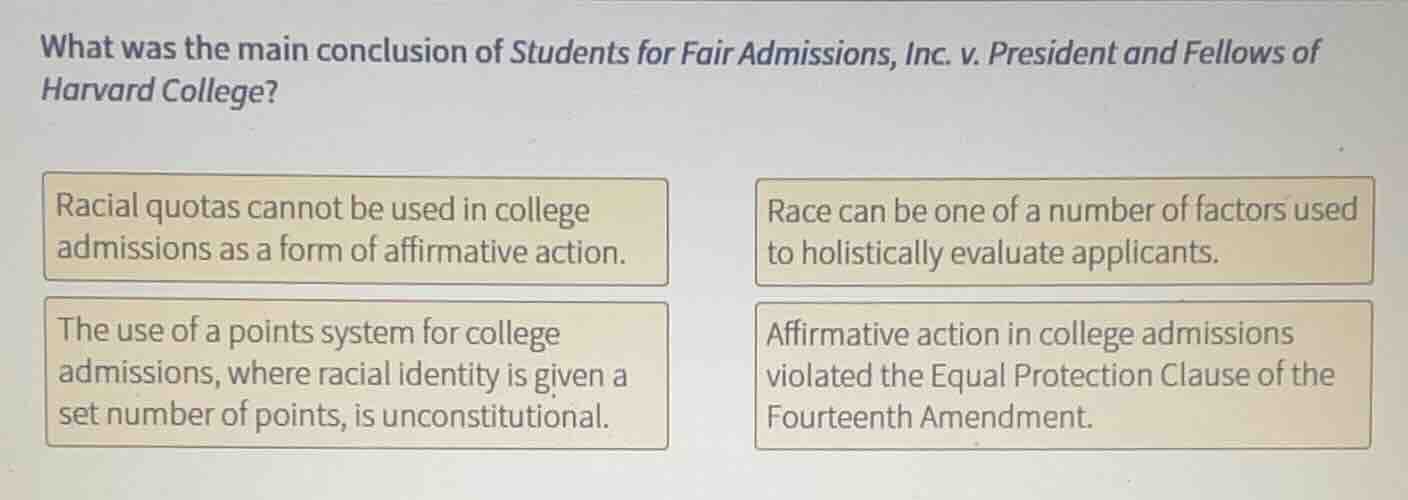
what was the main conclusion of students for fair admissions, inc. v. president and fellows of harvard college?
racial quotas cannot be used in college admissions as a form of affirmative action.
race can be one of a number of factors used to holistically evaluate applicants.
the use of a points system for college admissions, where racial identity is given a set number of points, is unconstitutional.
affirmative action in college admissions violated the equal protection clause of the fourteenth amendment.
Identify the case and its core ruling
The question asks for the main conclusion of Students for Fair Admissions, Inc. v. President and Fellows of Harvard College (2023).
Analyze the legal holding
In this landmark decision, the Supreme Court held that the race-conscious admissions programs at Harvard and the University of North Carolina violated the Equal Protection Clause of the Fourteenth Amendment.
Evaluate the options
- "Racial quotas cannot be used..." refers to Regents of the University of California v. Bakke (1978).
- "Race can be one of a number of factors..." refers to the previous standard established in Grutter v. Bollinger (2003), which was effectively overturned by this ruling.
- "The use of a points system..." refers to Gratz v. Bollinger (2003).
- "Affirmative action in college admissions violated the Equal Protection Clause of the Fourteenth Amendment" directly states the main conclusion of the 2023 SFFA v. Harvard decision.

Snap & solve any problem in the app
Get step-by-step solutions on Sovi AI
Photo-based solutions with guided steps
Explore more problems and detailed explanations
- Racial quotas cannot be used in college admissions as a form of affirmative action.
- Race can be one of a number of factors used to holistically evaluate applicants.
- The use of a points system for college admissions, where racial identity is given a set number of points, is unconstitutional.
- Affirmative action in college admissions violated the Equal Protection Clause of the Fourteenth Amendment. (Correct answer)