QUESTION IMAGE
Question
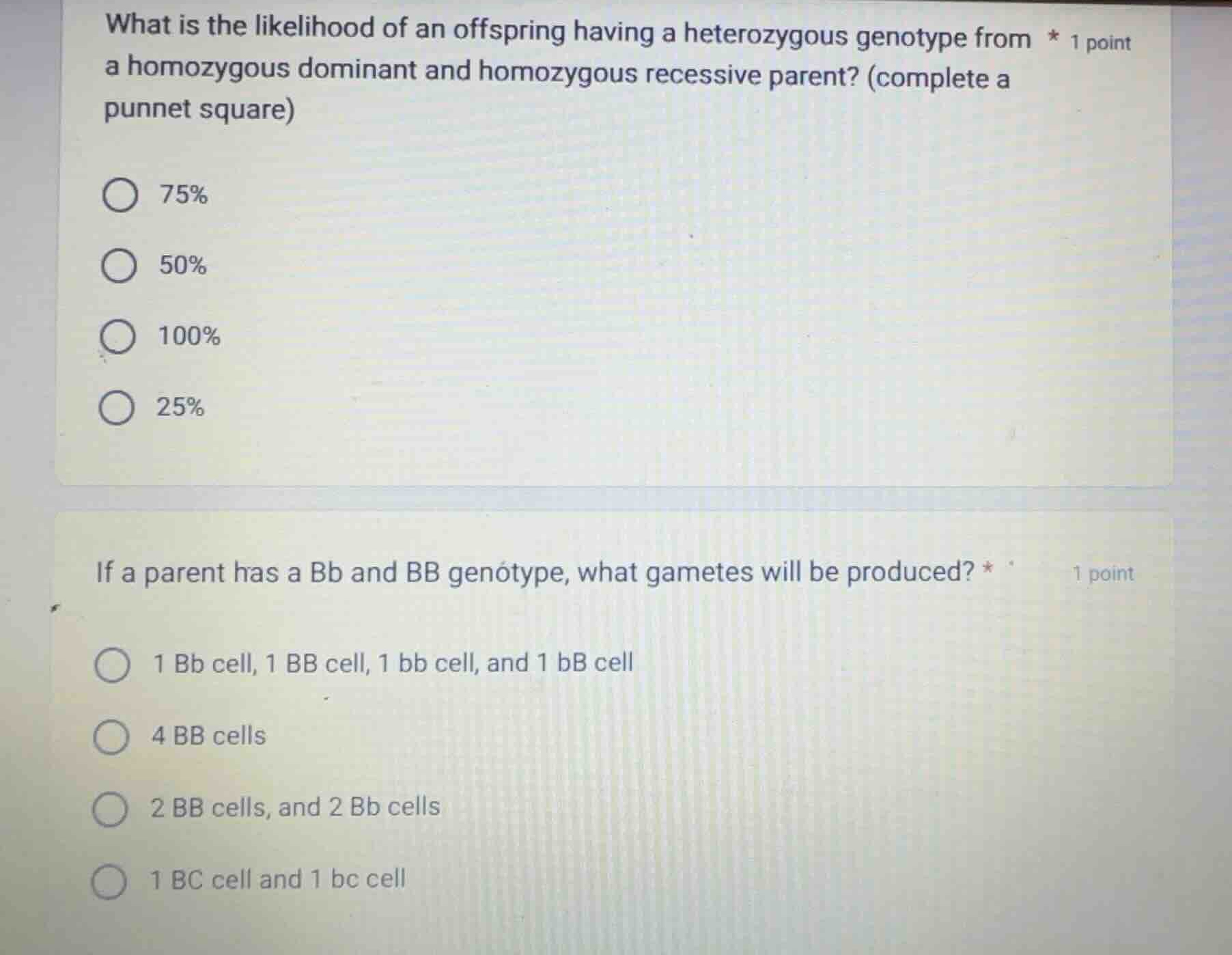
what is the likelihood of an offspring having a heterozygous genotype from a homozygous dominant and homozygous recessive parent? (complete a punnet square)
75%
50%
100%
25%
if a parent has a bb and bb genotype, what gametes will be produced?
1 bb cell, 1 bb cell, 1 bb cell, and 1 bb cell
4 bb cells
2 bb cells, and 2 bb cells
1 bc cell and 1 bc cell
Analyze Question 1
The cross is between a homozygous dominant parent (\(AA\)) and a homozygous recessive parent (\(aa\)).
All gametes from the first parent carry the allele \(A\).
All gametes from the second parent carry the allele \(a\).
Combining these gametes in a Punnett square yields only heterozygous offspring (\(Aa\)).
Therefore, the likelihood of a heterozygous genotype is \(100\%\).
Analyze Question 2
The question asks what gametes will be produced if a parent has a \(Bb\) and \(BB\) genotype. Note that this phrasing likely refers to a diploid cell undergoing meiosis (gamete formation) where the homologous chromosomes carry these alleles, or it represents two separate loci/cells. Looking at the options:
- Option 1: 1 Bb cell, 1 BB cell, 1 bb cell, and 1 bB cell (incorrect, gametes are haploid, not diploid)
- Option 2: 4 BB cells (incorrect)
- Option 3: 2 BB cells, and 2 Bb cells (incorrect, gametes must be haploid)
- Option 4: 1 BC cell and 1 bc cell (incorrect, introduces a new gene C)
Re-evaluating the question's likely intent: "If a parent has a Bb and BB genotype..." is biologically non-standard for a single individual's single-gene locus. However, if we look at the options, they all describe diploid cells (e.g., "BB cells", "Bb cells") rather than haploid gametes (which would be single alleles like \(B\) or \(b\)).
If the question is asking about the mitotic division or a specific genetic cross outcome represented poorly as "gametes", let's look at the options again.
If a parent has a \(Bb\) genotype and another has a \(BB\) genotype, their cross produces:
- \(50\%\) \(BB\) offspring
- \(50\%\) \(Bb\) offspring
In a typical 4-offspring Punnett square, this corresponds to 2 \(BB\) cells and 2 \(Bb\) cells. This matches Option 3 perfectly.

Snap & solve any problem in the app
Get step-by-step solutions on Sovi AI
Photo-based solutions with guided steps
Explore more problems and detailed explanations
Question 1
- 75%
- 50%
- 100% (Correct answer)
- 25%
Question 2
- 1 Bb cell, 1 BB cell, 1 bb cell, and 1 bB cell
- 4 BB cells
- 2 BB cells, and 2 Bb cells (Correct answer)
- 1 BC cell and 1 bc cell