QUESTION IMAGE
Question
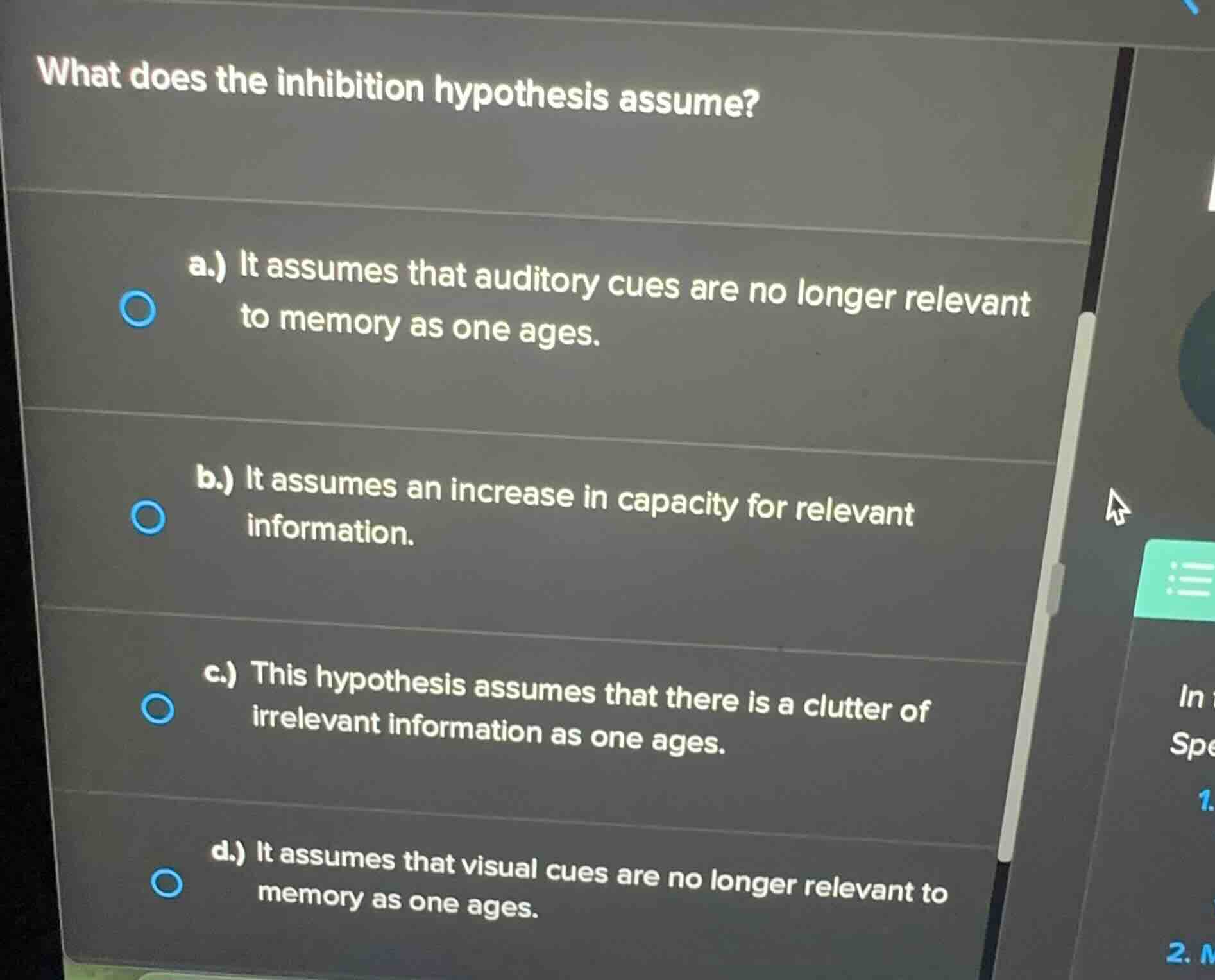
what does the inhibition hypothesis assume?
a.) it assumes that auditory cues are no longer relevant to memory as one ages.
b.) it assumes an increase in capacity for relevant information.
c.) this hypothesis assumes that there is a clutter of irrelevant information as one ages.
d.) it assumes that visual cues are no longer relevant to memory as one ages.
Define the inhibitory deficit hypothesis
The inhibitory deficit hypothesis of Cognitive Aging suggests that older adults experience a decline in the cognitive mechanisms that normally inhibit or suppress irrelevant information from entering working memory.
Analyze the consequences of reduced inhibition
When inhibitory control weakens, the mind is unable to effectively filter out distractions. This leads to working memory becoming cluttered with task-irrelevant thoughts, environmental distractions, and off-topic information.
Evaluate the given options
- a.) Focuses on auditory cues specifically, which is too narrow and not the core assumption of the hypothesis.
- b.) Suggests an increase in capacity for relevant information, which contradicts the observed cognitive declines in aging.
- c.) Correctly states that the hypothesis assumes a clutter of irrelevant information in working memory as one ages due to reduced inhibitory control.
- d.) Focuses on visual cues specifically, which is too narrow and not the core assumption of the hypothesis.

Snap & solve any problem in the app
Get step-by-step solutions on Sovi AI
Photo-based solutions with guided steps
Explore more problems and detailed explanations
- a.) It assumes that auditory cues are no longer relevant to memory as one ages.
- b.) It assumes an increase in capacity for relevant information.
- c.) This hypothesis assumes that there is a clutter of irrelevant information as one ages. (Correct answer)
- d.) It assumes that visual cues are no longer relevant to memory as one ages.