QUESTION IMAGE
Question
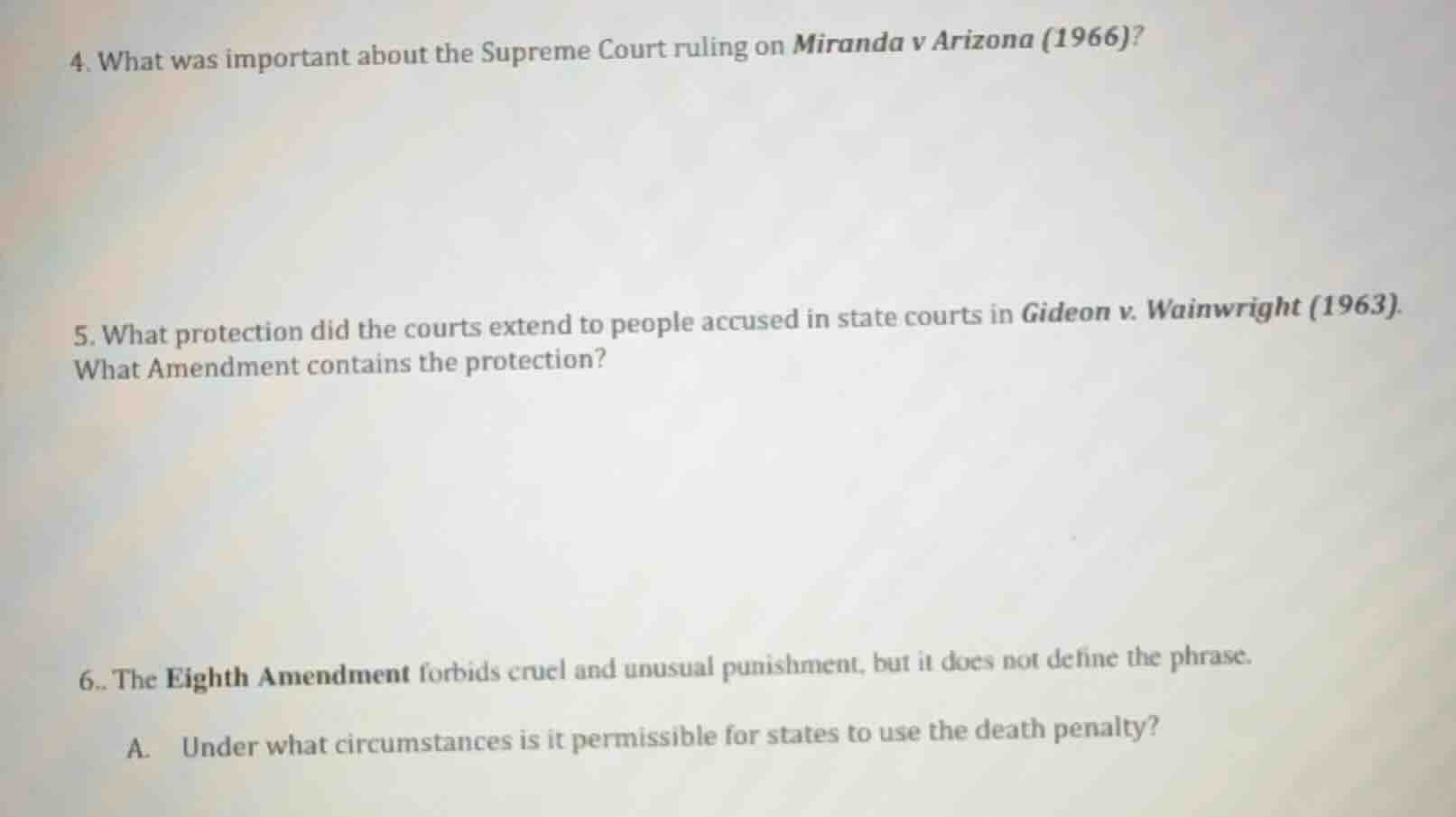
- what was important about the supreme court ruling on miranda v arizona (1966)?
- what protection did the courts extend to people accused in state courts in gideon v. wainwright (1963). what amendment contains the protection?
6.. the eighth amendment forbids cruel and unusual punishment, but it does not define the phrase.
a. under what circumstances is it permissible for states to use the death penalty?
Question 4
The Supreme Court ruling in Miranda v. Arizona (1966) established that law enforcement must inform criminal suspects of their constitutional rights before interrogation. These rights include the right to remain silent, the right to an attorney, and that anything they say can be used against them in court. This ruling was important as it safeguarded the Fifth Amendment right against self - incrimination and the Sixth Amendment right to counsel during custodial interrogations, ensuring that confessions obtained without these warnings were not admissible in court.
In Gideon v. Wainwright (1963), the courts extended the right to legal counsel (a lawyer) to people accused in state courts who could not afford an attorney. This protection is contained in the Sixth Amendment of the United States Constitution, which guarantees the right to counsel in criminal prosecutions.
States can use the death penalty when it is applied in a non - arbitrary, non - discriminatory manner, and when the crime is serious (usually first - degree murder or other heinous crimes). The Supreme Court has ruled that the death penalty does not per se violate the Eighth Amendment's ban on cruel and unusual punishment, but it must be applied in a way that follows clear guidelines to avoid arbitrary or discriminatory application (e.g., as established in cases like Gregg v. Georgia which upheld the death penalty when imposed under a bifurcated trial system with sentencing guidelines).

Snap & solve any problem in the app
Get step-by-step solutions on Sovi AI
Photo-based solutions with guided steps
Explore more problems and detailed explanations
The ruling established that police must inform suspects of their rights (right to remain silent, right to an attorney) before interrogation (Miranda rights), protecting Fifth and Sixth Amendment rights and ensuring confessions without warnings are inadmissible.