QUESTION IMAGE
Question
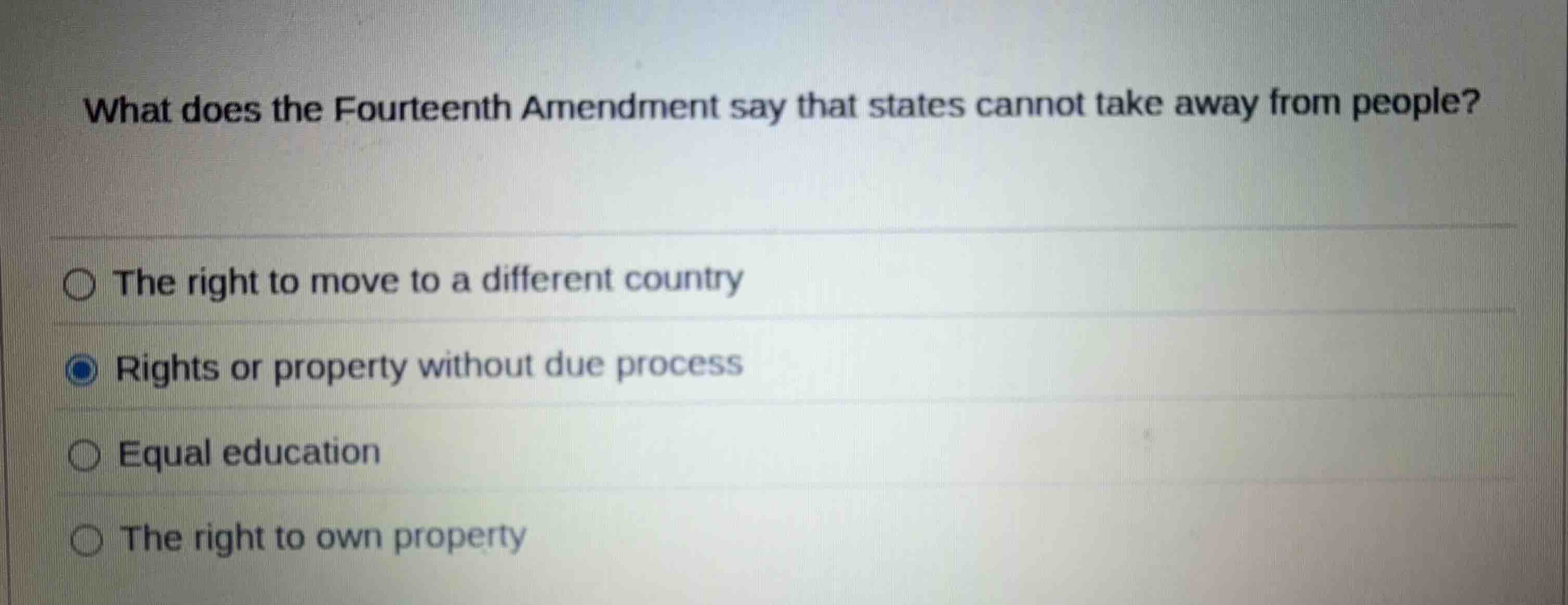
what does the fourteenth amendment say that states cannot take away from people?
the right to move to a different country
rights or property without due process
equal education
the right to own property
Analyze the Fourteenth Amendment
The Fourteenth Amendment of the United States Constitution contains the Due Process Clause, which states: "...nor shall any State deprive any person of life, liberty, or property, without due process of law."
Evaluate the given options
- "The right to move to a different country": Not protected or mentioned in the amendment.
- "Rights or property without due process": Directly matches the Due Process Clause protecting life, liberty (rights), or property from being taken without proper legal procedures.
- "Equal education": While the Equal Protection Clause was later used to desegregate schools, the amendment does not explicitly state that states cannot take away "equal education."
- "The right to own property": The amendment protects existing property from deprivation without due process, rather than guaranteeing a general right to acquire or own property.

Snap & solve any problem in the app
Get step-by-step solutions on Sovi AI
Photo-based solutions with guided steps
Explore more problems and detailed explanations
- (A) The right to move to a different country
- (B) Rights or property without due process (Correct answer)
- (C) Equal education
- (D) The right to own property