QUESTION IMAGE
Question
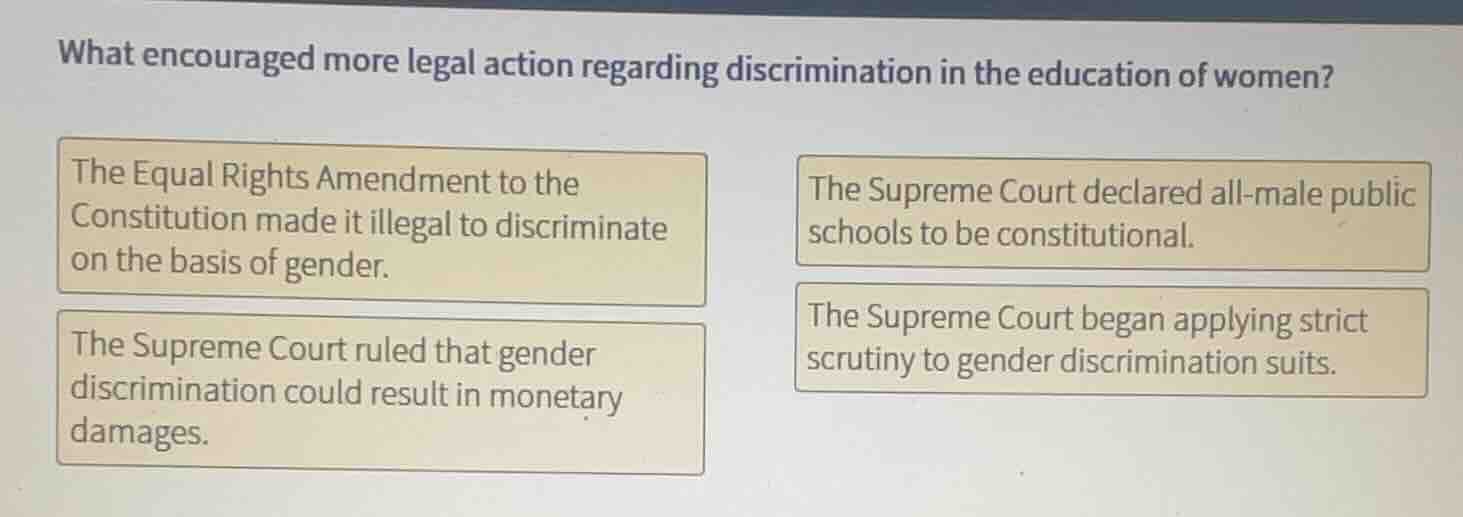
what encouraged more legal action regarding discrimination in the education of women?
the equal rights amendment to the constitution made it illegal to discriminate on the basis of gender.
the supreme court ruled that gender discrimination could result in monetary damages.
the supreme court declared all-male public schools to be constitutional.
the supreme court began applying strict scrutiny to gender discrimination suits.
Analyze the impact of legal remedies on gender discrimination in education
The Supreme Court's decision in Franklin v. Gwinnett County Public Schools (1992) established that monetary damages could be awarded under Title IX for intentional gender discrimination. This financial remedy significantly incentivized plaintiffs and attorneys to file lawsuits, thereby encouraging more legal action regarding discrimination in the education of women.
Evaluate the alternative options
- The Equal Rights Amendment (ERA) was never ratified and is not part of the Constitution.
- The Supreme Court did not declare all-male public schools constitutional in a way that encouraged more anti-discrimination lawsuits; rather, cases like United States v. Virginia (1996) declared them unconstitutional.
- The Supreme Court applies "intermediate scrutiny" (or heightened scrutiny) to gender discrimination, not "strict scrutiny" (which is reserved for race, national origin, and religion).

Snap & solve any problem in the app
Get step-by-step solutions on Sovi AI
Photo-based solutions with guided steps
Explore more problems and detailed explanations
- The Equal Rights Amendment to the Constitution made it illegal to discriminate on the basis of gender.
- The Supreme Court ruled that gender discrimination could result in monetary damages. (Correct answer)
- The Supreme Court declared all-male public schools to be constitutional.
- The Supreme Court began applying strict scrutiny to gender discrimination suits.