QUESTION IMAGE
Question
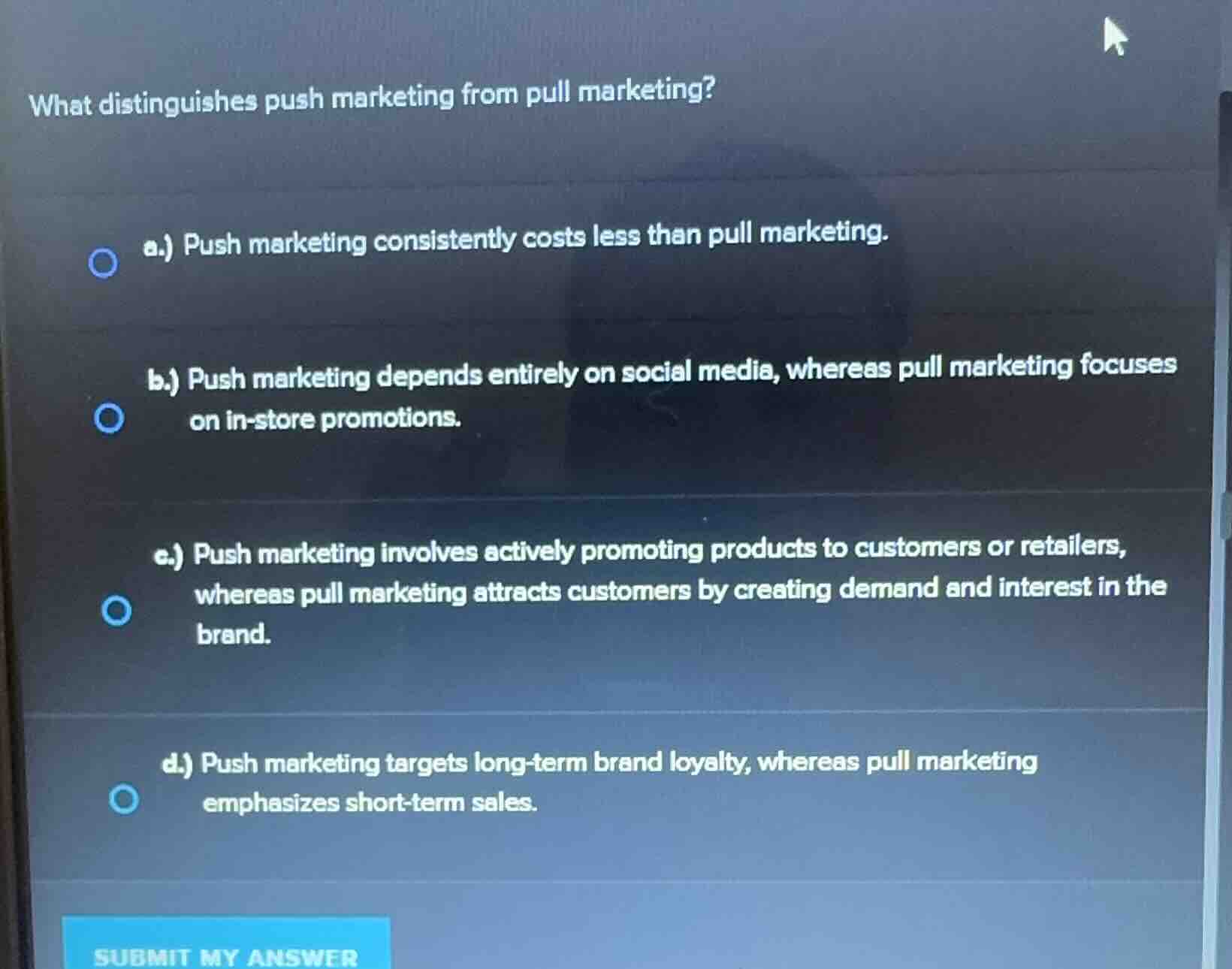
what distinguishes push marketing from pull marketing?
a.) push marketing consistently costs less than pull marketing.
b.) push marketing depends entirely on social media, whereas pull marketing focuses on in-store promotions.
c.) push marketing involves actively promoting products to customers or retailers, whereas pull marketing attracts customers by creating demand and interest in the brand.
d.) push marketing targets long-term brand loyalty, whereas pull marketing emphasizes short-term sales.
Define push and pull marketing strategies
Using the Basics of Marketing knowledge point, let's distinguish between these two promotional strategies:
- Push marketing is a promotional strategy where businesses attempt to take their products directly to the customer (pushing the product onto them). This involves active outbound tactics such as direct selling, trade shows, point-of-sale displays, and direct retail promotion.
- Pull marketing is a promotional strategy where a business aims to draw customers in (pulling them toward the product). This involves creating brand awareness, demand, and interest through advertising, search engine optimization, word-of-mouth, and social media campaigns so that customers actively seek out the product.
Evaluate the given options
- Option a: Incorrect. Neither strategy is consistently cheaper than the other; costs depend entirely on the scale and execution of the campaigns.
- Option b: Incorrect. Social media is highly effective for pull marketing (building brand interest), while in-store promotions are classic examples of push marketing. This option reverses or mischaracterizes their primary channels.
- Option c: Correct. This accurately describes the core mechanism of both strategies: push marketing actively promotes products directly to customers or intermediaries, while pull marketing builds demand so customers seek out the brand.
- Option d: Incorrect. Pull marketing is typically associated with long-term brand equity and loyalty, whereas push marketing often focuses on driving immediate, short-term sales.

Snap & solve any problem in the app
Get step-by-step solutions on Sovi AI
Photo-based solutions with guided steps
Explore more problems and detailed explanations
- a.) Push marketing consistently costs less than pull marketing.
- b.) Push marketing depends entirely on social media, whereas pull marketing focuses on in-store promotions.
- c.) Push marketing involves actively promoting products to customers or retailers, whereas pull marketing attracts customers by creating demand and interest in the brand. (Correct answer)
- d.) Push marketing targets long-term brand loyalty, whereas pull marketing emphasizes short-term sales.