QUESTION IMAGE
Question
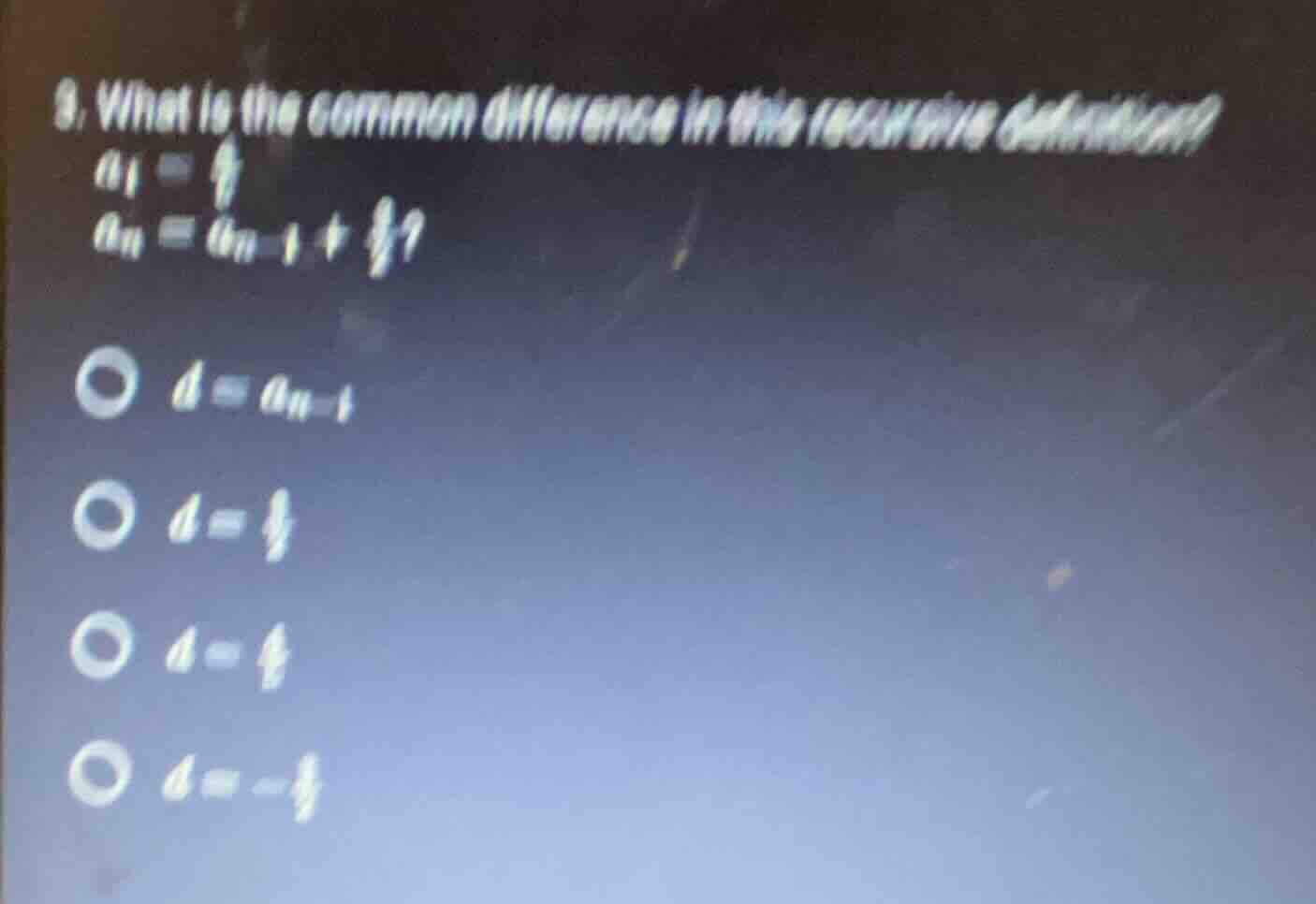
- what is the common difference in this recursive definition?
\\(a_1 = \frac{4}{7}\\)
\\(a_n = a_{n-1} + \frac{1}{7}\\)
\\(d = a_{n-1}\\)
\\(d = \frac{1}{7}\\)
\\(d = \frac{4}{7}\\)
\\(d = -\frac{1}{7}\\)
⚡ Using what you learned: Arithmetic Sequences · Recursive and Explicit Formulas
Step 1: Identify the recursive formula structure
The given recursive definition is:
$$ a_1 = 4 $$
$$ a_n = a_{n-1} + \frac{2}{7} $$
The general recursive formula for an arithmetic sequence is:
$$ a_n = a_{n-1} + d $$
where \( d \) represents the common difference.
Step 2: Determine the value of \( d \)
By comparing the given formula to the general form:
$$ a_n = a_{n-1} + \frac{2}{7} $$
We find:
$$ d = \frac{2}{7} $$

Snap & solve any problem in the app
Get step-by-step solutions on Sovi AI
Photo-based solutions with guided steps
Explore more problems and detailed explanations
\( d = \frac{2}{7} \)