QUESTION IMAGE
Question
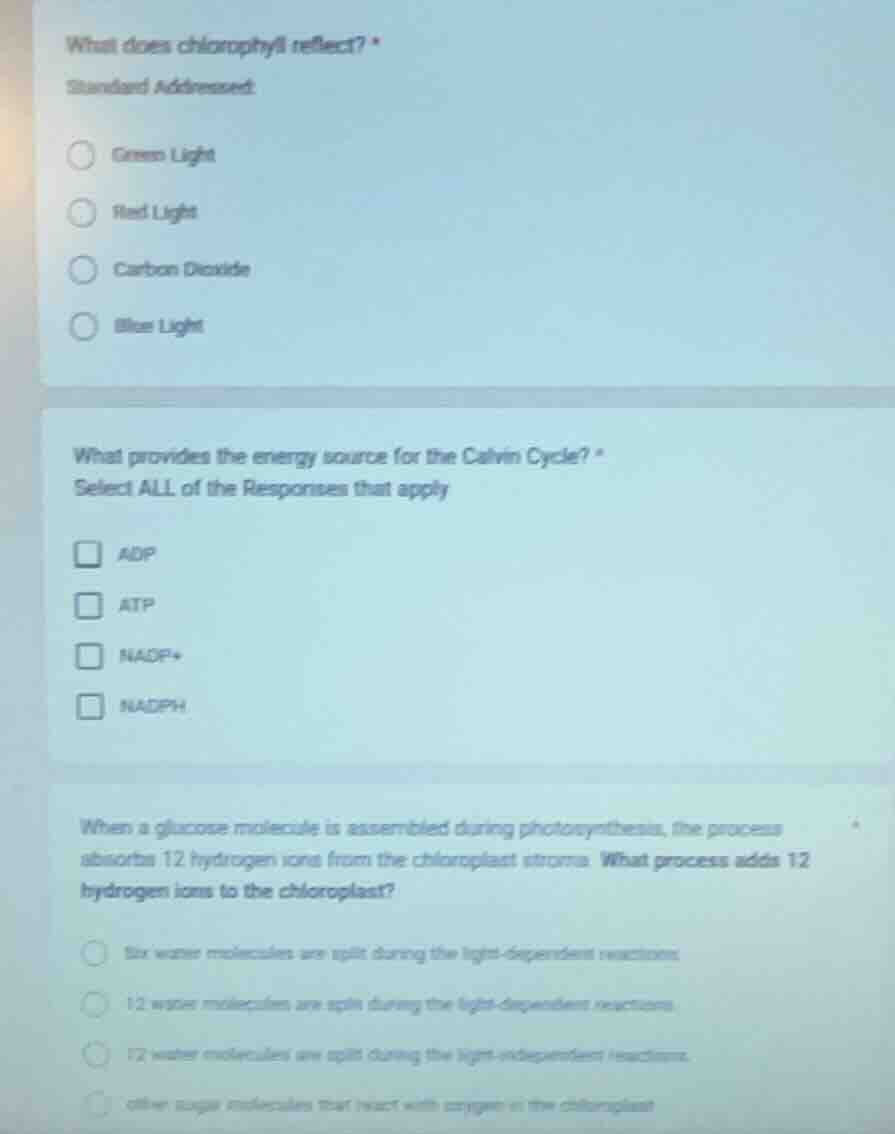
what does chlorophyll reflect? *
standard addressed:
green light
red light
carbon dioxide
blue light
what provides the energy source for the calvin cycle? *
select all of the responses that apply
adp
atp
nadp+
nadph
when a glucose molecule is assembled during photosynthesis, the process absorbs 12 hydrogen ions from the chloroplast stroma. what process adds 12 hydrogen ions to the chloroplast?
six water molecules are split during the light-dependent reactions
12 water molecules are split during the light-dependent reactions
12 water molecules are split during the light-independent reactions
other sugar molecules that react with oxygen in the chloroplast
Analyze chlorophyll light reflection
Using the Chlorophyll Localization knowledge point.
Chlorophyll is the primary photosynthetic pigment in plants. It absorbs light in the blue and red regions of the visible spectrum to power photosynthesis. Because it does not absorb green light efficiently, it reflects green wavelengths, giving plants their characteristic green color.
Identify energy sources for the Calvin Cycle
Using the Intermediate Energy Carriers and Calvin Cycle Reactants knowledge points.
The Calvin Cycle is the light-independent phase of photosynthesis that synthesizes sugars. It requires chemical energy and reducing power produced during the light-dependent reactions. ATP provides the necessary chemical energy, and NADPH provides the high-energy electrons (reducing power) required to reduce carbon dioxide. ADP and NADP+ are the depleted forms returned to the thylakoid membrane.
Determine the source of hydrogen ions
Using the Photolysis of Water and Photosynthetic Stoichiometry knowledge points.
The assembly of one glucose molecule (\(\text{C}_6\text{H}_{12}\text{O}_6\)) requires hydrogen atoms. During the light-dependent reactions, water molecules undergo photolysis (splitting) to release oxygen, electrons, and hydrogen ions (\(\text{H}^+\)). The balanced equation for water splitting is:
To generate and add 12 hydrogen ions (\(\text{H}^+\)) to the chloroplast system, we calculate the required water molecules:
Thus, splitting six water molecules during the light-dependent reactions adds 12 hydrogen ions.

Snap & solve any problem in the app
Get step-by-step solutions on Sovi AI
Photo-based solutions with guided steps
Explore more problems and detailed explanations
Question 1
- Green Light (Correct answer)
- Red Light
- Carbon Dioxide
- Blue Light
Question 2
- ADP
- ATP (Correct answer)
- NADP+
- NADPH (Correct answer)
Question 3
- Six water molecules are split during the light-dependent reactions (Correct answer)
- 12 water molecules are split during the light-dependent reactions
- 12 water molecules are split during the light-independent reactions
- other sugar molecules that react with oxygen in the chloroplast