QUESTION IMAGE
Question
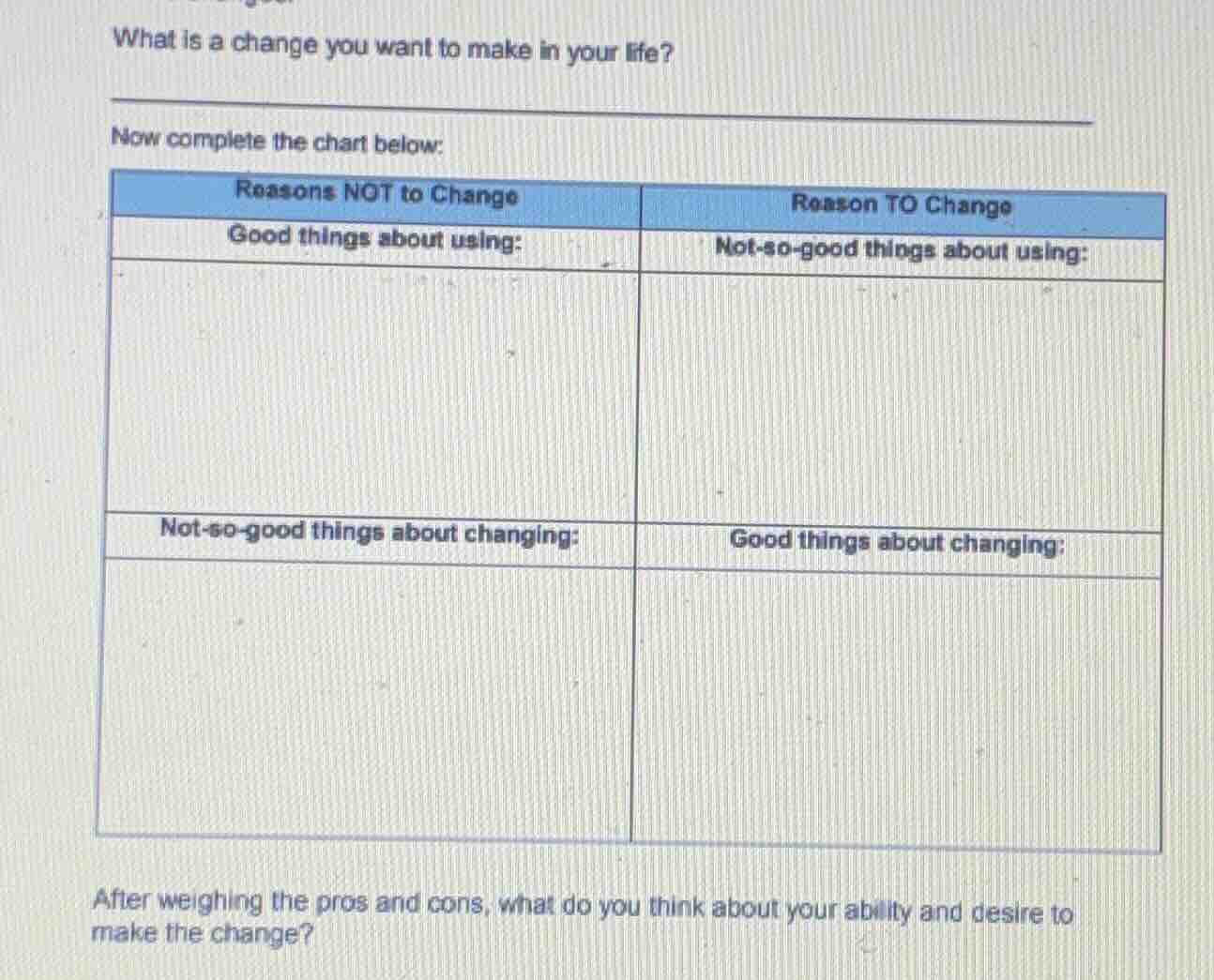
what is a change you want to make in your life?
now complete the chart below:
reasons not to change | reason to change
good things about using: | not-so-good things about using:
not-so-good things about changing: | good things about changing:
after weighing the pros and cons, what do you think about your ability and desire to make the change?
Identify the clinical tool and framework
The worksheet shown in the image is a Decisional Balance Sheet, a classic therapeutic tool used in Behavioral Therapy and Motivational Interviewing (often associated with the Transtheoretical Model of Change). It helps individuals explore ambivalence about making a behavioral change (such as reducing or stopping substance use, indicated by the word "using"). The tool is structured to weigh the pros and cons of both continuing the current behavior ("using") and making a change.
Analyze the structure of the decisional balance matrix
The chart is divided into a $2 \times 2$ matrix:
- Reasons NOT to Change (Left Column):
- Good things about using: The perceived benefits, pleasures, or coping mechanisms provided by the current behavior (e.g., stress relief, social connection, temporary escape).
- Not-so-good things about changing: The perceived costs, barriers, or challenges of making the change (e.g., withdrawal, losing a coping mechanism, social discomfort, effort required).
- Reason TO Change (Right Column):
- Not-so-good things about using: The negative consequences or costs of continuing the current behavior (e.g., health issues, financial strain, relationship conflicts, legal problems).
- Good things about changing: The positive outcomes or benefits of making the change (e.g., better health, saving money, improved relationships, self-esteem).
Formulate educational guidance for completing the worksheet
To guide a student at the community college level through this clinical exercise, we must explain how to systematically approach each prompt:
- Initial Prompt: "What is a change you want to make in your life?" requires identifying a specific target behavior (e.g., "I want to stop smoking cigarettes" or "I want to reduce my screen time").
- The $2 \times 2$ Chart: Needs to be filled out honestly to map out the psychological conflict (ambivalence).
- Final Reflection Prompt: "After weighing the pros and cons, what do you think about your ability and desire to make the change?" asks the individual to assess their self-efficacy (ability) and intrinsic motivation (desire) based on the completed matrix.

Snap & solve any problem in the app
Get step-by-step solutions on Sovi AI
Photo-based solutions with guided steps
Explore more problems and detailed explanations
This worksheet is a Decisional Balance Sheet, a standard cognitive-behavioral tool used to resolve ambivalence and build motivation for behavioral change. Below is an explanation of how to complete each section of the worksheet:
1. Target Change
- Prompt: What is a change you want to make in your life?
- How to answer: Identify a specific, concrete behavior you are considering changing (for example: "I want to stop smoking cigarettes" or "I want to reduce my daily screen time").
---
2. Decisional Balance Chart
| Reasons NOT to Change | Reason TO Change |
|---|---|
| Not-so-good things about changing:<br>• Experiencing withdrawal symptoms or discomfort.<br>• Losing a primary coping mechanism for stress.<br>• Having to find new social circles or activities. | Good things about changing:<br>• Improved long-term health, energy, and well-being.<br>• Saving money and resources.<br>• Increased self-esteem and sense of personal control. |
---
3. Self-Reflection
- Prompt: After weighing the pros and cons, what do you think about your ability and desire to make the change?
- How to answer: Reflect on the completed chart. If the "Reasons TO Change" outweigh the "Reasons NOT to Change," your desire is likely high. Assess your confidence (ability) by identifying strategies to manage the "Not-so-good things about changing" (e.g., finding healthier stress-relief alternatives).