QUESTION IMAGE
Question
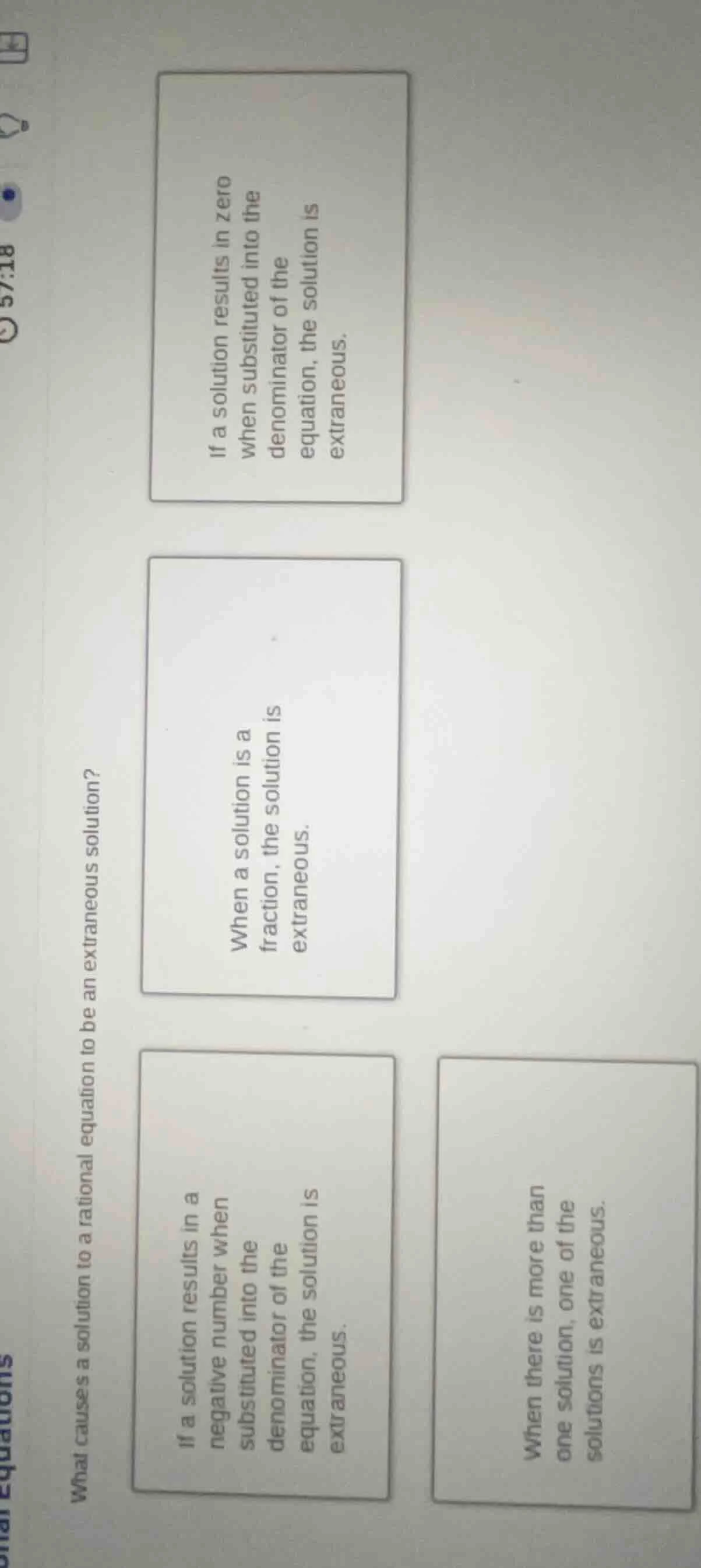
what causes a solution to a rational equation to be an extraneous solution?
if a solution results in a negative number when substituted into the denominator of the equation, the solution is extraneous.
when a solution is a fraction, the solution is extraneous.
if a solution results in zero when substituted into the denominator of the equation, the solution is extraneous.
when there is more than one solution, one of the solutions is extraneous.
An extraneous solution in a rational equation is a solution that does not satisfy the original equation, often because it makes the denominator zero (since division by zero is undefined). The first statement correctly defines this: if a solution makes the denominator zero when substituted, it's extraneous. The other statements are incorrect (a solution being a fraction, negative, or one of multiple solutions doesn't make it extraneous by those definitions).

Snap & solve any problem in the app
Get step-by-step solutions on Sovi AI
Photo-based solutions with guided steps
Explore more problems and detailed explanations
If a solution results in zero when substituted into the denominator of the equation, the solution is extraneous.