QUESTION IMAGE
Question
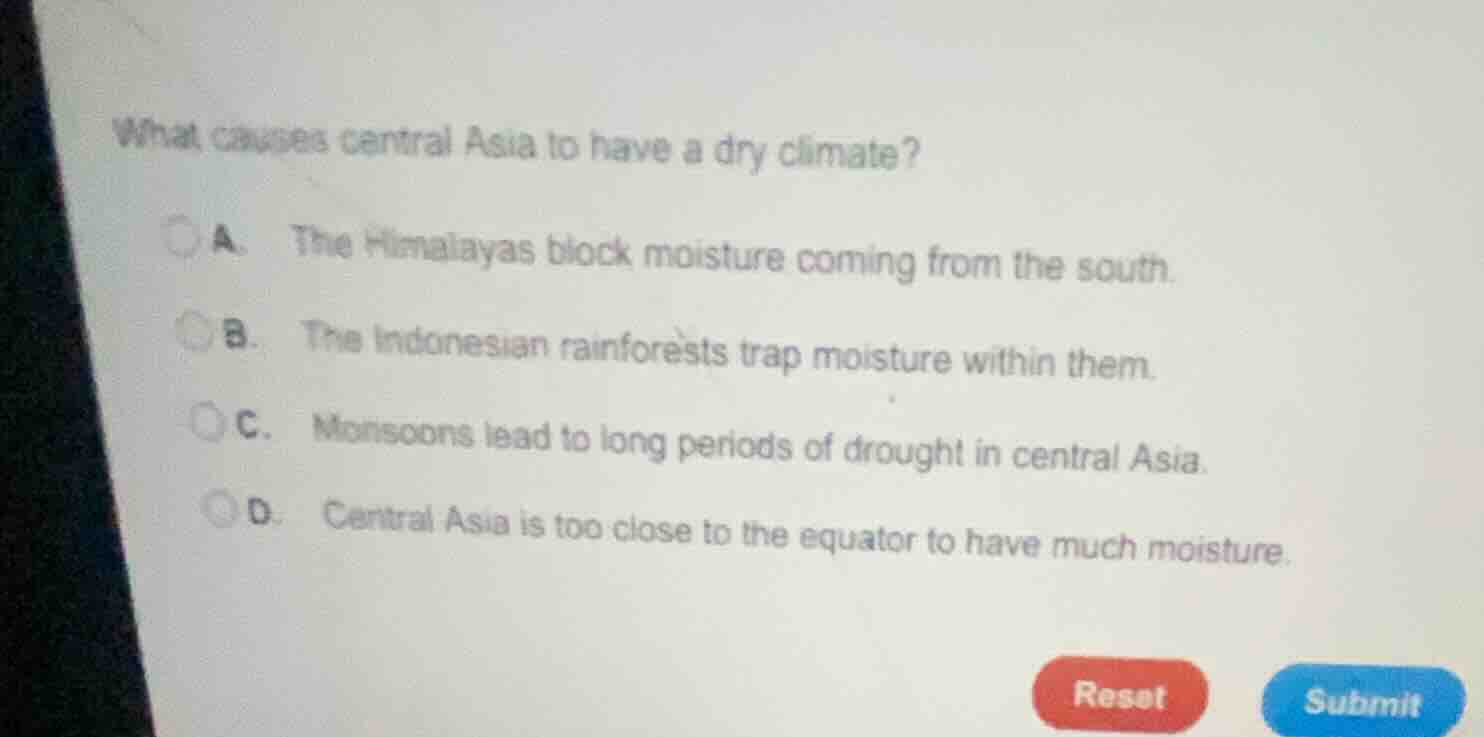
what causes central asia to have a dry climate?
a. the himalayas block moisture coming from the south.
b. the indonesian rainforests trap moisture within them.
c. monsoons lead to long periods of drought in central asia.
d. central asia is too close to the equator to have much moisture.
<pre_analysis>
{
"quality": "clear",
"question_count": 1,
"skills_matched": [
"direct_cot",
"multiple_choice_formatter",
"explain_then_answer",
"tutor"
],
"needs_drawing": false,
"concepts_used": [],
"new_concepts": [
"Rain Shadow Effect",
"Central Asian Climate"
],
"current_concepts": [
"Rain Shadow Effect",
"Central Asian Climate",
"Himalayan Orographic Barrier"
]
}
</pre_analysis>
<reasoning>
Identify the core question
The question asks for the primary cause of the dry (arid/semi-arid) climate in Central Asia.
Analyze the geographical factors
Central Asia's aridity is primarily driven by its extreme continentality (distance from oceans) and major topographic barriers. To the south, the massive Himalayan mountain range and the Tibetan Plateau act as a colossal barrier to atmospheric circulation.
Evaluate the rain shadow effect
Warm, moist air masses moving northward from the Indian Ocean are forced to rise as they encounter the Himalayas. As this air rises, it cools and condenses, dropping its moisture as heavy precipitation on the southern slopes (orographic precipitation). By the time the air crosses the mountains and descends into Central Asia, it is extremely dry. This is a classic example of a rain shadow effect.
Assess the given options
- A. The Himalayas block moisture coming from the south. This directly describes the rain shadow effect created by the Himalayas blocking Indian Ocean moisture. This is correct.
- B. The Indonesian rainforests trap moisture within them. Indonesian rainforests are too far south and do not dictate the dry climate of Central Asia.
- C. Monsoons lead to long periods of drought in central Asia. Monsoons bring seasonal rains to South and East Asia, not prolonged droughts to Central Asia.
- D. Central Asia is too close to the equator to have much moisture. Central Asia is located in the mid-latitudes, far north of the equator.
</reasoning>
<answer>
<mcq-correct>(A) The Himalayas block moisture coming from the south.</mcq-correct>
<mcq-option>(B) The Indonesian rainforests trap moisture within them.</mcq-option>
<mcq-option>(C) Monsoons lead to long periods of drought in central Asia.</mcq-option>
<mcq-option>(D) Central Asia is too close to the equator to have much moisture.</mcq-option>
</answer>
<post_analysis>
{
"subject": "Social Science",
"question_type": "Multiple Choice",
"knowledge_point": [
"Social Science",
"Geography",
"Climatology and Physical Geography"
]
}
</post_analysis>
Snap & solve any problem in the app
Get step-by-step solutions on Sovi AI
Photo-based solutions with guided steps
Explore more problems and detailed explanations
<pre_analysis>
{
"quality": "clear",
"question_count": 1,
"skills_matched": [
"direct_cot",
"multiple_choice_formatter",
"explain_then_answer",
"tutor"
],
"needs_drawing": false,
"concepts_used": [],
"new_concepts": [
"Rain Shadow Effect",
"Central Asian Climate"
],
"current_concepts": [
"Rain Shadow Effect",
"Central Asian Climate",
"Himalayan Orographic Barrier"
]
}
</pre_analysis>
<reasoning>
Identify the core question
The question asks for the primary cause of the dry (arid/semi-arid) climate in Central Asia.
Analyze the geographical factors
Central Asia's aridity is primarily driven by its extreme continentality (distance from oceans) and major topographic barriers. To the south, the massive Himalayan mountain range and the Tibetan Plateau act as a colossal barrier to atmospheric circulation.
Evaluate the rain shadow effect
Warm, moist air masses moving northward from the Indian Ocean are forced to rise as they encounter the Himalayas. As this air rises, it cools and condenses, dropping its moisture as heavy precipitation on the southern slopes (orographic precipitation). By the time the air crosses the mountains and descends into Central Asia, it is extremely dry. This is a classic example of a rain shadow effect.
Assess the given options
- A. The Himalayas block moisture coming from the south. This directly describes the rain shadow effect created by the Himalayas blocking Indian Ocean moisture. This is correct.
- B. The Indonesian rainforests trap moisture within them. Indonesian rainforests are too far south and do not dictate the dry climate of Central Asia.
- C. Monsoons lead to long periods of drought in central Asia. Monsoons bring seasonal rains to South and East Asia, not prolonged droughts to Central Asia.
- D. Central Asia is too close to the equator to have much moisture. Central Asia is located in the mid-latitudes, far north of the equator.
</reasoning>
<answer>
<mcq-correct>(A) The Himalayas block moisture coming from the south.</mcq-correct>
<mcq-option>(B) The Indonesian rainforests trap moisture within them.</mcq-option>
<mcq-option>(C) Monsoons lead to long periods of drought in central Asia.</mcq-option>
<mcq-option>(D) Central Asia is too close to the equator to have much moisture.</mcq-option>
</answer>
<post_analysis>
{
"subject": "Social Science",
"question_type": "Multiple Choice",
"knowledge_point": [
"Social Science",
"Geography",
"Climatology and Physical Geography"
]
}
</post_analysis>