QUESTION IMAGE
Question
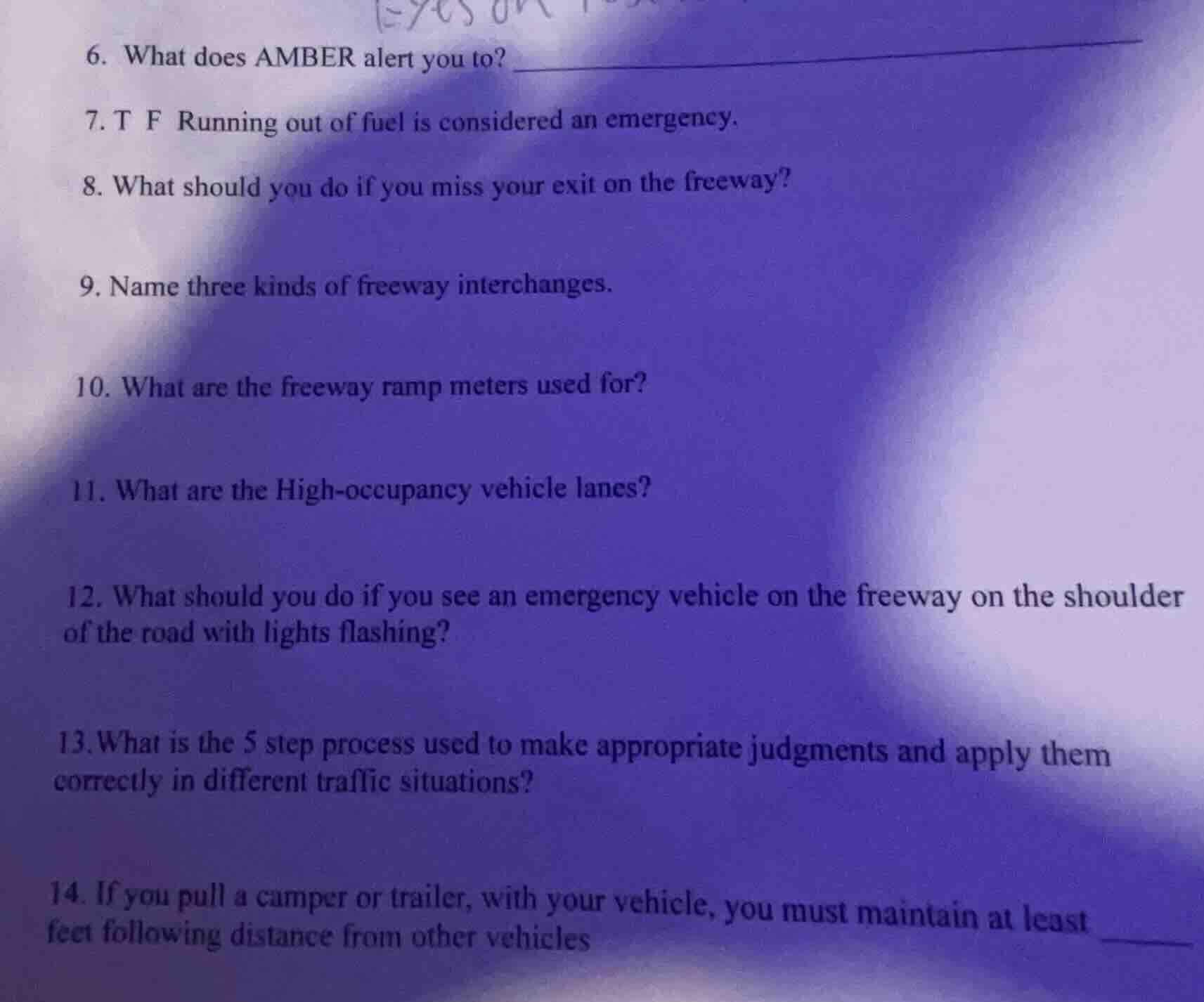
- what does amber alert you to?
- t f running out of fuel is considered an emergency.
- what should you do if you miss your exit on the freeway?
- name three kinds of freeway interchanges.
- what are the freeway ramp meters used for?
- what are the high-occupancy vehicle lanes?
- what should you do if you see an emergency vehicle on the freeway on the shoulder of the road with lights flashing?
- what is the 5 step process used to make appropriate judgments and apply them correctly in different traffic situations?
- if you pull a camper or trailer, with your vehicle, you must maintain at least ______ feet following distance from other vehicles
<pre_analysis>
{
"quality": "clear",
"question_count": 9,
"skills_matched": [
"direct_cot",
"table_formatter",
"explain_then_answer",
"quick"
],
"needs_drawing": false,
"concepts_used": [],
"new_concepts": [
"Driver Education",
"Freeway Driving Rules",
"Traffic Safety"
],
"current_concepts": [
"Driver Education",
"Freeway Driving Rules",
"Traffic Safety"
]
}
</pre_analysis>
<reasoning>
Analyze questions 6 to 8
- Question 6 asks what an AMBER alert is for. It is used to notify the public about abducted children.
- Question 7 is a True/False question about running out of fuel. Running out of fuel on a highway is considered an emergency because it creates a hazard.
- Question 8 asks what to do if you miss a freeway exit. You must proceed to the next exit and never back up.
Analyze questions 9 to 11
- Question 9 asks for three types of freeway interchanges. Common types include cloverleaf, diamond, trumpet, and directional interchanges.
- Question 10 asks about ramp meters. They are used to control the flow of vehicles entering the freeway to reduce congestion.
- Question 11 asks about High-Occupancy Vehicle (HOV) lanes. These are restricted lanes reserved for vehicles with a minimum number of occupants.
Analyze questions 12 to 14
- Question 12 asks about encountering an emergency vehicle on the shoulder. Drivers must slow down and, if safe, move over one lane (Move Over Law).
- Question 13 asks for the 5-step process for traffic judgments. This refers to the SIPDE process: Search, Identify, Predict, Decide, Execute.
- Question 14 asks for the minimum following distance when towing a camper/trailer. Standard driver education guidelines require maintaining at least a 500-foot following distance on open highways.
</reasoning>
<answer>
| No. | Answer |
|---|---|
| 7 | True |
| 8 | Continue to the next exit; never back up or turn around. |
| 9 | Cloverleaf, Diamond, and Trumpet interchanges. |
| 10 | To regulate the flow of traffic entering the freeway. |
| 11 | Lanes reserved for vehicles with multiple occupants (carpools). |
| 12 | Slow down and safely move over one lane (Move Over Law). |
| 13 | SIPDE (Search, Identify, Predict, Decide, Execute). |
| 14 | 500 |
</answer>
<post_analysis>
{
"subject": "Others",
"question_type": "Multi-part",
"knowledge_point": [
"Others",
"Driver Education",
"Traffic Laws and Regulations"
]
}
</post_analysis>
Snap & solve any problem in the app
Get step-by-step solutions on Sovi AI
Photo-based solutions with guided steps
Explore more problems and detailed explanations
<pre_analysis>
{
"quality": "clear",
"question_count": 9,
"skills_matched": [
"direct_cot",
"table_formatter",
"explain_then_answer",
"quick"
],
"needs_drawing": false,
"concepts_used": [],
"new_concepts": [
"Driver Education",
"Freeway Driving Rules",
"Traffic Safety"
],
"current_concepts": [
"Driver Education",
"Freeway Driving Rules",
"Traffic Safety"
]
}
</pre_analysis>
<reasoning>
Analyze questions 6 to 8
- Question 6 asks what an AMBER alert is for. It is used to notify the public about abducted children.
- Question 7 is a True/False question about running out of fuel. Running out of fuel on a highway is considered an emergency because it creates a hazard.
- Question 8 asks what to do if you miss a freeway exit. You must proceed to the next exit and never back up.
Analyze questions 9 to 11
- Question 9 asks for three types of freeway interchanges. Common types include cloverleaf, diamond, trumpet, and directional interchanges.
- Question 10 asks about ramp meters. They are used to control the flow of vehicles entering the freeway to reduce congestion.
- Question 11 asks about High-Occupancy Vehicle (HOV) lanes. These are restricted lanes reserved for vehicles with a minimum number of occupants.
Analyze questions 12 to 14
- Question 12 asks about encountering an emergency vehicle on the shoulder. Drivers must slow down and, if safe, move over one lane (Move Over Law).
- Question 13 asks for the 5-step process for traffic judgments. This refers to the SIPDE process: Search, Identify, Predict, Decide, Execute.
- Question 14 asks for the minimum following distance when towing a camper/trailer. Standard driver education guidelines require maintaining at least a 500-foot following distance on open highways.
</reasoning>
<answer>
| No. | Answer |
|---|---|
| 7 | True |
| 8 | Continue to the next exit; never back up or turn around. |
| 9 | Cloverleaf, Diamond, and Trumpet interchanges. |
| 10 | To regulate the flow of traffic entering the freeway. |
| 11 | Lanes reserved for vehicles with multiple occupants (carpools). |
| 12 | Slow down and safely move over one lane (Move Over Law). |
| 13 | SIPDE (Search, Identify, Predict, Decide, Execute). |
| 14 | 500 |
</answer>
<post_analysis>
{
"subject": "Others",
"question_type": "Multi-part",
"knowledge_point": [
"Others",
"Driver Education",
"Traffic Laws and Regulations"
]
}
</post_analysis>