QUESTION IMAGE
Question
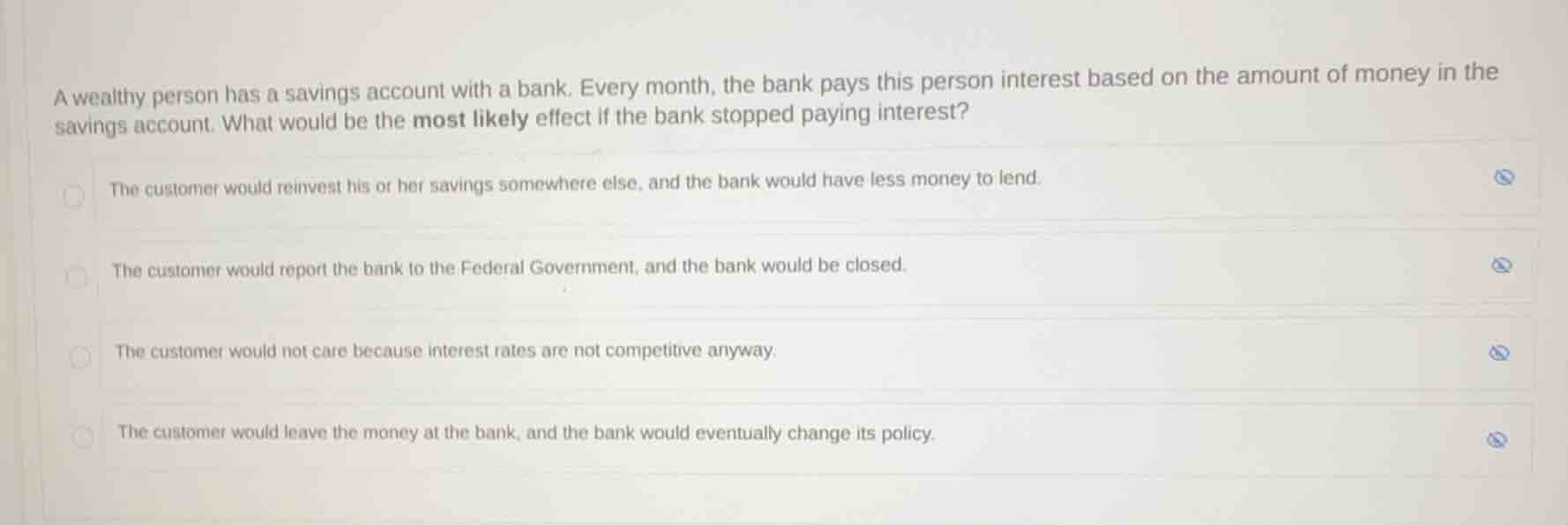
a wealthy person has a savings account with a bank. every month, the bank pays this person interest based on the amount of money in the savings account. what would be the most likely effect if the bank stopped paying interest?
the customer would reinvest his or her savings somewhere else, and the bank would have less money to lend.
the customer would report the bank to the federal government, and the bank would be closed.
the customer would not care because interest rates are not competitive anyway.
the customer would leave the money at the bank, and the bank would eventually change its policy.
<pre_analysis>
{
"quality": "clear",
"question_count": 1,
"skills_matched": [
"direct_cot",
"multiple_choice_formatter",
"explain_then_answer",
"tutor"
],
"needs_drawing": false,
"concepts_used": [
"Banking Operations",
"Financial Intermediation"
],
"new_concepts": [],
"current_concepts": [
"Banking Operations",
"Financial Intermediation",
"Interest Rates"
]
}
</pre_analysis>
<reasoning>
Analyze the role of interest in savings accounts
Using the Banking Operations knowledge point, banks pay interest on savings accounts as an incentive for customers to deposit and keep their money there. For a wealthy individual, earning interest is a key motivation for maintaining large balances in a savings account.
Determine the customer's reaction to losing interest
If the bank stops paying interest, the opportunity cost of keeping money in that savings account increases. The wealthy customer would seek alternative financial instruments (such as bonds, stocks, or other banks) that offer a return on investment. Thus, the customer would likely withdraw and reinvest their savings elsewhere.
Evaluate the impact on the bank's lending capacity
Using the Financial Intermediation knowledge point, banks rely on customer deposits to fund loans for other borrowers. When a wealthy customer withdraws their savings, the bank's total reserves decrease. Consequently, the bank has less capital available to lend out to other customers.
Assess the given options
- Option 1: "The customer would reinvest his or her savings somewhere else, and the bank would have less money to lend." This matches our economic analysis perfectly.
- Option 2: "The customer would report the bank to the Federal Government, and the bank would be closed." Banks are generally not legally required to pay interest on savings accounts; stopping interest is a business decision, not an illegal act that would cause a shutdown.
- Option 3: "The customer would not care because interest rates are not competitive anyway." A wealthy person with significant capital is highly sensitive to interest rates and returns, so they would care.
- Option 4: "The customer would leave the money at the bank, and the bank would eventually change its policy." Leaving money in a non-interest-bearing account results in a loss of purchasing power due to inflation, which is economically irrational.
</reasoning>
<answer>
<mcq-correct>(A) The customer would reinvest his or her savings somewhere else, and the bank would have less money to lend.</mcq-correct>
<mcq-option>(B) The customer would report the bank to the Federal Government, and the bank would be closed.</mcq-option>
<mcq-option>(C) The customer would not care because interest rates are not competitive anyway.</mcq-option>
<mcq-option>(D) The customer would leave the money at the bank, and the bank would eventually change its policy.</mcq-option>
</answer>
<post_analysis>
{
"subject": "Business",
"question_type": "Multiple Choice",
"knowledge_point": [
"Business",
"Banking Operations",
"Financial Intermediation"
]
}
</post_analysis>
Snap & solve any problem in the app
Get step-by-step solutions on Sovi AI
Photo-based solutions with guided steps
Explore more problems and detailed explanations
<pre_analysis>
{
"quality": "clear",
"question_count": 1,
"skills_matched": [
"direct_cot",
"multiple_choice_formatter",
"explain_then_answer",
"tutor"
],
"needs_drawing": false,
"concepts_used": [
"Banking Operations",
"Financial Intermediation"
],
"new_concepts": [],
"current_concepts": [
"Banking Operations",
"Financial Intermediation",
"Interest Rates"
]
}
</pre_analysis>
<reasoning>
Analyze the role of interest in savings accounts
Using the Banking Operations knowledge point, banks pay interest on savings accounts as an incentive for customers to deposit and keep their money there. For a wealthy individual, earning interest is a key motivation for maintaining large balances in a savings account.
Determine the customer's reaction to losing interest
If the bank stops paying interest, the opportunity cost of keeping money in that savings account increases. The wealthy customer would seek alternative financial instruments (such as bonds, stocks, or other banks) that offer a return on investment. Thus, the customer would likely withdraw and reinvest their savings elsewhere.
Evaluate the impact on the bank's lending capacity
Using the Financial Intermediation knowledge point, banks rely on customer deposits to fund loans for other borrowers. When a wealthy customer withdraws their savings, the bank's total reserves decrease. Consequently, the bank has less capital available to lend out to other customers.
Assess the given options
- Option 1: "The customer would reinvest his or her savings somewhere else, and the bank would have less money to lend." This matches our economic analysis perfectly.
- Option 2: "The customer would report the bank to the Federal Government, and the bank would be closed." Banks are generally not legally required to pay interest on savings accounts; stopping interest is a business decision, not an illegal act that would cause a shutdown.
- Option 3: "The customer would not care because interest rates are not competitive anyway." A wealthy person with significant capital is highly sensitive to interest rates and returns, so they would care.
- Option 4: "The customer would leave the money at the bank, and the bank would eventually change its policy." Leaving money in a non-interest-bearing account results in a loss of purchasing power due to inflation, which is economically irrational.
</reasoning>
<answer>
<mcq-correct>(A) The customer would reinvest his or her savings somewhere else, and the bank would have less money to lend.</mcq-correct>
<mcq-option>(B) The customer would report the bank to the Federal Government, and the bank would be closed.</mcq-option>
<mcq-option>(C) The customer would not care because interest rates are not competitive anyway.</mcq-option>
<mcq-option>(D) The customer would leave the money at the bank, and the bank would eventually change its policy.</mcq-option>
</answer>
<post_analysis>
{
"subject": "Business",
"question_type": "Multiple Choice",
"knowledge_point": [
"Business",
"Banking Operations",
"Financial Intermediation"
]
}
</post_analysis>