QUESTION IMAGE
Question
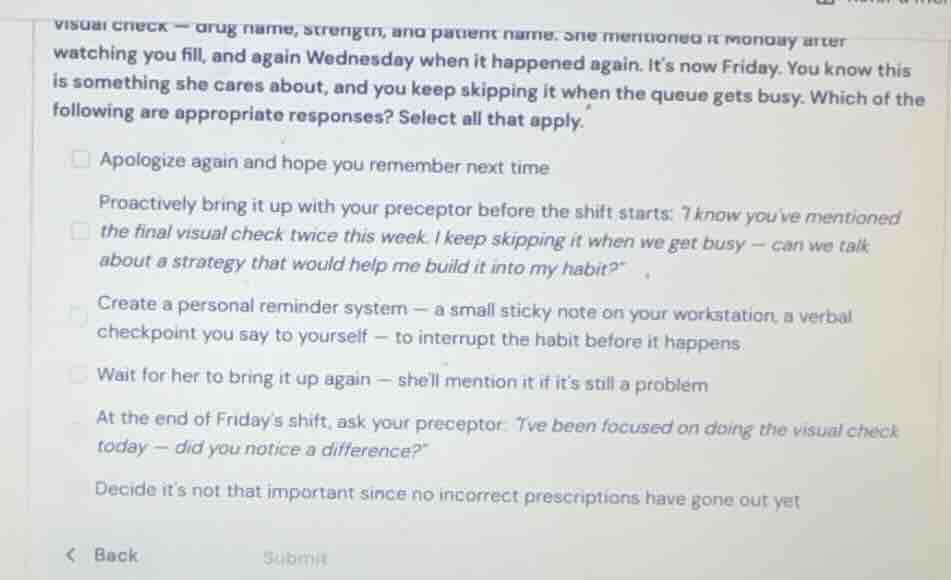
visual check - drug name, strength, and patient name. she mentioned it monday after watching you fill, and again wednesday when it happened again. its now friday. you know this is something she cares about, and you keep skipping it when the queue gets busy. which of the following are appropriate responses? select all that apply.
apologize again and hope you remember next time
proactively bring it up with your preceptor before the shift starts: \i know youve mentioned the final visual check twice this week. i keep skipping it when we get busy - can we talk about a strategy that would help me build it into my habit?\
create a personal reminder system - a small sticky note on your workstation, a verbal checkpoint you say to yourself - to interrupt the habit before it happens.
wait for her to bring it up again - shell mention it if its still a problem
at the end of fridays shift, ask your preceptor: \ive been focused on doing the visual check today - did you notice a difference?\
decide its not that important since no incorrect prescriptions have gone out yet
Analyze the scenario and feedback
The scenario describes a situation where a preceptor has twice pointed out a failure to perform a final visual check (drug name, strength, and patient name) when the pharmacy queue gets busy. This is a critical safety step in the Pharmacy Workflow. Receiving feedback constructively is essential for professional growth and patient safety.
Evaluate passive or dismissive responses
- "Apologize again and hope you remember next time": This is passive and does not show a proactive effort to change behavior or build a reliable habit.
- "Wait for her to bring it up again — she'll mention it if it's still a problem": This is passive and avoids taking responsibility for self-improvement, placing the burden back on the preceptor.
- "Decide it's not that important since no incorrect prescriptions have gone out yet": This is a dangerous attitude in pharmacy practice. Near-misses or potential errors must be addressed before they reach a patient.
Evaluate proactive and constructive responses
- "Proactively bring it up with your preceptor before the shift starts...": This demonstrates excellent Preceptor Communication and a willingness to learn. It shows initiative in seeking a strategy to improve.
- "Create a personal reminder system...": This is a practical, self-reflective action to address the habit directly at the workstation, showing active engagement with Professional Feedback Reception.
- "At the end of Friday's shift, ask your preceptor: 'I've been focused on doing the visual check today — did you notice a difference?'": This closes the feedback loop, showing accountability and inviting ongoing evaluation of your progress.

Snap & solve any problem in the app
Get step-by-step solutions on Sovi AI
Photo-based solutions with guided steps
Explore more problems and detailed explanations
- Apologize again and hope you remember next time
- Proactively bring it up with your preceptor before the shift starts: "I know you've mentioned the final visual check twice this week. I keep skipping it when we get busy — can we talk about a strategy that would help me build it into my habit?" (Correct answer)
- Create a personal reminder system — a small sticky note on your workstation, a verbal checkpoint you say to yourself — to interrupt the habit before it happens (Correct answer)
- Wait for her to bring it up again — she'll mention it if it's still a problem
- At the end of Friday's shift, ask your preceptor: "I've been focused on doing the visual check today — did you notice a difference?" (Correct answer)
- Decide it's not that important since no incorrect prescriptions have gone out yet