QUESTION IMAGE
Question
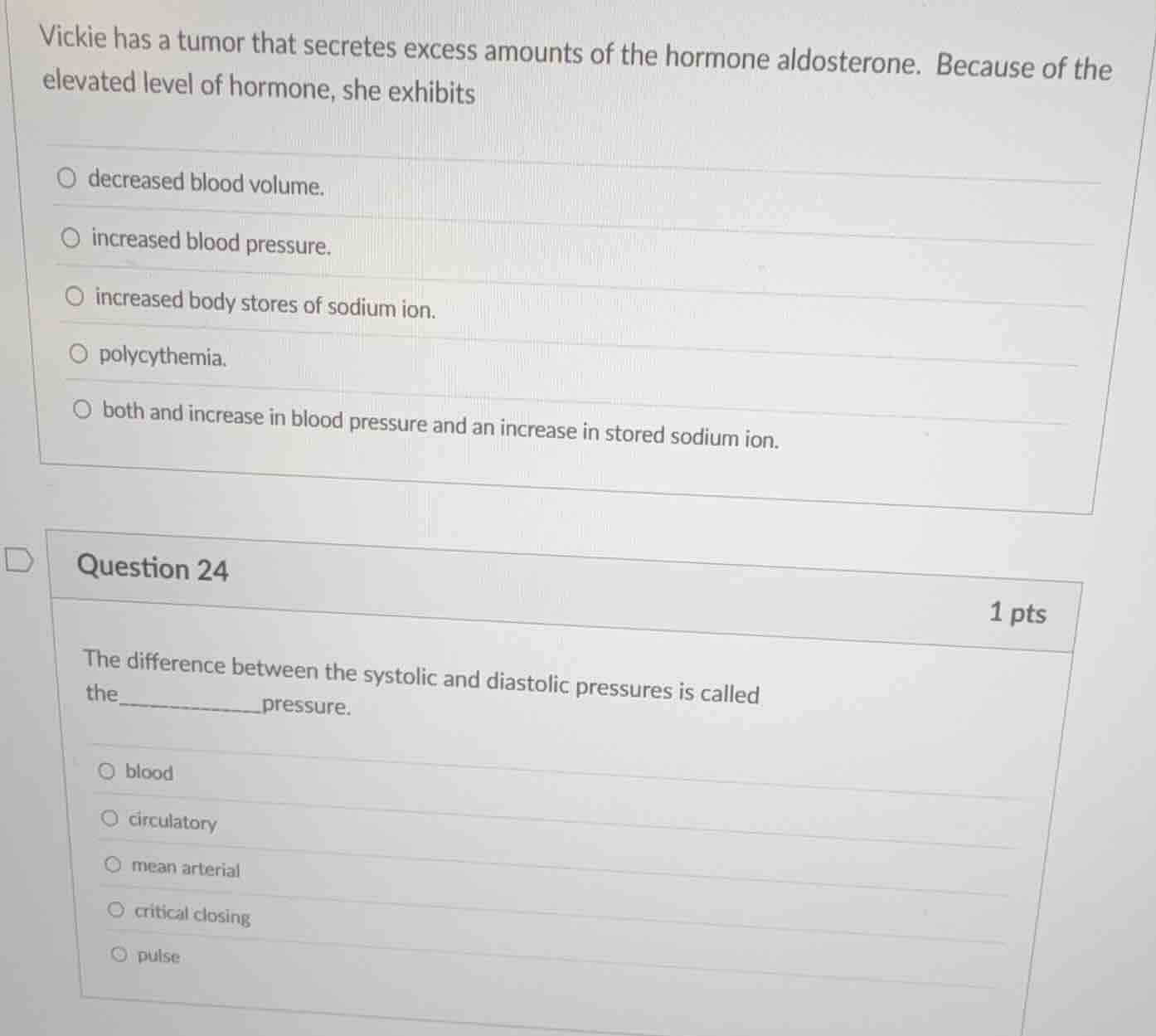
vickie has a tumor that secretes excess amounts of the hormone aldosterone. because of the elevated level of hormone, she exhibits
decreased blood volume.
increased blood pressure.
increased body stores of sodium ion.
polycythemia.
both and increase in blood pressure and an increase in stored sodium ion.
question 24
1 pts
the difference between the systolic and diastolic pressures is called the ________ pressure.
blood
circulatory
mean arterial
critical closing
pulse
Analyze aldosterone physiological effects
Aldosterone is a mineralocorticoid hormone produced by the adrenal cortex. Its primary physiological role is to promote sodium reabsorption and potassium excretion in the distal tubules and collecting ducts of the kidneys. When sodium is reabsorbed, water follows osmotically, which expands the extracellular fluid volume and blood volume. This expansion of blood volume directly leads to an increase in systemic blood pressure. Therefore, excess aldosterone (hyperaldosteronism) results in both increased body stores of sodium ions and increased blood pressure.
Evaluate Question 1 options
- decreased blood volume: Incorrect, because aldosterone excess increases sodium and water retention, expanding blood volume.
- increased blood pressure: Correct, but incomplete on its own as sodium stores also increase.
- increased body stores of sodium ion: Correct, but incomplete on its own as blood pressure also increases.
- polycythemia: Incorrect, as this refers to an abnormal increase in red blood cells.
- both and increase in blood pressure and an increase in stored sodium ion: Correct, as it combines both direct physiological consequences of excess aldosterone.
Define systolic and diastolic pressure difference
Using the Hemodynamics knowledge point, we analyze the pressure changes in the arterial system during the cardiac cycle. Systolic pressure is the maximum pressure exerted in the arteries during ventricular contraction, while diastolic pressure is the minimum pressure during ventricular relaxation. The difference between these two pressures represents the pressure wave felt as a pulse.
Evaluate Question 24 options
- blood: Incorrect, blood pressure is the general term for pressure exerted by blood on vessel walls.
- circulatory: Incorrect, not a standard term for this specific difference.
- mean arterial: Incorrect, mean arterial pressure (MAP) is the average pressure throughout the cardiac cycle, calculated approximately as diastolic pressure plus one-third of the pulse pressure.
- critical closing: Incorrect, this is the minimum pressure required to keep a blood vessel open.
- pulse: Correct, the mathematical difference between systolic and diastolic pressure is defined as the pulse pressure:

Snap & solve any problem in the app
Get step-by-step solutions on Sovi AI
Photo-based solutions with guided steps
Explore more problems and detailed explanations
Question 1
- decreased blood volume.
- increased blood pressure.
- increased body stores of sodium ion.
- polycythemia.
- both and increase in blood pressure and an increase in stored sodium ion. (Correct answer)
Question 24
- blood
- circulatory
- mean arterial
- critical closing
- pulse (Correct answer)