QUESTION IMAGE
Question
vertebrate animals use antibodies to recognize and destroy foreign cells. cells of the immune system, called b cells, have receptors that bind to proteins on the surface of foreign cells. upon binding, b cells release antibodies that enable other immune cells to recognize and destroy the foreign cells.
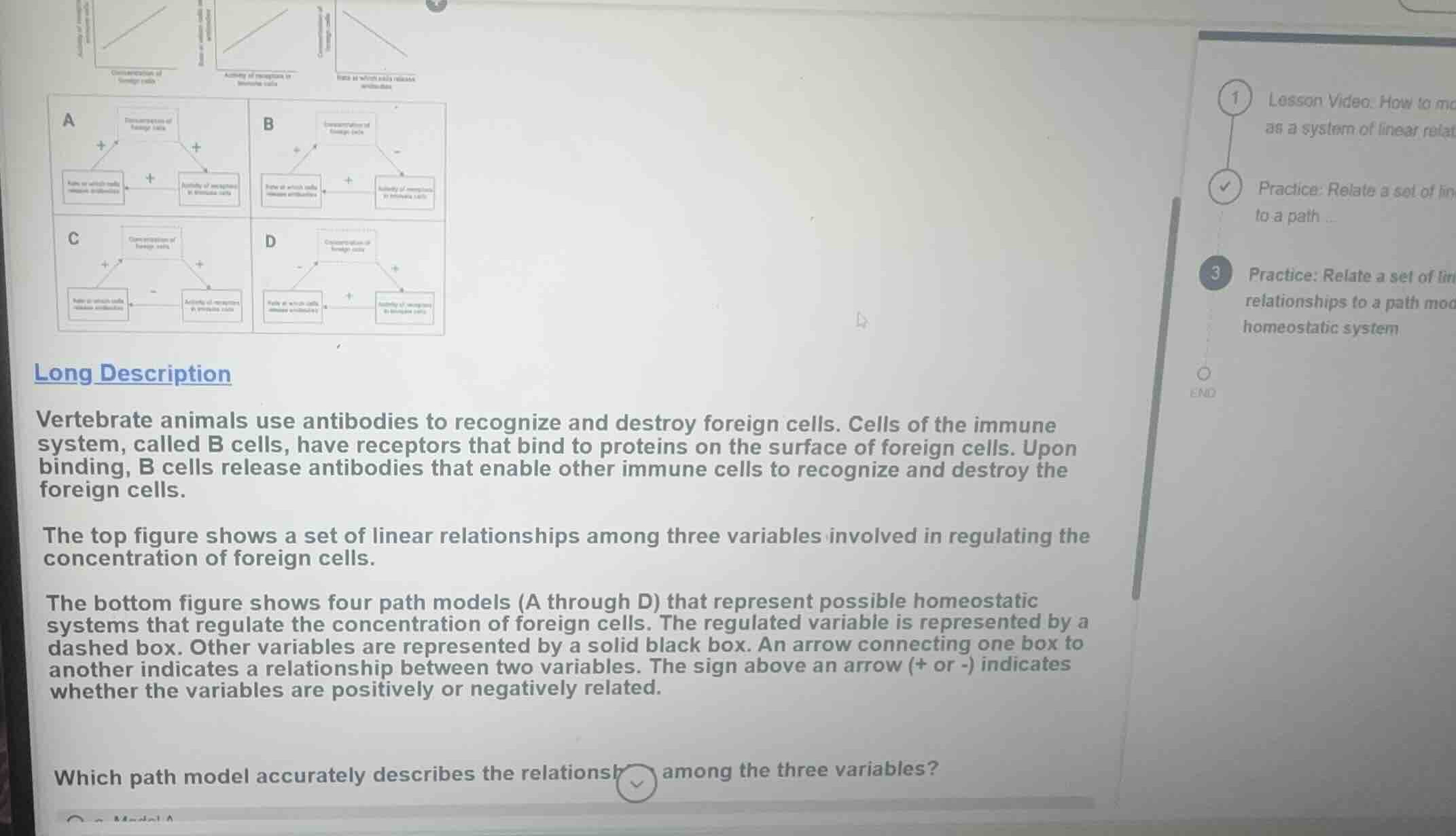
the top figure shows a set of linear relationships among three variables involved in regulating the concentration of foreign cells.
the bottom figure shows four path models (a through d) that represent possible homeostatic systems that regulate the concentration of foreign cells. the regulated variable is represented by a dashed box. other variables are represented by a solid black box. an arrow connecting one box to another indicates a relationship between two variables. the sign above an arrow (+ or -) indicates whether the variables are positively or negatively related.
which path model accurately describes the relationship among the three variables?
Analyze the biological relationships
We first identify the three variables involved in the system:
- Concentration of foreign cells (regulated variable, dashed box)
- Activity of receptors in immune cells
- Rate at which cells release antibodies
Based on the text description:
- "B cells have receptors that bind to proteins on the surface of foreign cells." This means as the Concentration of foreign cells increases, more binding occurs, which increases the Activity of receptors in immune cells. This is a positive relationship (\(+\)).
- "Upon binding, B cells release antibodies..." This means as the Activity of receptors in immune cells increases, the Rate at which cells release antibodies increases. This is a positive relationship (\(+\)).
- "...antibodies that enable other immune cells to recognize and destroy the foreign cells." This means as the Rate at which cells release antibodies increases, the destruction of foreign cells increases, which decreases the Concentration of foreign cells. This is a negative relationship (\(-\)).
We are applying the concepts of Homeostasis, Homeostatic Regulation, and Homeostatic Control Loop to trace this negative feedback loop.
Evaluate the path models
Now we translate these relationships into a causal path model using Path Models, Linear Relationships, and Causal Diagrams:
- Arrow from Concentration of foreign cells to Activity of receptors in immune cells: Positive (\(+\)).
- Arrow from Activity of receptors in immune cells to Rate at which cells release antibodies: Positive (\(+\)).
- Arrow from Rate at which cells release antibodies to Concentration of foreign cells: Negative (\(-\)).
Let's examine the four options (A, B, C, D) shown in the bottom figure:
- Model A:
- Arrow from "Concentration of foreign cells" to "Activity of receptors in immune cells" is labeled (\(+\)).
- Arrow from "Activity of receptors in immune cells" to "Rate at which cells release antibodies" is labeled (\(+\)).
- Arrow from "Rate at which cells release antibodies" to "Concentration of foreign cells" is labeled (\(+\)).
- This is incorrect because the third relationship must be negative.
- Model B:
- Arrow from "Concentration of foreign cells" to "Activity of receptors in immune cells" is labeled (\(+\)).
- Arrow from "Activity of receptors in immune cells" to "Rate at which cells release antibodies" is labeled (\(+\)).
- Arrow from "Rate at which cells release antibodies" to "Concentration of foreign cells" is labeled (\(-\\)).
- This matches our derived relationships perfectly.
- Model C:
- Arrow from "Concentration of foreign cells" to "Activity of receptors in immune cells" is labeled (\(+\)).
- Arrow from "Activity of receptors in immune cells" to "Rate at which cells release antibodies" is labeled (\(-\\)).
- Arrow from "Rate at which cells release antibodies" to "Concentration of…

Snap & solve any problem in the app
Get step-by-step solutions on Sovi AI
Photo-based solutions with guided steps
Explore more problems and detailed explanations
- (A) Model A
- (B) Model B (Correct answer)
- (C) Model C
- (D) Model D