QUESTION IMAGE
Question
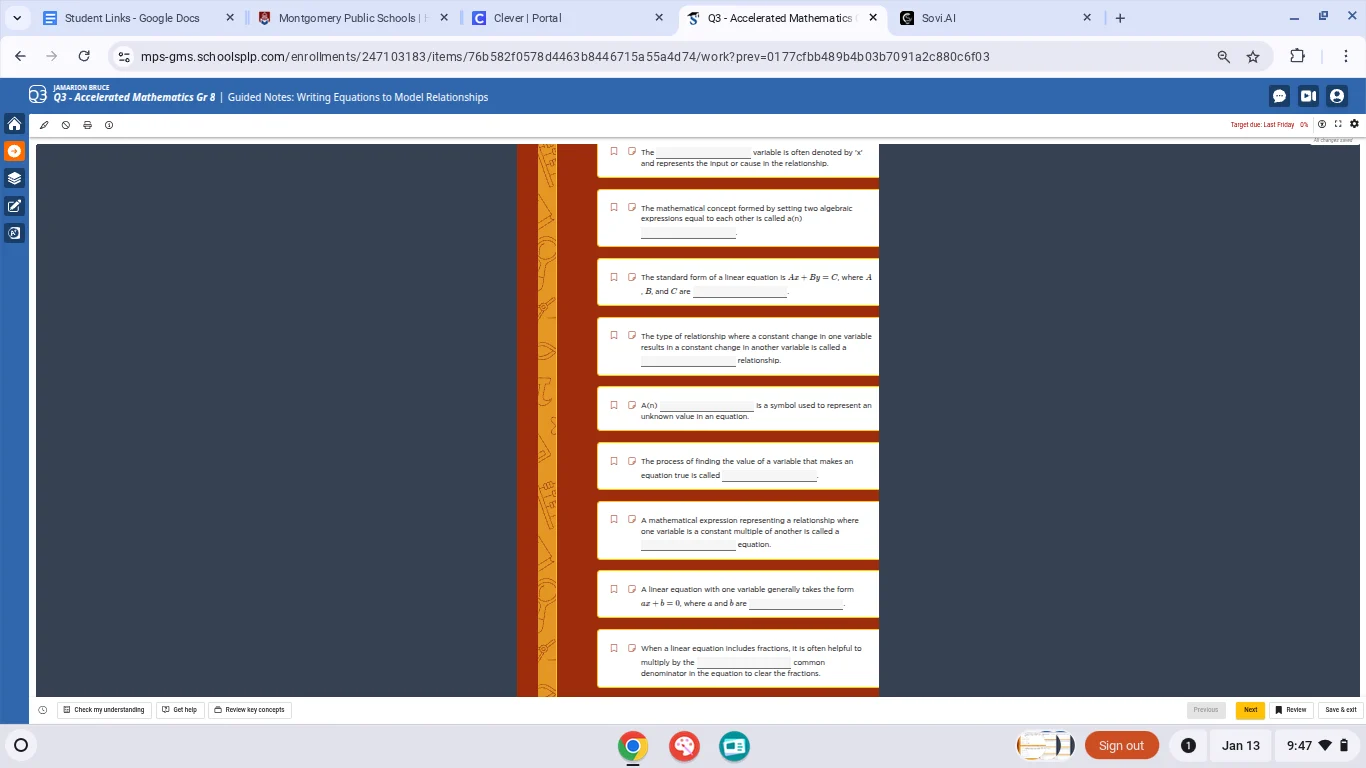
the ______ variable is often denoted by x and represents the input or cause in the relationship.
the mathematical concept formed by setting two algebraic expressions equal to each other is called a(n) ______.
the standard form of a linear equation is ( ax + by = c ), where ( a ), ( b ), and ( c ) are ______.
the type of relationship where a constant change in one variable results in a constant change in another variable is called a ______ relationship.
a(n) ______ is a symbol used to represent an unknown value in an equation.
the process of finding the value of a variable that makes an equation true is called ______.
a mathematical expression representing a relationship where one variable is a constant multiple of another is called a ______ equation.
a linear equation with one variable generally takes the form ( ax + b = 0 ), where ( a ) and ( b ) are ______.
when a linear equation includes fractions, it is often helpful to multiply by the ______ common denominator in the equation to clear the fractions.
To solve these fill - in - the - blank questions related to algebraic concepts, we analyze each one based on algebraic definitions:
1. The ______ variable is often denoted by \( x \) and represents the input or cause in the relationship.
In a functional or relational context, the independent variable is the one that we can manipulate or that acts as the input. It's often denoted by \( x \). So the answer is "independent".
2. The mathematical concept formed by setting two algebraic expressions equal to each other is called a(n) ______.
By definition, when we set two algebraic expressions equal, we form an equation. So the answer is "equation".
3. The standard form of a linear equation is \( Ax + By = C \), where \( A \), \( B \), and \( C \) are ______.
In the standard form of a linear equation \( Ax+By = C \), \( A \), \( B \), and \( C \) are constants (and \( A \) and \( B \) are not both zero). So the answer is "constants".
4. The type of relationship where a constant change in one variable results in a constant change in another variable is called a ______ relationship.
A linear relationship is characterized by a constant rate of change, meaning a constant change in one variable leads to a constant change in the other variable. So the answer is "linear".
5. A(n) ______ is a symbol used to represent an unknown value in an equation.
A variable (like \( x \), \( y \), etc.) is a symbol that stands for an unknown quantity in an equation. So the answer is "variable".
6. The process of finding the value of a variable that makes an equation true is called ______.
When we find the value of the variable that satisfies the equation (makes it true), this process is known as solving the equation or "solving" (more specifically, "finding the solution" or "solving for the variable", but the key term here is "solving" or more precisely "finding the solution" - in the context of the process, "solving" or "solution - finding", but the standard term is "solving" or "finding the solution of the equation". However, the most appropriate term here is "solving" or more accurately "finding the solution" - but the term for the process is "solving" the equation. So the answer is "solving the equation" (or more concisely "solving").
7. A mathematical expression representing a relationship where one variable is a constant multiple of another is called a ______ equation.
If one variable \( y \) is a constant multiple of another variable \( x \), we can write \( y=kx \) (where \( k \) is a constant), which is a proportional (or direct - variation) equation. So the answer is "proportional" (or "direct - variation").
8. A linear equation with one variable generally takes the form \( ax + b = 0 \), where \( a \) and \( b \) are ______.
In the linear equation \( ax + b=0 \) with one variable, \( a \) and \( b \) are constants (and \( a
eq0 \) for a non - trivial linear equation). So the answer is "constants".
9. When a linear equation includes fractions, it is often helpful to multiply by the ______ common denominator in the equation to clear the fractions.
To clear the fractions in a linear equation with fractional coefficients, we multiply each term by the least common denominator (LCD) of the fractions. So the answer is "least".
Final Answers:
- independent
- equation
- constants
- linear
- variable
- solving (or finding the solution of the equation)
- proportional (or direct - variation)
- constants
- least

Snap & solve any problem in the app
Get step-by-step solutions on Sovi AI
Photo-based solutions with guided steps
Explore more problems and detailed explanations
To solve these fill - in - the - blank questions related to algebraic concepts, we analyze each one based on algebraic definitions:
1. The ______ variable is often denoted by \( x \) and represents the input or cause in the relationship.
In a functional or relational context, the independent variable is the one that we can manipulate or that acts as the input. It's often denoted by \( x \). So the answer is "independent".
2. The mathematical concept formed by setting two algebraic expressions equal to each other is called a(n) ______.
By definition, when we set two algebraic expressions equal, we form an equation. So the answer is "equation".
3. The standard form of a linear equation is \( Ax + By = C \), where \( A \), \( B \), and \( C \) are ______.
In the standard form of a linear equation \( Ax+By = C \), \( A \), \( B \), and \( C \) are constants (and \( A \) and \( B \) are not both zero). So the answer is "constants".
4. The type of relationship where a constant change in one variable results in a constant change in another variable is called a ______ relationship.
A linear relationship is characterized by a constant rate of change, meaning a constant change in one variable leads to a constant change in the other variable. So the answer is "linear".
5. A(n) ______ is a symbol used to represent an unknown value in an equation.
A variable (like \( x \), \( y \), etc.) is a symbol that stands for an unknown quantity in an equation. So the answer is "variable".
6. The process of finding the value of a variable that makes an equation true is called ______.
When we find the value of the variable that satisfies the equation (makes it true), this process is known as solving the equation or "solving" (more specifically, "finding the solution" or "solving for the variable", but the key term here is "solving" or more precisely "finding the solution" - in the context of the process, "solving" or "solution - finding", but the standard term is "solving" or "finding the solution of the equation". However, the most appropriate term here is "solving" or more accurately "finding the solution" - but the term for the process is "solving" the equation. So the answer is "solving the equation" (or more concisely "solving").
7. A mathematical expression representing a relationship where one variable is a constant multiple of another is called a ______ equation.
If one variable \( y \) is a constant multiple of another variable \( x \), we can write \( y=kx \) (where \( k \) is a constant), which is a proportional (or direct - variation) equation. So the answer is "proportional" (or "direct - variation").
8. A linear equation with one variable generally takes the form \( ax + b = 0 \), where \( a \) and \( b \) are ______.
In the linear equation \( ax + b=0 \) with one variable, \( a \) and \( b \) are constants (and \( a
eq0 \) for a non - trivial linear equation). So the answer is "constants".
9. When a linear equation includes fractions, it is often helpful to multiply by the ______ common denominator in the equation to clear the fractions.
To clear the fractions in a linear equation with fractional coefficients, we multiply each term by the least common denominator (LCD) of the fractions. So the answer is "least".
Final Answers:
- independent
- equation
- constants
- linear
- variable
- solving (or finding the solution of the equation)
- proportional (or direct - variation)
- constants
- least