QUESTION IMAGE
Question
value: 20
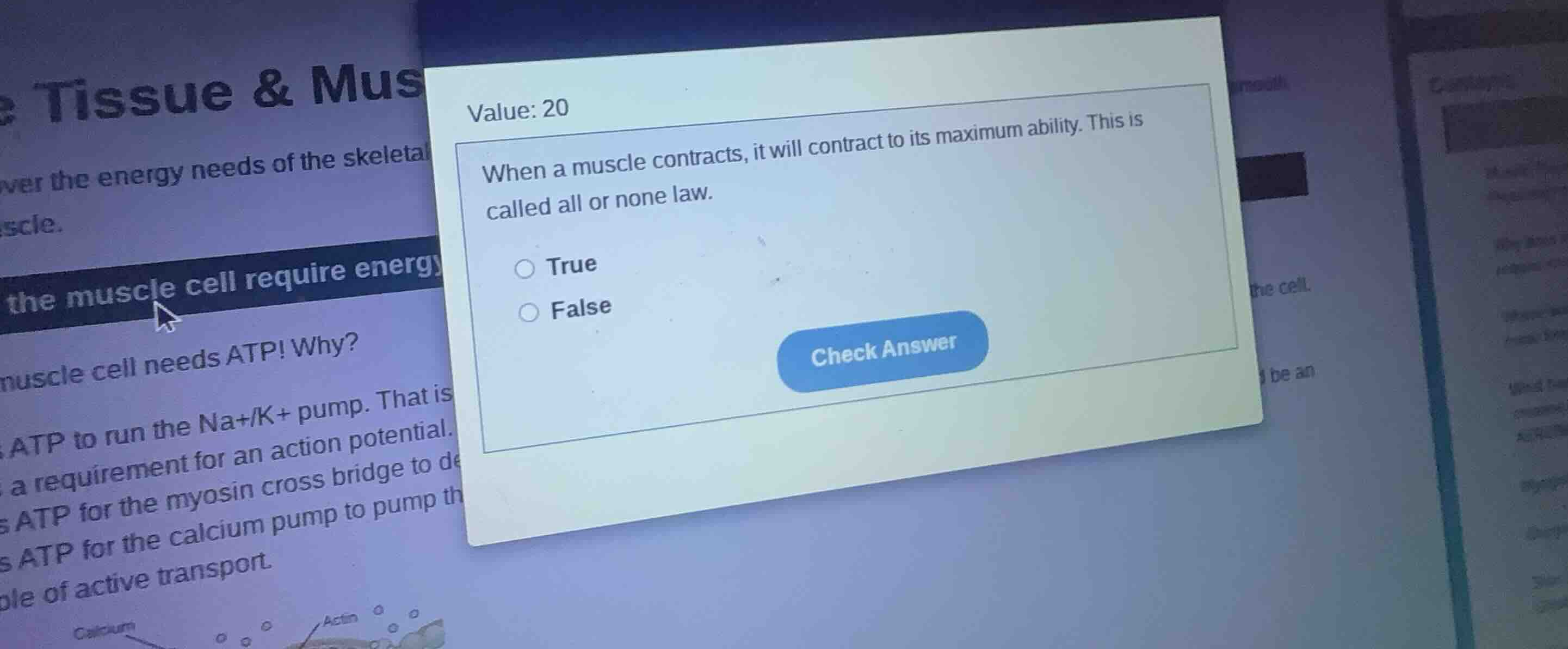
when a muscle contracts, it will contract to its maximum ability. this is called all or none law.
true
false
Define the all-or-none law
The all-or-none law states that if a stimulus is strong enough to trigger an action potential in an individual muscle fiber (or neuron), the fiber will contract completely to its maximum ability. If the stimulus is below the threshold, no contraction occurs.
Distinguish fiber vs. whole muscle
While individual muscle fibers contract completely (all-or-none), a whole skeletal muscle does not follow this law. A whole muscle can produce graded contractions of varying strengths by recruiting different numbers of motor units.
Evaluate the statement
The statement in the question says: "When a muscle contracts, it will contract to its maximum ability. This is called all or none law." In physiological terms, this law applies specifically to individual muscle cells (fibers) or motor units, rather than the entire muscle organ. However, in introductory biology and anatomy contexts, the statement is commonly presented as "True" to describe the fundamental behavior of the contracting cellular units under this law.

Snap & solve any problem in the app
Get step-by-step solutions on Sovi AI
Photo-based solutions with guided steps
Explore more problems and detailed explanations
- True (Correct answer)
- False