QUESTION IMAGE
Question
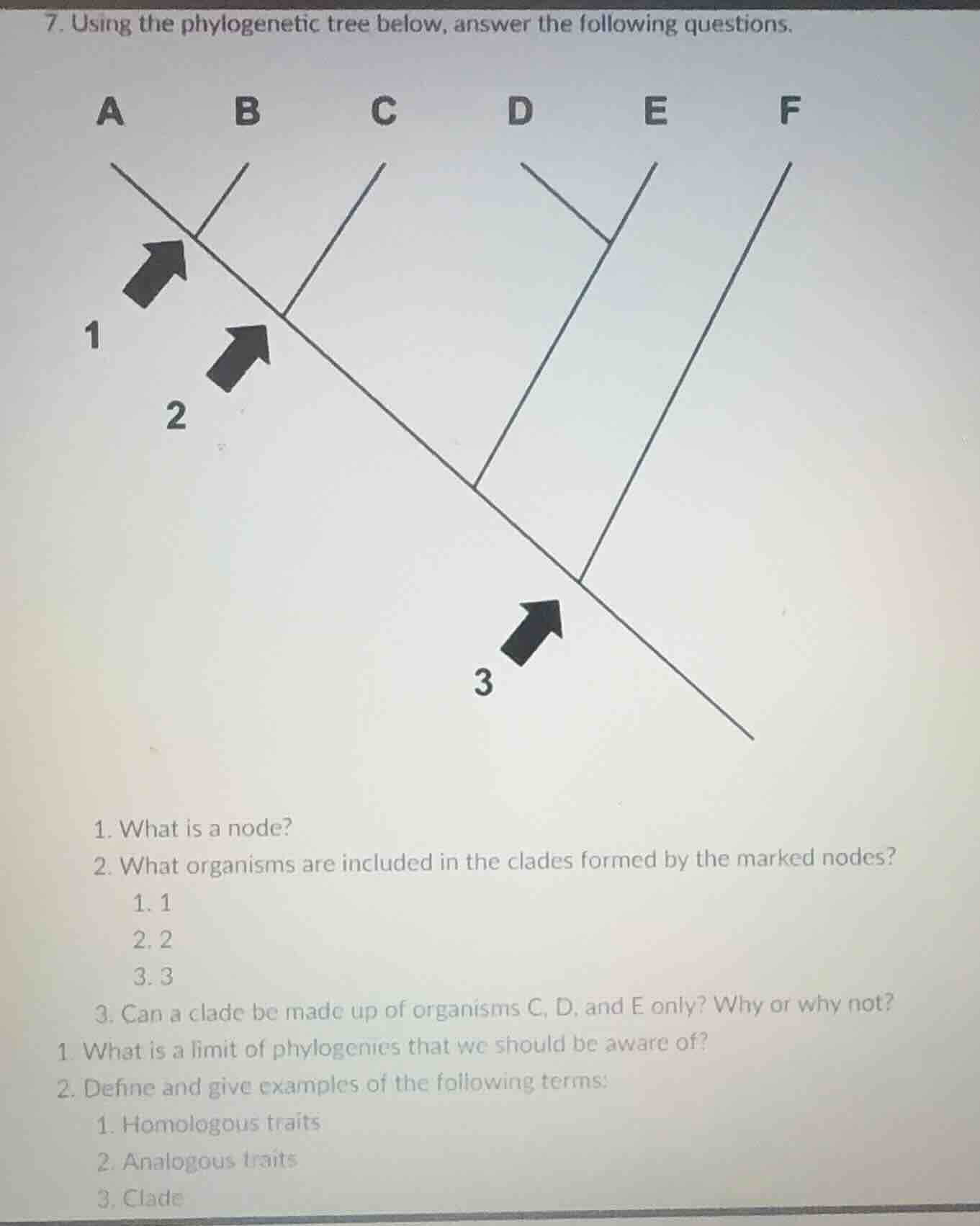
- using the phylogenetic tree below, answer the following questions.
- what is a node?
- what organisms are included in the clades formed by the marked nodes?
- 1
- 2
- 3
- can a clade be made up of organisms c, d, and e only? why or why not?
- what is a limit of phylogenies that we should be aware of?
- define and give examples of the following terms:
- homologous traits
- analogous traits
- clade
Define a node in phylogenetics
A node represents a branching point on a phylogenetic tree where an ancestral lineage splits into two or more descendant lineages. It signifies the most recent common ancestor (MRCA) of those descendant groups.
Identify organisms in marked clades
A clade is a monophyletic group consisting of an ancestral node and all of its descendants.
- Node 1: The arrow points to the node where the lineages leading to A and B split. The descendants are organisms A and B.
- Node 2: The arrow points to the node ancestral to A, B, and C. The descendants are organisms A, B, and C.
- Node 3: The arrow points to the node near the base of the tree. Following all branches arising from this node leads to organisms A, B, C, D, E, and F.
Evaluate clade composition for C, D, and E
A valid clade must include a common ancestor and all of its descendants. The most recent common ancestor of C, D, and E is also the ancestor of A and B. Therefore, any clade containing C, D, and E must also include A and B. Excluding A and B makes the group paraphyletic, which is not a valid clade.
Identify a limitation of phylogenies
Phylogenetic trees show patterns of descent, not phenotypic similarity. They do not indicate the absolute ages of species or when specific character traits evolved unless calibrated with fossil data. Additionally, closely related organisms do not always look alike due to different evolutionary pressures.
Define homologous and analogous traits
- Homologous traits: Features shared by species because they were inherited from a common ancestor (e.g., the forelimbs of humans and bats).
- Analogous traits: Features that are similar due to convergent evolution under similar environmental pressures, not common ancestry (e.g., the wings of birds and butterflies).
- Clade: A monophyletic group consisting of a single common ancestor and all of its descendants.

Snap & solve any problem in the app
Get step-by-step solutions on Sovi AI
Photo-based solutions with guided steps
Explore more problems and detailed explanations
Question 1
A node represents a branching point on a phylogenetic tree where an ancestral lineage splits into two or more descendant lineages, representing their most recent common ancestor.
Question 2
- Node 1: Organisms A and B.
- Node 2: Organisms A, B, and C.
- Node 3: Organisms A, B, C, D, E, and F.
Question 3
No, a clade cannot be made up of organisms C, D, and E only. The most recent common ancestor of C, D, and E is also the ancestor of A and B. A valid clade must include the common ancestor and all of its descendants; excluding A and B makes the group paraphyletic.
Question 4
A key limitation of phylogenies is that they show patterns of descent and evolutionary relationships, not phenotypic similarity or the absolute timing of evolutionary events (unless calibrated with fossil data).
Question 5
- Homologous traits: Structures shared by different species because they were inherited from a common ancestor. Example: The bone structure in the forelimbs of humans, cats, and whales.
- Analogous traits: Structures that are similar in function or appearance due to convergent evolution rather than shared ancestry. Example: The wings of insects and the wings of birds.
- Clade: A monophyletic group that includes a single ancestral species and all of its evolutionary descendants.