QUESTION IMAGE
Question
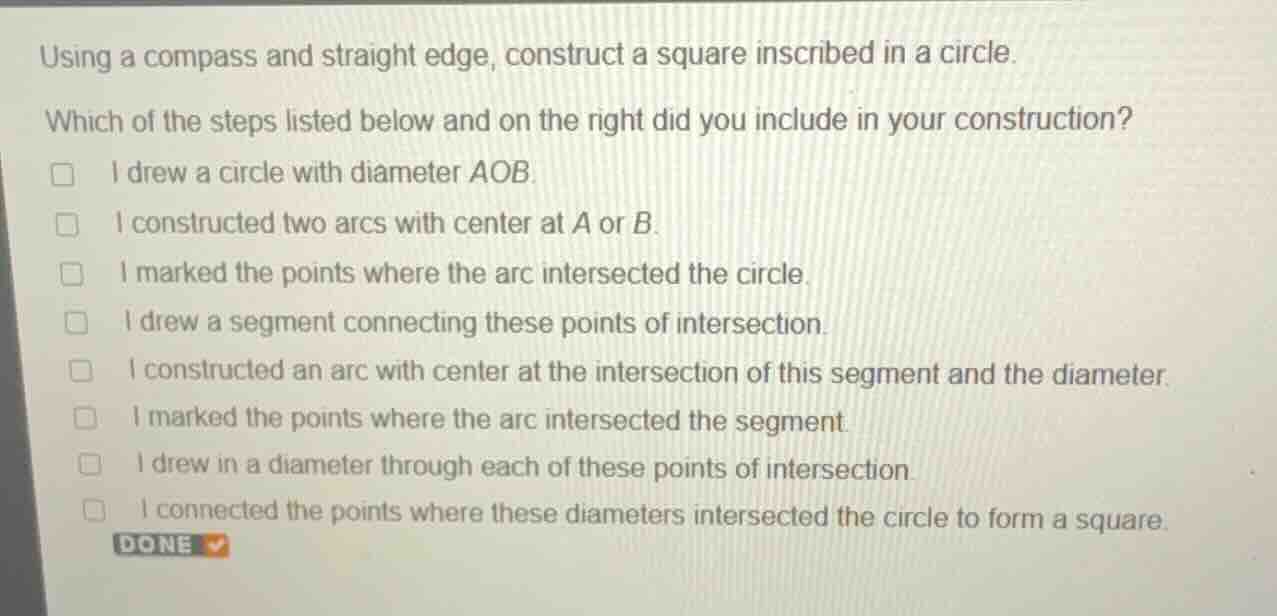
using a compass and straight edge, construct a square inscribed in a circle.
which of the steps listed below and on the right did you include in your construction?
- i drew a circle with diameter \\(aob\\).
- i constructed two arcs with center at \\(a\\) or \\(b\\).
- i marked the points where the arc intersected the circle.
- i drew a segment connecting these points of intersection.
- i constructed an arc with center at the intersection of this segment and the diameter.
- i marked the points where the arc intersected the segment.
- i drew in a diameter through each of these points of intersection.
- i connected the points where these diameters intersected the circle to form a square.
Analyze the standard construction of an inscribed square
- Draw a circle with center \(O\) and a diameter \(AOB\).
- Construct the perpendicular bisector of diameter \(AOB\) by drawing arcs centered at \(A\) and \(B\) with a radius greater than the circle's radius.
- Mark the intersection points of these arcs and draw a line (segment) through them, which is the perpendicular bisector.
- Mark the points where this perpendicular bisector intersects the circle (let's call them \(C\) and \(D\)).
- Connect the four points on the circle (\(A\), \(C\), \(B\), and \(D\)) sequentially to form the inscribed square.
Evaluate the given checklist options against the standard construction
- "I drew a circle with diameter AOB." -> Yes, this is the starting step.
- "I constructed two arcs with center at A or B." -> Yes, these are used to construct the perpendicular bisector of \(AOB\).
- "I marked the points where the arc intersected the circle." -> No, the arcs for the perpendicular bisector intersect each other outside the circle, not the circle itself.
- "I drew a segment connecting these points of intersection." -> Yes, connecting the arc intersections creates the perpendicular bisector.
- "I constructed an arc with center at the intersection of this segment and the diameter." -> No, the intersection is the center \(O\), and we do not need to draw another arc from \(O\).
- "I marked the points where the arc intersected the segment." -> No, this is not part of the standard square construction.
- "I drew in a diameter through each of these points of intersection." -> No, we only need the perpendicular bisector, which is already a diameter.
- "I connected the points where these diameters intersected the circle to form a square." -> Yes, connecting the four intersection points on the circle forms the square.
Select the correct steps
The correct steps included in the construction are:
- I drew a circle with diameter \(AOB\).
- I constructed two arcs with center at \(A\) or \(B\).
- I drew a segment connecting these points of intersection.
- I connected the points where these diameters intersected the circle to form a square.

Snap & solve any problem in the app
Get step-by-step solutions on Sovi AI
Photo-based solutions with guided steps
Explore more problems and detailed explanations
- I drew a circle with diameter AOB. (Correct answer)
- I constructed two arcs with center at A or B. (Correct answer)
- I marked the points where the arc intersected the circle.
- I drew a segment connecting these points of intersection. (Correct answer)
- I constructed an arc with center at the intersection of this segment and the diameter.
- I marked the points where the arc intersected the segment.
- I drew in a diameter through each of these points of intersection.
- I connected the points where these diameters intersected the circle to form a square. (Correct answer)