QUESTION IMAGE
Question
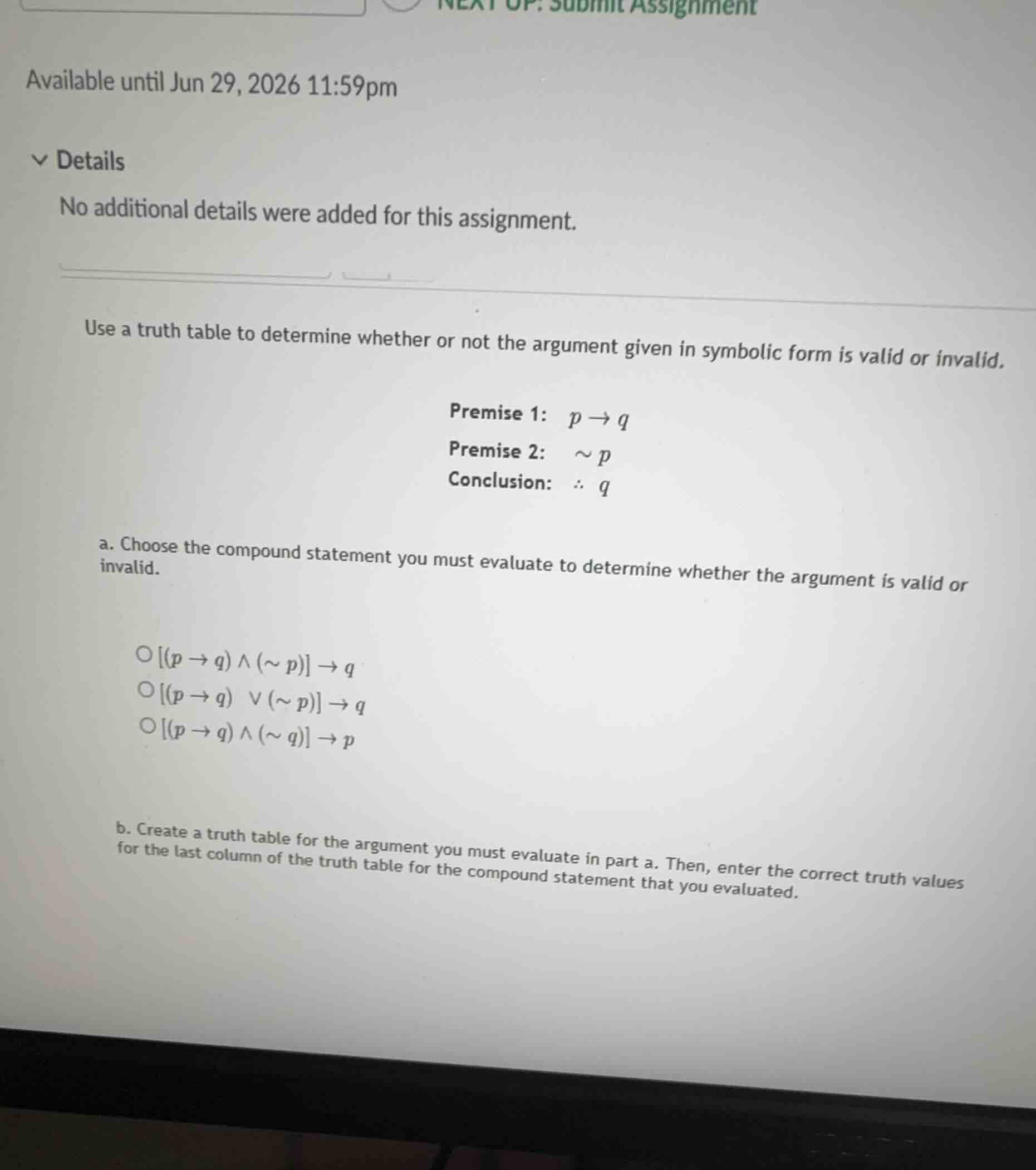
use a truth table to determine whether or not the argument given in symbolic form is valid or invalid.
premise 1: \\(p \
ightarrow q\\)
premise 2: \\(\sim p\\)
conclusion: \\(\therefore q\\)
a. choose the compound statement you must evaluate to determine whether the argument is valid or invalid.
\\(\bigcirc (p \
ightarrow q) \wedge (\sim p) \
ightarrow q\\)
\\(\bigcirc (p \
ightarrow q) \vee (\sim p) \
ightarrow q\\)
\\(\bigcirc (p \
ightarrow q) \wedge (\sim q) \
ightarrow p\\)
b. create a truth table for the argument you must evaluate in part a. then, enter the correct truth values for the last column of the truth table for the compound statement that you evaluated.
<pre_analysis>
{
"quality": "clear",
"question_count": 2,
"skills_matched": [
"step_cot",
"explain_then_answer",
"quick"
],
"needs_drawing": false,
"concepts_used": [],
"new_concepts": [
"Symbolic Arguments",
"Argument Validity",
"Truth Table Construction"
],
"current_concepts": [
"Symbolic Arguments",
"Argument Validity",
"Truth Table Construction"
]
}
</pre_analysis>
<reasoning>
Formulate the conditional statement representing the argument
\[
\]
Construct the truth table to find the final column values
\[
\]
Determine the truth values for the final column
\[
\]
</reasoning>
<answer>
Question a
<mcq-correct>\([(p
ightarrow q) \wedge (\sim p)]
ightarrow q\)</mcq-correct>
<mcq-option>\([(p
ightarrow q) \vee (\sim p)]
ightarrow q\)</mcq-option>
<mcq-option>\([(p
ightarrow q) \wedge (\sim q)]
ightarrow p\)</mcq-option>
Question b
The truth values for the last column of the truth table from top to bottom are:
T, T, T, F
</answer>
<post_analysis>
{
"subject": "Mathematics",
"question_type": "Multi-part",
"knowledge_point": [
"Mathematics",
"Algebra",
"Symbolic Arguments"
]
}
</post_analysis>
Snap & solve any problem in the app
Get step-by-step solutions on Sovi AI
Photo-based solutions with guided steps
Explore more problems and detailed explanations
<pre_analysis>
{
"quality": "clear",
"question_count": 2,
"skills_matched": [
"step_cot",
"explain_then_answer",
"quick"
],
"needs_drawing": false,
"concepts_used": [],
"new_concepts": [
"Symbolic Arguments",
"Argument Validity",
"Truth Table Construction"
],
"current_concepts": [
"Symbolic Arguments",
"Argument Validity",
"Truth Table Construction"
]
}
</pre_analysis>
<reasoning>
Formulate the conditional statement representing the argument
\[
\]
Construct the truth table to find the final column values
\[
\]
Determine the truth values for the final column
\[
\]
</reasoning>
<answer>
Question a
<mcq-correct>\([(p
ightarrow q) \wedge (\sim p)]
ightarrow q\)</mcq-correct>
<mcq-option>\([(p
ightarrow q) \vee (\sim p)]
ightarrow q\)</mcq-option>
<mcq-option>\([(p
ightarrow q) \wedge (\sim q)]
ightarrow p\)</mcq-option>
Question b
The truth values for the last column of the truth table from top to bottom are:
T, T, T, F
</answer>
<post_analysis>
{
"subject": "Mathematics",
"question_type": "Multi-part",
"knowledge_point": [
"Mathematics",
"Algebra",
"Symbolic Arguments"
]
}
</post_analysis>