QUESTION IMAGE
Question
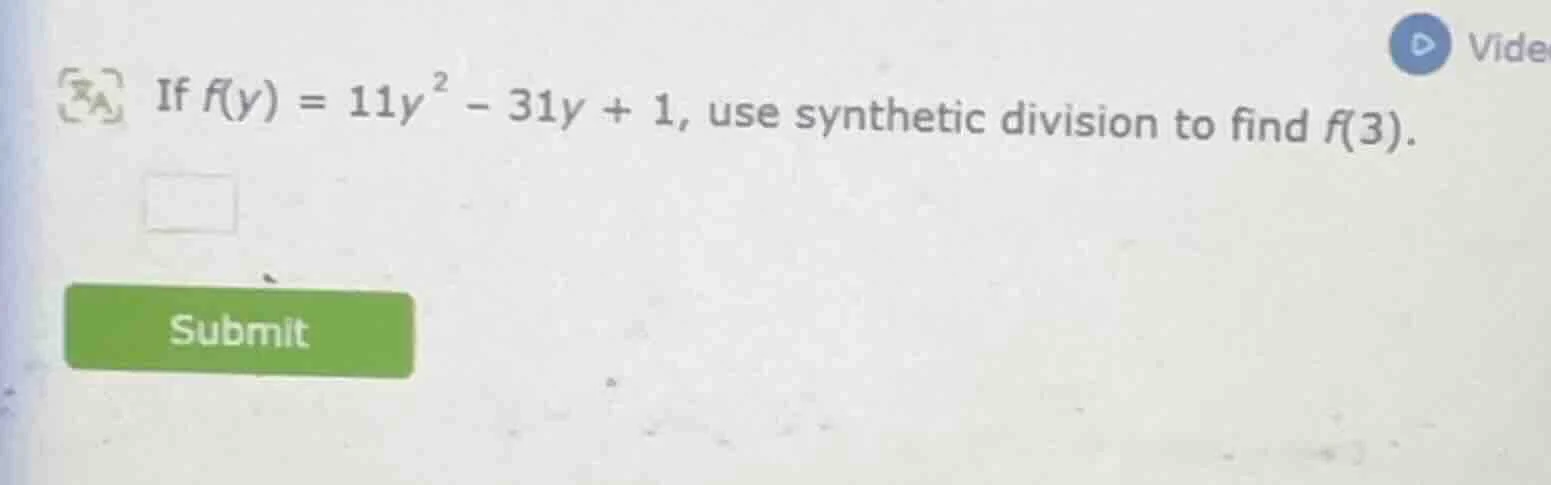
if $f(y) = 11y^2 - 31y + 1$, use synthetic division to find $f(3)$.
Step1: Set up synthetic division
We are dividing \(11y^{2}-31y + 1\) by \(y - 3\) (since we want to find \(f(3)\), we use \(c = 3\) for synthetic division). The coefficients of the polynomial are \(11\), \(-31\), and \(1\).
We write the coefficients and the value \(3\) as follows:
\[
\]
Step2: Bring down the leading coefficient
Bring down the \(11\) to the bottom row:
\[
\]
Step3: Multiply and add
Multiply the number we just brought down (\(11\)) by \(3\): \(11\times3 = 33\). Add this to the next coefficient (\(-31\)): \(-31+33 = 2\). Write this result in the bottom row:
\[
\]
Step4: Multiply and add again
Multiply the new number in the bottom row (\(2\)) by \(3\): \(2\times3=6\). Add this to the last coefficient (\(1\)): \(1 + 6=7\). Write this result in the bottom row:
\[
\]
The last number in the bottom row is the value of \(f(3)\) when we use synthetic division (by the Remainder Theorem, the remainder when dividing by \(y - c\) is \(f(c)\)).

Snap & solve any problem in the app
Get step-by-step solutions on Sovi AI
Photo-based solutions with guided steps
Explore more problems and detailed explanations
\(7\)