Sovi.AI - AI Math Tutor

Scan to solve math questions

QUESTION IMAGE

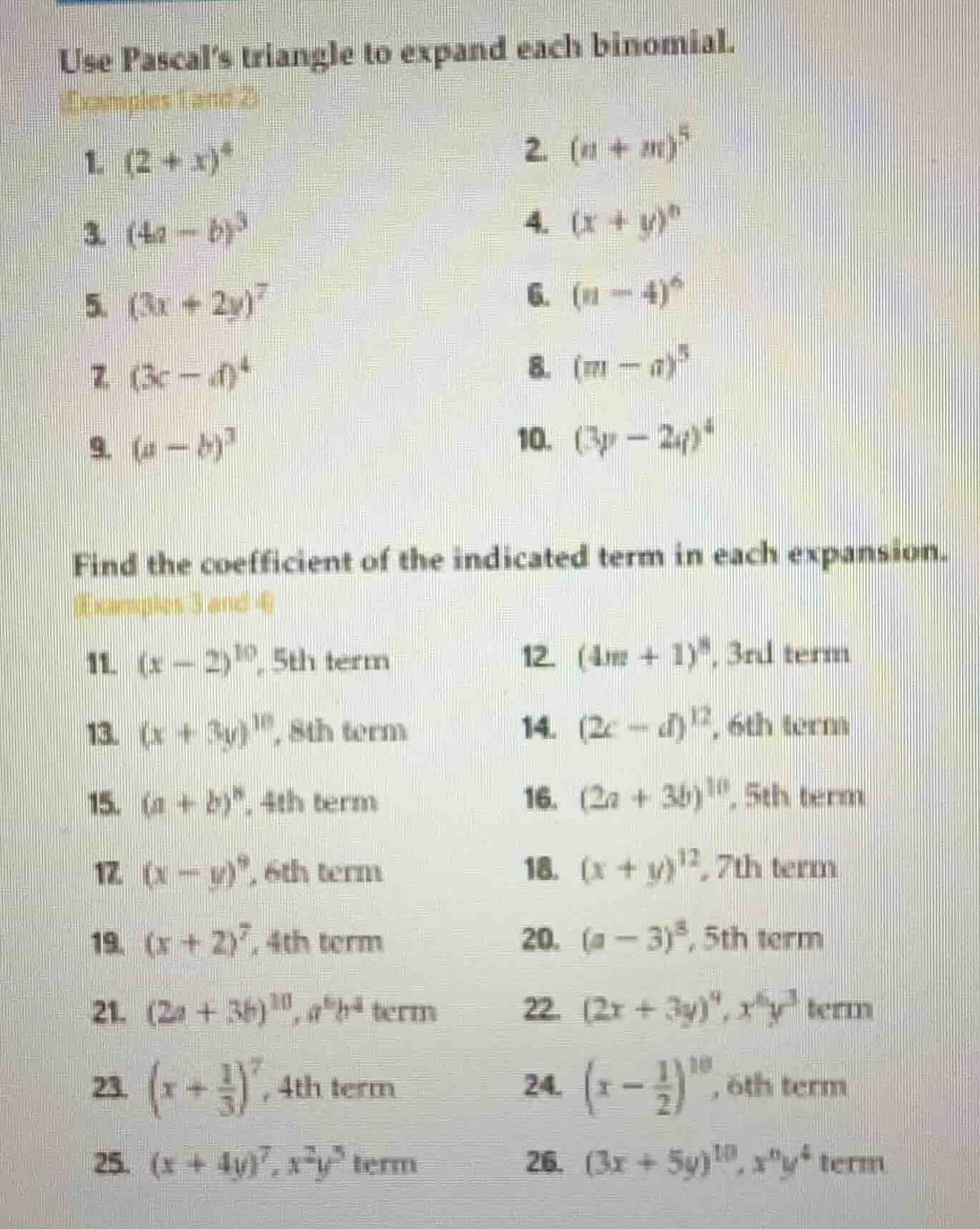
use pascals triangle to expand each binomial. 1. \\((2 + x)^4\\) 2. \\(…

Question

use pascals triangle to expand each binomial.

  1. \\((2 + x)^4\\)
  2. \\((n + m)^5\\)
  3. \\((4a - b)^3\\)
  4. \\((x + y)^6\\)
  5. \\((3x + 2y)^7\\)
  6. \\((a - 4)^6\\)
  7. \\((3c - d)^4\\)
  8. \\((m - n)^5\\)
  9. \\((a - b)^3\\)
  10. \\((3p - 2q)^4\\)

find the coefficient of the indicated term in each expansion.

  1. \\((x - 2)^{10}\\), 5th term
  2. \\((4m + 1)^8\\), 3rd term
  3. \\((x + 3y)^{10}\\), 8th term
  4. \\((2c - d)^{12}\\), 6th term
  5. \\((a + b)^8\\), 4th term
  6. \\((2a + 3b)^{10}\\), 5th term
  7. \\((x - y)^9\\), 6th term
  8. \\((x + y)^{12}\\), 7th term
  9. \\((x + 2)^7\\), 4th term
  10. \\((a - 3)^8\\), 5th term
  11. \\((2a + 3b)^{10}\\), \\(a^6 b^4\\) term
  12. \\((2x + 3y)^9\\), \\(x^6 y^3\\) term
  13. \\(\left(x + \frac{1}{3}\

ight)^7\\), 4th term

  1. \\(\left(x - \frac{1}{2}\

ight)^{10}\\), 6th term

  1. \\((x + 4y)^7\\), \\(x^2 y^5\\) term
  2. \\((3x + 5y)^{10}\\), \\(x^6 y^4\\) term

Explanation:

Response

<pre_analysis>
{
"quality": "clear",
"question_count": 26,
"skills_matched": [
"step_cot",
"table_formatter",
"explain_then_answer",
"quick"
],
"needs_drawing": false,
"concepts_used": [],
"new_concepts": [
"Binomial Theorem",
"Pascal's Triangle",
"Binomial Expansion"
],
"current_concepts": [
"Binomial Theorem",
"Pascal's Triangle",
"Binomial Expansion"
]
}
</pre_analysis>

<reasoning>

Expand binomials using Pascal's triangle (Questions 1-10)

\[

$$\begin{aligned} \text{Row 3: } & 1, 3, 3, 1 \\ \text{Row 4: } & 1, 4, 6, 4, 1 \\ \text{Row 5: } & 1, 5, 10, 10, 5, 1 \\ \text{Row 6: } & 1, 6, 15, 20, 15, 6, 1 \\ \text{Row 7: } & 1, 7, 21, 35, 35, 21, 7, 1 \\ \text{Row 8: } & 1, 8, 28, 56, 70, 56, 28, 8, 1 \\ 1. \quad (2+x)^4 &= 1(2)^4 + 4(2)^3(x) + 6(2)^2(x)^2 + 4(2)(x)^3 + 1(x)^4 = 16 + 32x + 24x^2 + 8x^3 + x^4 \\ 2. \quad (n+m)^5 &= n^5 + 5n^4m + 10n^3m^2 + 10n^2m^3 + 5nm^4 + m^5 \\ 3. \quad (4a-b)^3 &= 1(4a)^3 - 3(4a)^2(b) + 3(4a)(b)^2 - 1(b)^3 = 64a^3 - 48a^2b + 12ab^2 - b^3 \\ 4. \quad (x+y)^6 &= x^6 + 6x^5y + 15x^4y^2 + 20x^3y^3 + 15x^2y^4 + 6xy^5 + y^6 \\ 5. \quad (3x+2y)^7 &= 1(3x)^7 + 7(3x)^6(2y) + 21(3x)^5(2y)^2 + 35(3x)^4(2y)^3 + 35(3x)^3(2y)^4 + 21(3x)^2(2y)^5 + 7(3x)(2y)^6 + 1(2y)^7 \\ &= 2187x^7 + 10206x^6y + 20412x^5y^2 + 22680x^4y^3 + 15120x^3y^4 + 6048x^2y^5 + 1344xy^6 + 128y^7 \\ 6. \quad (n-4)^6 &= n^6 - 6n^5(4) + 15n^4(16) - 20n^3(64) + 15n^2(256) - 6n(1024) + 4096 \\ &= n^6 - 24n^5 + 240n^4 - 1280n^3 + 3840n^2 - 6144n + 4096 \\ 7. \quad (3c-d)^4 &= 1(3c)^4 - 4(3c)^3(d) + 6(3c)^2(d)^2 - 4(3c)(d)^3 + 1(d)^4 = 81c^4 - 108c^3d + 54c^2d^2 - 12cd^3 + d^4 \\ 8. \quad (m-n)^5 &= m^5 - 5m^4n + 10m^3n^2 - 10m^2n^3 + 5mn^4 - n^5 \\ 9. \quad (a-b)^3 &= a^3 - 3a^2b + 3ab^2 - b^3 \\ 10. \quad (3p-2q)^4 &= 1(3p)^4 - 4(3p)^3(2q) + 6(3p)^2(2q)^2 - 4(3p)(2q)^3 + 1(2q)^4 = 81p^4 - 216p^3q + 216p^2q^2 - 96pq^3 + 16q^4 \end{aligned}$$

\]

Find the coefficient of the indicated term (Questions 11-20)

\[
\begin{aligned}
\text{General term of } (A+B)^n \text{ is } & T_{k+1} = \binom{n}{k} A^{n-k} B^k \\

  1. \quad (x-2)^{10}, \text{ 5th term } (k=4) &\implies T_5 = \binom{10}{4} x^6 (-2)^4 = 210 \cdot 16 \cdot x^6 = 3360x^6 \implies \text{Coefficient} = 3360 \\
  2. \quad (4m+1)^8, \text{ 3rd term } (k=2) &\implies T_3 = \binom{8}{2} (4m)^6 (1)^2 = 28 \cdot 4096 \cdot m^6 = 114688m^6 \implies \text{Coefficient} = 114688 \\
  3. \quad (x+3y)^{10}, \text{ 8th term } (k=7) &\implies T_8 = \binom{10}{7} x^3 (3y)^7 = 120 \cdot 2187 \cdot x^3 y^7 = 262440x^3y^7 \implies \text{Coefficient} = 262440 \\
  4. \quad (2c-d)^{12}, \text{ 6th term } (k=5) &\implies T_6 = \binom{12}{5} (2c)^7 (-d)^5 = 792 \cdot 128 \cdot (-1) \cdot c^7 d^5 = -101376c^7d^5 \implies \text{Coefficient} = -101376 \\
  5. \quad (a+b)^8, \text{ 4th term } (k=3) &\implies T_4 = \binom{8}{3} a^5 b^3 = 56a^5b^3 \implies \text{Coefficient} = 56 \\
  6. \quad (2a+3b)^{10}, \text{ 5th term } (k=4) &\implies T_5 = \binom{10}{4} (2a)^6 (3b)^4 = 210 \cdot 64 \cdot 81 \cdot a^6 b^4 = 1088640a^6b^4 \implies \text{Coefficient} = 1088640 \\
  7. \quad (x-y)^9, \text{ 6th term } (k=5) &\implies T_6 = \binom{9}{5} x^4 (-y)^5 = 126 \cdot (-1) \cdot x^4 y^5 = -126x^4y^5 \implies \text{Coefficient} = -126 \\
  8. \quad (x+y)^{12}, \text{ 7th term } (k=6) &\implies T_7 = \binom{12}{6} x^6 y^6 = 924x^6y^6 \implies \text{Coefficient} = 924 \\
  9. \quad (x+2)^7, \text{ 4th term } (k=3) &\implies T_4 = \binom{7}{3} x^4 (2)^3 = 35 \cdot 8 \cdot x^4 = 280x^4 \implies \text{Coefficient} = 280 \\
  10. \quad (a-3)^8, \text{ 5th term } (k=4) &\implies T_5…

Answer:

<pre_analysis>
{
"quality": "clear",
"question_count": 26,
"skills_matched": [
"step_cot",
"table_formatter",
"explain_then_answer",
"quick"
],
"needs_drawing": false,
"concepts_used": [],
"new_concepts": [
"Binomial Theorem",
"Pascal's Triangle",
"Binomial Expansion"
],
"current_concepts": [
"Binomial Theorem",
"Pascal's Triangle",
"Binomial Expansion"
]
}
</pre_analysis>

<reasoning>

Expand binomials using Pascal's triangle (Questions 1-10)

\[

$$\begin{aligned} \text{Row 3: } & 1, 3, 3, 1 \\ \text{Row 4: } & 1, 4, 6, 4, 1 \\ \text{Row 5: } & 1, 5, 10, 10, 5, 1 \\ \text{Row 6: } & 1, 6, 15, 20, 15, 6, 1 \\ \text{Row 7: } & 1, 7, 21, 35, 35, 21, 7, 1 \\ \text{Row 8: } & 1, 8, 28, 56, 70, 56, 28, 8, 1 \\ 1. \quad (2+x)^4 &= 1(2)^4 + 4(2)^3(x) + 6(2)^2(x)^2 + 4(2)(x)^3 + 1(x)^4 = 16 + 32x + 24x^2 + 8x^3 + x^4 \\ 2. \quad (n+m)^5 &= n^5 + 5n^4m + 10n^3m^2 + 10n^2m^3 + 5nm^4 + m^5 \\ 3. \quad (4a-b)^3 &= 1(4a)^3 - 3(4a)^2(b) + 3(4a)(b)^2 - 1(b)^3 = 64a^3 - 48a^2b + 12ab^2 - b^3 \\ 4. \quad (x+y)^6 &= x^6 + 6x^5y + 15x^4y^2 + 20x^3y^3 + 15x^2y^4 + 6xy^5 + y^6 \\ 5. \quad (3x+2y)^7 &= 1(3x)^7 + 7(3x)^6(2y) + 21(3x)^5(2y)^2 + 35(3x)^4(2y)^3 + 35(3x)^3(2y)^4 + 21(3x)^2(2y)^5 + 7(3x)(2y)^6 + 1(2y)^7 \\ &= 2187x^7 + 10206x^6y + 20412x^5y^2 + 22680x^4y^3 + 15120x^3y^4 + 6048x^2y^5 + 1344xy^6 + 128y^7 \\ 6. \quad (n-4)^6 &= n^6 - 6n^5(4) + 15n^4(16) - 20n^3(64) + 15n^2(256) - 6n(1024) + 4096 \\ &= n^6 - 24n^5 + 240n^4 - 1280n^3 + 3840n^2 - 6144n + 4096 \\ 7. \quad (3c-d)^4 &= 1(3c)^4 - 4(3c)^3(d) + 6(3c)^2(d)^2 - 4(3c)(d)^3 + 1(d)^4 = 81c^4 - 108c^3d + 54c^2d^2 - 12cd^3 + d^4 \\ 8. \quad (m-n)^5 &= m^5 - 5m^4n + 10m^3n^2 - 10m^2n^3 + 5mn^4 - n^5 \\ 9. \quad (a-b)^3 &= a^3 - 3a^2b + 3ab^2 - b^3 \\ 10. \quad (3p-2q)^4 &= 1(3p)^4 - 4(3p)^3(2q) + 6(3p)^2(2q)^2 - 4(3p)(2q)^3 + 1(2q)^4 = 81p^4 - 216p^3q + 216p^2q^2 - 96pq^3 + 16q^4 \end{aligned}$$

\]

Find the coefficient of the indicated term (Questions 11-20)

\[

$$\begin{aligned} \text{General term of } (A+B)^n \text{ is } & T_{k+1} = \binom{n}{k} A^{n-k} B^k \\ 11. \quad (x-2)^{10}, \text{ 5th term } (k=4) &\implies T_5 = \binom{10}{4} x^6 (-2)^4 = 210 \cdot 16 \cdot x^6 = 3360x^6 \implies \text{Coefficient} = 3360 \\ 12. \quad (4m+1)^8, \text{ 3rd term } (k=2) &\implies T_3 = \binom{8}{2} (4m)^6 (1)^2 = 28 \cdot 4096 \cdot m^6 = 114688m^6 \implies \text{Coefficient} = 114688 \\ 13. \quad (x+3y)^{10}, \text{ 8th term } (k=7) &\implies T_8 = \binom{10}{7} x^3 (3y)^7 = 120 \cdot 2187 \cdot x^3 y^7 = 262440x^3y^7 \implies \text{Coefficient} = 262440 \\ 14. \quad (2c-d)^{12}, \text{ 6th term } (k=5) &\implies T_6 = \binom{12}{5} (2c)^7 (-d)^5 = 792 \cdot 128 \cdot (-1) \cdot c^7 d^5 = -101376c^7d^5 \implies \text{Coefficient} = -101376 \\ 15. \quad (a+b)^8, \text{ 4th term } (k=3) &\implies T_4 = \binom{8}{3} a^5 b^3 = 56a^5b^3 \implies \text{Coefficient} = 56 \\ 16. \quad (2a+3b)^{10}, \text{ 5th term } (k=4) &\implies T_5 = \binom{10}{4} (2a)^6 (3b)^4 = 210 \cdot 64 \cdot 81 \cdot a^6 b^4 = 1088640a^6b^4 \implies \text{Coefficient} = 1088640 \\ 17. \quad (x-y)^9, \text{ 6th term } (k=5) &\implies T_6 = \binom{9}{5} x^4 (-y)^5 = 126 \cdot (-1) \cdot x^4 y^5 = -126x^4y^5 \implies \text{Coefficient} = -126 \\ 18. \quad (x+y)^{12}, \text{ 7th term } (k=6) &\implies T_7 = \binom{12}{6} x^6 y^6 = 924x^6y^6 \implies \text{Coefficient} = 924 \\ 19. \quad (x+2)^7, \text{ 4th term } (k=3) &\implies T_4 = \binom{7}{3} x^4 (2)^3 = 35 \cdot 8 \cdot x^4 = 280x^4 \implies \text{Coefficient} = 280 \\ 20. \quad (a-3)^8, \text{ 5th term } (k=4) &\implies T_5 = \binom{8}{4} a^4 (-3)^4 = 70 \cdot 81 \cdot a^4 = 5670a^4 \implies \text{Coefficient} = 5670 \end{aligned}$$

\]

Find the coefficient of the specified variable term (Questions 21-26)

\[

$$\begin{aligned} 21. \quad (2a+3b)^{10}, a^6b^4 \text{ term } (k=4) &\implies T_5 = \binom{10}{4} (2a)^6 (3b)^4 = 210 \cdot 64 \cdot 81 \cdot a^6 b^4 = 1088640a^6b^4 \implies \text{Coefficient} = 1088640 \\ 22. \quad (2x+3y)^9, x^6y^3 \text{ term } (k=3) &\implies T_4 = \binom{9}{3} (2x)^6 (3y)^3 = 84 \cdot 64 \cdot 27 \cdot x^6 y^3 = 145152x^6y^3 \implies \text{Coefficient} = 145152 \\ 23. \quad (x+\frac{1}{3})^7, \text{ 4th term } (k=3) &\implies T_4 = \binom{7}{3} x^4 (\frac{1}{3})^3 = 35 \cdot \frac{1}{27} \cdot x^4 = \frac{35}{27}x^4 \implies \text{Coefficient} = \frac{35}{27} \\ 24. \quad (x-\frac{1}{2})^{10}, \text{ 6th term } (k=5) &\implies T_6 = \binom{10}{5} x^5 (-\frac{1}{2})^5 = 252 \cdot (-\frac{1}{32}) \cdot x^5 = -\frac{63}{8}x^5 \implies \text{Coefficient} = -\frac{63}{8} \\ 25. \quad (x+4y)^7, x^2y^5 \text{ term } (k=5) &\implies T_6 = \binom{7}{5} x^2 (4y)^5 = 21 \cdot 1024 \cdot x^2 y^5 = 21504x^2y^5 \implies \text{Coefficient} = 21504 \\ 26. \quad (3x+5y)^{10}, x^6y^4 \text{ term } (k=4) &\implies T_5 = \binom{10}{4} (3x)^6 (5y)^4 = 210 \cdot 729 \cdot 625 \cdot x^6 y^4 = 95681250x^6y^4 \implies \text{Coefficient} = 95681250 \end{aligned}$$

\]
</reasoning>

<answer>

No.Answer
2\(n^5 + 5n^4m + 10n^3m^2 + 10n^2m^3 + 5nm^4 + m^5\)
3\(64a^3 - 48a^2b + 12ab^2 - b^3\)
4\(x^6 + 6x^5y + 15x^4y^2 + 20x^3y^3 + 15x^2y^4 + 6xy^5 + y^6\)
5\(2187x^7 + 10206x^6y + 20412x^5y^2 + 22680x^4y^3 + 15120x^3y^4 + 6048x^2y^5 + 1344xy^6 + 128y^7\)
6\(n^6 - 24n^5 + 240n^4 - 1280n^3 + 3840n^2 - 6144n + 4096\)
7\(81c^4 - 108c^3d + 54c^2d^2 - 12cd^3 + d^4\)
8\(m^5 - 5m^4n + 10m^3n^2 - 10m^2n^3 + 5mn^4 - n^5\)
9\(a^3 - 3a^2b + 3ab^2 - b^3\)
10\(81p^4 - 216p^3q + 216p^2q^2 - 96pq^3 + 16q^4\)
11\(3360\)
12\(114688\)
13\(262440\)
14\(-101376\)
15\(56\)
16\(1088640\)
17\(-126\)
18\(924\)
19\(280\)
20\(5670\)
21\(1088640\)
22\(145152\)
23\(\frac{35}{27}\)
24\(-\frac{63}{8}\)
25\(21504\)
26\(95681250\)

</answer>

<post_analysis>
{
"subject": "Mathematics",
"question_type": "Free Response",
"knowledge_point": [
"Mathematics",
"Algebra",
"Binomial Theorem"
]
}
</post_analysis>