QUESTION IMAGE
Question
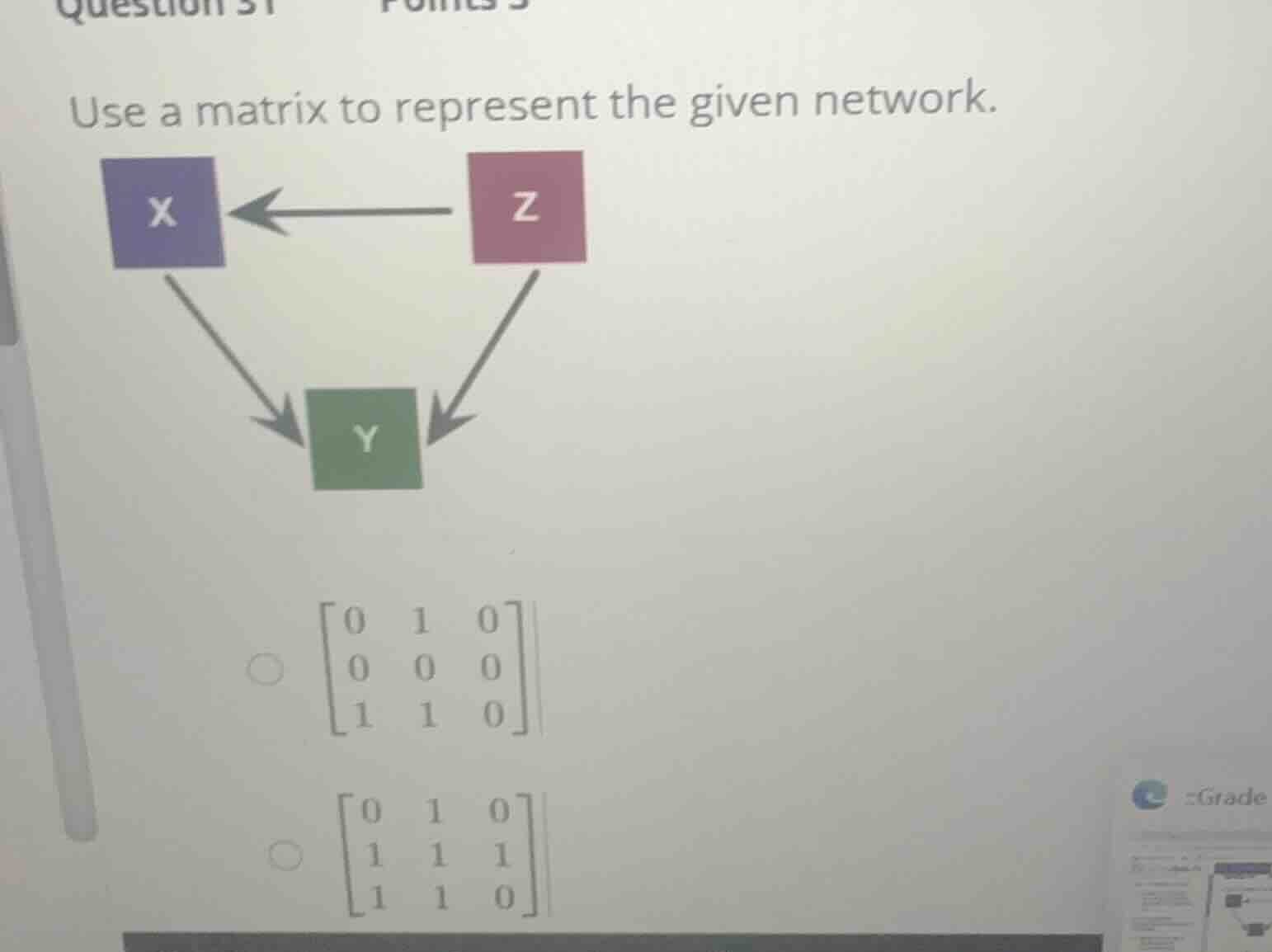
use a matrix to represent the given network.
\\(\
\\)
\\(\
\\)
Identify the vertices and directed edges
Using the Directed Graph knowledge point, we identify the vertices and directed edges from the network diagram.
The vertices are \(X\), \(Y\), and \(Z\). We order them alphabetically: row/column 1 corresponds to \(X\), row/column 2 to \(Y\), and row/column 3 to \(Z\).
The directed edges (arrows) in the network are:
- From \(Z\) to \(X\)
- From \(X\) to \(Y\)
- From \(Z\) to \(Y\)
Construct the adjacency matrix
Using the Adjacency Matrix Construction knowledge point, we construct a \(3 \times 3\) matrix where the element in row \(i\) and column \(j\) is \(1\) if there is a directed edge from vertex \(i\) to vertex \(j\), and \(0\) otherwise.
- Row 1 (\(X\)):
- Edge from \(X\) to \(X\): None (\(0\))
- Edge from \(X\) to \(Y\): Yes (\(1\))
- Edge from \(X\) to \(Z\): None (\(0\))
- Row 1 is \(
\).
- Row 2 (\(Y\)):
- Edge from \(Y\) to \(X\): None (\(0\))
- Edge from \(Y\) to \(Y\): None (\(0\))
- Edge from \(Y\) to \(Z\): None (\(0\))
- Row 2 is \(
\).
- Row 3 (\(Z\)):
- Edge from \(Z\) to \(X\): Yes (\(1\))
- Edge from \(Z\) to \(Y\): Yes (\(1\))
- Edge from \(Z\) to \(Z\): None (\(0\))
- Row 3 is \(
\).
Combine into the final matrix
Combining the rows, we get the complete adjacency matrix:
This matches the first option.

Snap & solve any problem in the app
Get step-by-step solutions on Sovi AI
Photo-based solutions with guided steps
Explore more problems and detailed explanations
- **\(
\) (Correct answer)**
- \(
\)