QUESTION IMAGE
Question
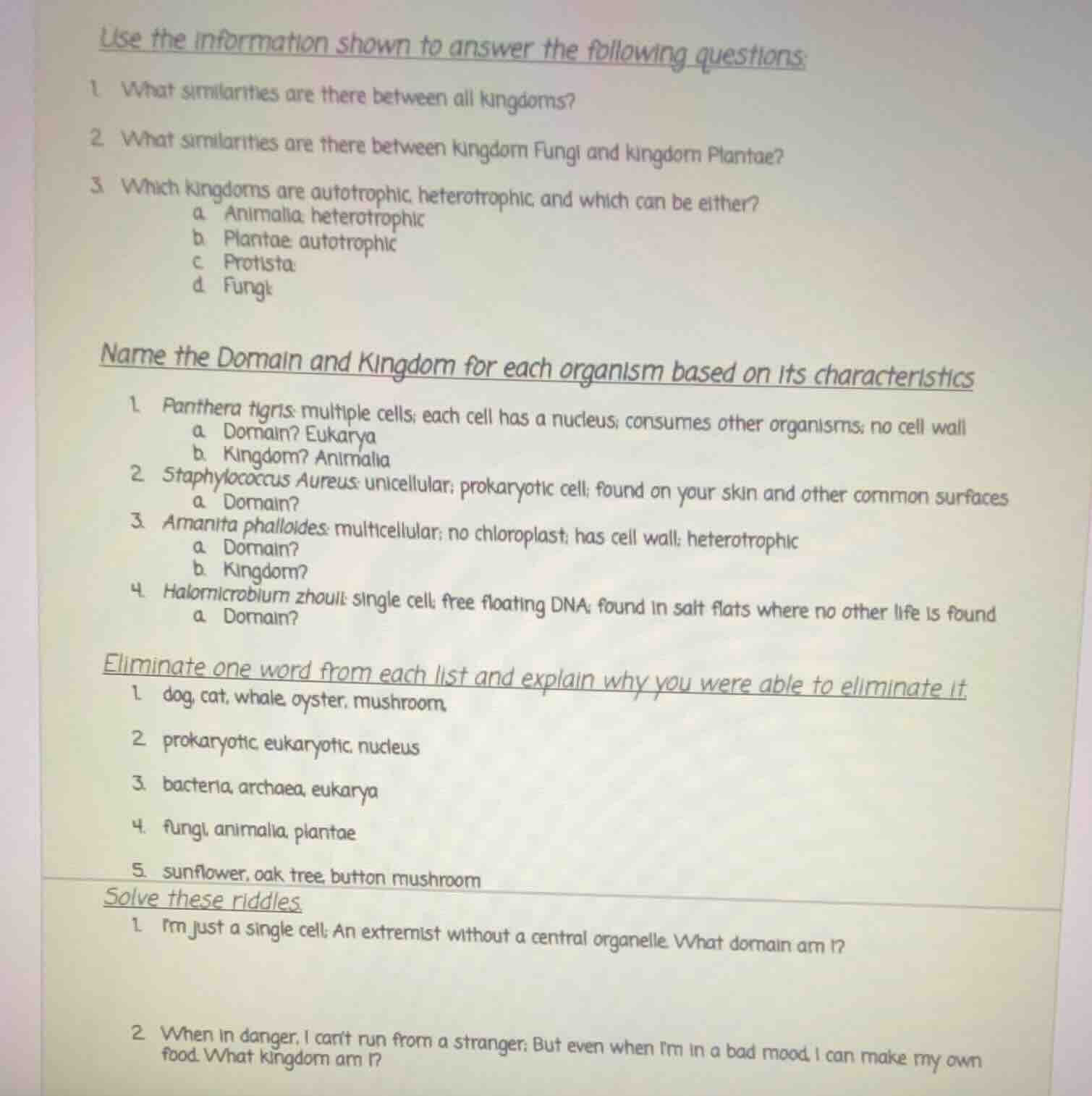
use the information shown to answer the following questions:
- what similarities are there between all kingdoms?
- what similarities are there between kingdom fungi and kingdom plantae?
- which kingdoms are autotrophic, heterotrophic, and which can be either?
a. animalia: heterotrophic
b. plantae: autotrophic
c. protista:
d. fungi:
name the domain and kingdom for each organism based on its characteristics
- panthera tigris: multiple cells; each cell has a nucleus; consumes other organisms; no cell wall
a. domain? eukarya
b. kingdom? animalia
- staphylococcus aureus: unicellular; prokaryotic cell; found on your skin and other common surfaces
a. domain?
- amanita phalloides: multicellular; no chloroplast; has cell wall; heterotrophic
a. domain?
b. kingdom?
- halomicrobium zhouii: single cell; free floating dna; found in salt flats where no other life is found
a. domain?
eliminate one word from each list and explain why you were able to eliminate it.
- dog, cat, whale, oyster, mushroom
- prokaryotic, eukaryotic, nucleus
- bacteria, archaea, eukarya
- fungi, animalia, plantae
- sunflower, oak tree, button mushroom
solve these riddles:
- im just a single cell; an extremist without a central organelle. what domain am i?
- when in danger, i cant run from a stranger; but even when im in a bad mood, i can make my own food. what kingdom am i?
Analyze similarities among kingdoms
All living kingdoms share fundamental characteristics of life. They are composed of cells containing genetic material, carry out metabolic processes, and maintain homeostasis.
Compare Fungi and Plantae
Both kingdoms belong to the domain Eukarya, meaning they consist of Eukaryotic Cells with a defined Cell Structure including a nucleus and membrane-bound organelles. Additionally, both have cell walls and are multicellular.
Classify nutritional modes
We identify the nutritional strategies of the listed kingdoms:
- Animalia: Heterotrophic.
- Plantae: Autotrophic.
- Protista: Can be either autotrophic or heterotrophic.
- Fungi: Heterotrophic.
Identify organism domains and kingdoms
We analyze the cellular characteristics of each organism:
- Staphylococcus aureus: Unicellular, Prokaryotic Cells (lacks a nucleus). This places it in the domain Bacteria.
- Amanita phalloides: Multicellular, eukaryotic, heterotrophic, cell wall. This places it in domain Eukarya, kingdom Fungi.
- Halomicrobium zhouii: Single cell, free-floating DNA (prokaryotic), lives in extreme salt flats. This places it in domain Archaea.
Evaluate word elimination lists
We find the odd word out based on taxonomic and cellular relationships:
- "mushroom" is a fungus; others are animals.
- "nucleus" is a Cell Structure organelle; others are cell types (Prokaryotic Cells and Eukaryotic Cells).
- "eukarya" is a domain of eukaryotes; others are prokaryotic domains.
- "animalia" and "plantae" are kingdoms; "fungi" is plural for the kingdom Fungi (or "fungi" is a common name, while others are formal Latin kingdom names). Alternatively, plants and fungi have cell walls, while animals do not.
- "button mushroom" is a heterotrophic fungus; others are autotrophic plants.
Solve biological riddles
- A single-celled extremist without a nucleus (Prokaryotic Cells) belongs to the domain Archaea.
- A sessile (cannot run) autotroph (makes its own food) belongs to the kingdom Plantae.

Snap & solve any problem in the app
Get step-by-step solutions on Sovi AI
Photo-based solutions with guided steps
Explore more problems and detailed explanations
Use the information shown to answer the following questions:
- What similarities are there between all kingdoms?
All kingdoms consist of living organisms made of cells containing genetic material (DNA), which perform metabolic processes, reproduce, and maintain homeostasis.
- What similarities are there between kingdom Fungi and kingdom Plantae?
Both kingdoms consist of eukaryotic organisms (domain Eukarya) that possess cell walls and are primarily multicellular.
- Which kingdoms are autotrophic, heterotrophic, and which can be either?
- a. Animalia: Heterotrophic
- b. Plantae: Autotrophic
- c. Protista: Can be either (autotrophic or heterotrophic)
- d. Fungi: Heterotrophic
---
Name the Domain and Kingdom for each organism based on its characteristics:
- Panthera tigris:
- a. Domain: Eukarya
- b. Kingdom: Animalia
- Staphylococcus aureus:
- a. Domain: Bacteria
- Amanita phalloides:
- a. Domain: Eukarya
- b. Kingdom: Fungi
- Halomicrobium zhouii:
- a. Domain: Archaea
---
Eliminate one word from each list and explain why you were able to eliminate it:
- mushroom
- Explanation: A mushroom belongs to the kingdom Fungi, while the dog, cat, whale, and oyster belong to the kingdom Animalia.
- nucleus
- Explanation: A nucleus is an organelle within a cell, whereas prokaryotic and eukaryotic describe types of cells.
- eukarya
- Explanation: Eukarya consists of eukaryotic organisms, whereas bacteria and archaea consist of prokaryotic organisms.
- animalia
- Explanation: Organisms in Plantae and Fungi possess cell walls, whereas organisms in Animalia do not.
- button mushroom
- Explanation: A button mushroom is a heterotrophic fungus, whereas a sunflower and an oak tree are autotrophic plants.
---
Solve these riddles:
- What domain am I?
Archaea
- What kingdom am I?
Plantae