QUESTION IMAGE
Question
use the image to answer the questions on the page.
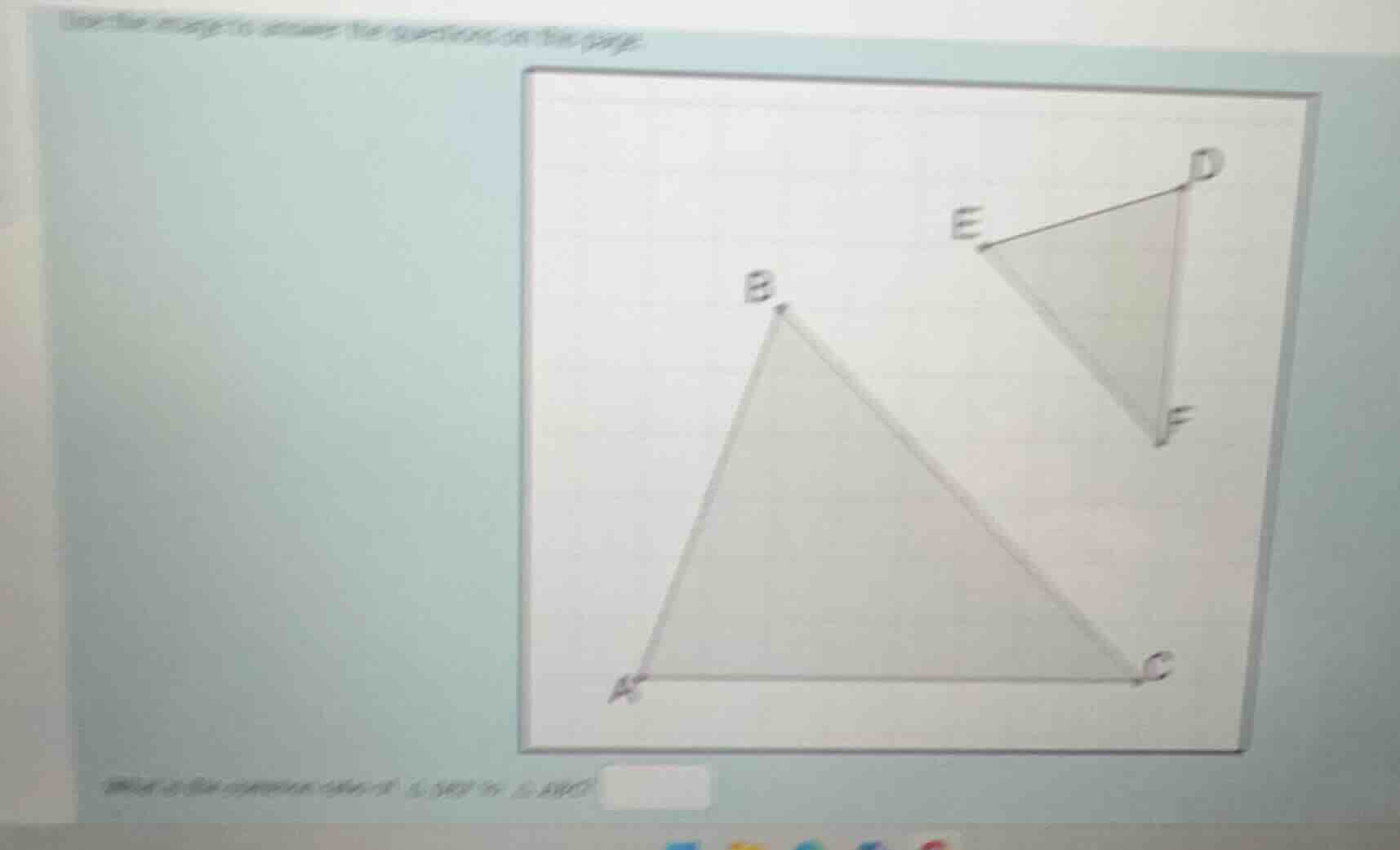
what is the dilation ratio of \\(\triangle def\\) to \\(\triangle abc\\)?
⚡ Using what you learned: dilations and scale factors
Step 1: Identify corresponding sides
To find the scale factor from \(\triangle DEF\) to \(\triangle ABC\), we compare the lengths of their corresponding horizontal or vertical sides.
- Side \(AC\) is horizontal. Counting the grid units:
$$ AC = 10 \text{ units} $$
- Side \(DF\) is vertical. Let's look at the orientation of the triangles. \(\triangle DEF\) is a scaled and rotated/reflected version of \(\triangle ABC\).
- Let's measure the horizontal base of \(\triangle ABC\):
$$ AC = 10 \text{ units} $$
- The corresponding side to \(AC\) in the smaller triangle \(\triangle DEF\) is \(ED\). Counting the grid units horizontally and vertically for \(ED\):
- \(E\) is at some grid intersection, and \(D\) is 5 units to the right of \(E\). Let's count the grid squares for the horizontal base of \(\triangle ABC\): \(AC = 10\) units.
- The corresponding horizontal-ish or base side of the smaller triangle is \(ED\), which has a horizontal span of \(5\) units.
- Alternatively, looking at the vertical side \(DF\): it spans \(5\) units vertically.
The ratio of the dimensions of \(\triangle DEF\) to \(\triangle ABC\) is:
$$ \frac{\text{Side of } \triangle DEF}{\text{Side of } \triangle ABC} = \frac{5}{10} = \frac{1}{2} $$
Step 2: Calculate the scale factor
The scale factor \(k\) from \(\triangle DEF\) to \(\triangle ABC\) is the multiplier that scales \(\triangle DEF\) up to \(\triangle ABC\):
$$ k = \frac{\text{Length in } \triangle ABC}{\text{Length in } \triangle DEF} = \frac{10}{5} = 2 $$

Snap & solve any problem in the app
Get step-by-step solutions on Sovi AI
Photo-based solutions with guided steps
Explore more problems and detailed explanations
2