QUESTION IMAGE
Question
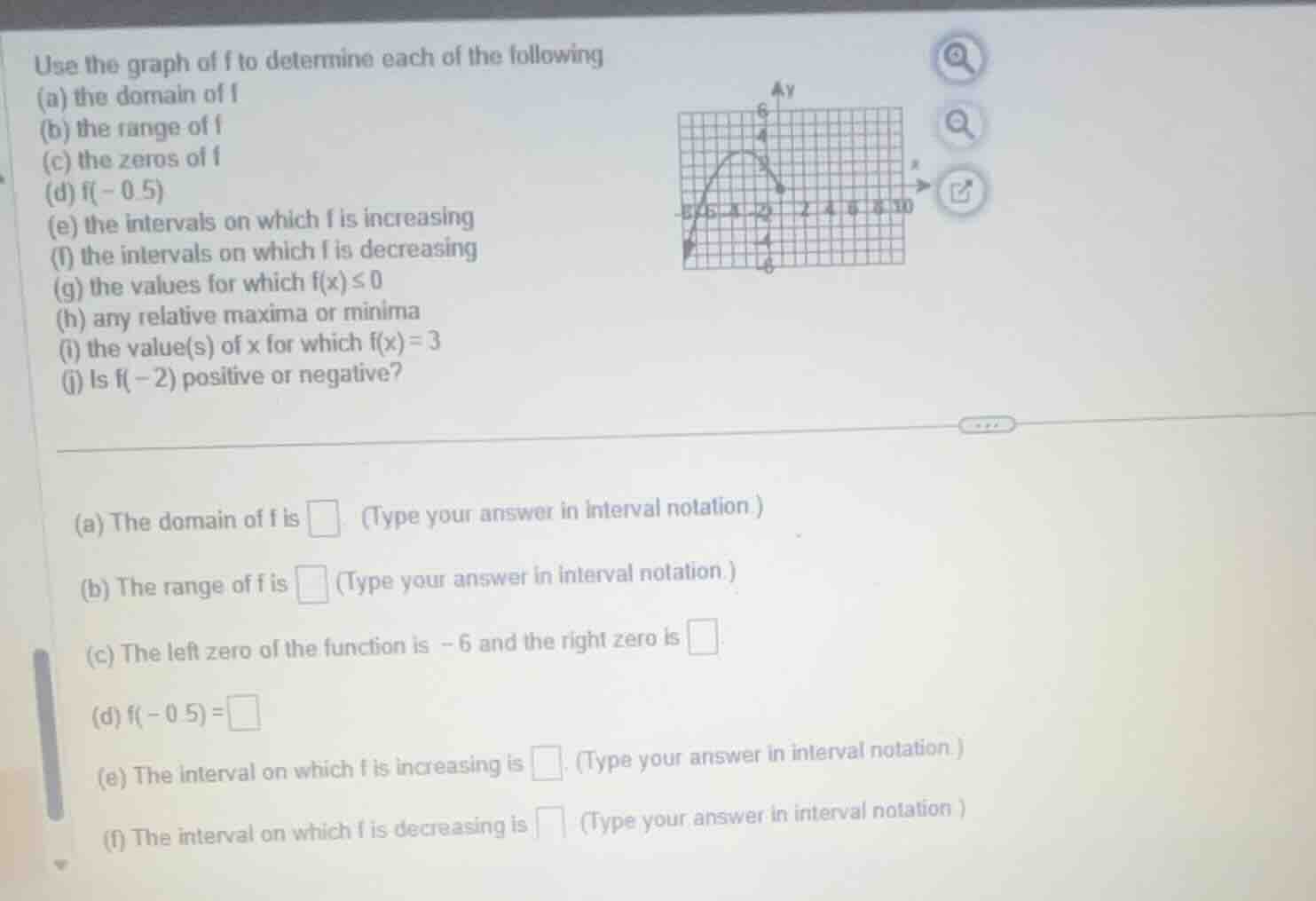
use the graph of f to determine each of the following
(a) the domain of f
(b) the range of f
(c) the zeros of f
(d) f(-0.5)
(e) the intervals on which f is increasing
(f) the intervals on which f is decreasing
(g) the values for which f(x) \le 0
(h) any relative maxima or minima
(i) the value(s) of x for which f(x) = 3
(j) is f(-2) positive or negative?
(a) the domain of f is (type your answer in interval notation.)
(b) the range of f is (type your answer in interval notation.)
(c) the left zero of the function is -6 and the right zero is
(d) f(-0.5) =
(e) the interval on which f is increasing is (type your answer in interval notation.)
(f) the interval on which f is decreasing is (type your answer in interval notation.)
Find the domain and range
Using the Interval Notation knowledge point
Find the zeros and evaluate the function
The graph intersects the \(x\)-axis at \(x = -6\) and \(x = -1\). Thus, the right zero is \(-1\).
To find \(f(-0.5)\), we locate \(x = -0.5\) on the graph and find the corresponding \(y\)-value, which is \(1\).
Determine intervals of increase and decrease
Using the Interval Notation knowledge point

Snap & solve any problem in the app
Get step-by-step solutions on Sovi AI
Photo-based solutions with guided steps
Explore more problems and detailed explanations
Question 1
(a) The domain of \(f\) is <blank>\([-6, 0]\)</blank>
Question 2
(b) The range of \(f\) is <blank>\([-4, 3]\)</blank>
Question 3
(c) The left zero of the function is \(-6\) and the right zero is <blank>\(-1\)</blank>
Question 4
(d) \(f(-0.5) =\) <blank>\(1\)</blank>
Question 5
(e) The interval on which \(f\) is increasing is <blank>\([-6, -3]\)</blank>
Question 6
(f) The interval on which \(f\) is decreasing is <blank>\([-3, 0]\)</blank>