Sovi.AI - AI Math Tutor

Scan to solve math questions

QUESTION IMAGE

use the following information to answer question 25. a photographer tak…

Question

use the following information to answer question 25.

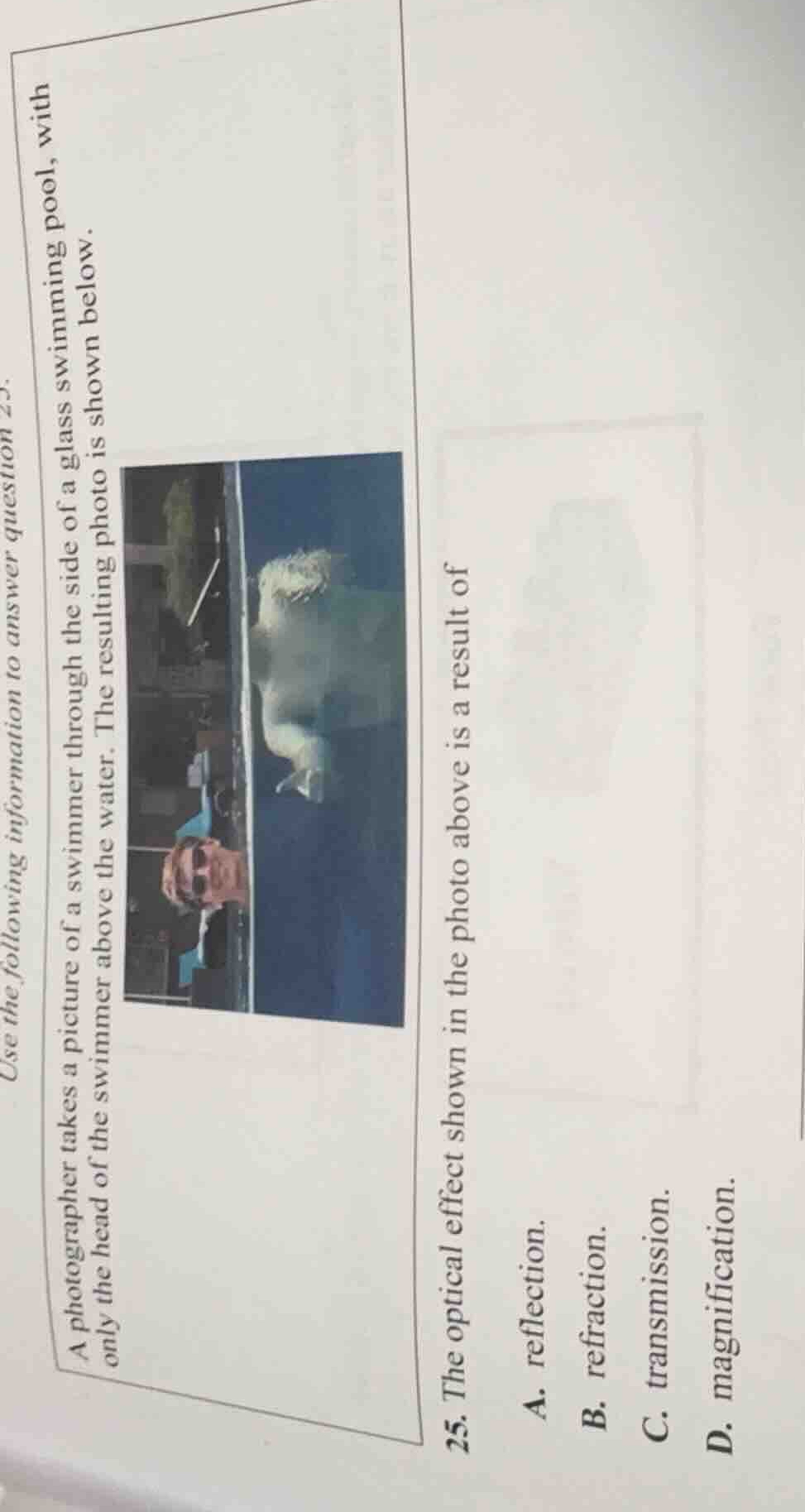
a photographer takes a picture of a swimmer through the side of a glass swimming pool, with only the head of the swimmer above the water. the resulting photo is shown below.

  1. the optical effect shown in the photo above is a result of

a. reflection.
b. refraction.
c. transmission.
d. magnification.

Explanation:

Response

<pre_analysis>
{
"quality": "clear",
"question_count": 1,
"skills_matched": [
"direct_cot",
"multiple_choice_formatter",
"explain_then_answer",
"tutor"
],
"needs_drawing": false,
"concepts_used": [
"Properties of Light"
],
"new_concepts": [
"Refraction of Light"
],
"current_concepts": [
"Properties of Light",
"Refraction of Light"
]
}
</pre_analysis>

<reasoning>

Analyze the visual phenomenon

The photograph shows a swimmer whose head (above the water) is visually separated and shifted horizontally from their body (below the water). This misalignment occurs because light travels through different media before reaching the camera.

Identify the behavior of light

Using our understanding of the Properties of Light, we know that light travels at different speeds in different media. When light passes from water through the glass wall of the pool and then into the air, it changes speed and bends.

Define the optical process

The bending of light as it passes from one medium (water/glass) to another (air) is called refraction. This bending causes the underwater portion of the swimmer's body to appear in a different position relative to their head, which is seen directly through the air.

Evaluate the given options

  • A. reflection: This is the bouncing of light off a surface, which does not cause this shifting effect.
  • B. refraction: This is the bending of light as it changes media, which directly explains the visual displacement.
  • C. transmission: This is simply light passing through a medium without necessarily bending or causing displacement.
  • D. magnification: This refers to making an object appear larger, which is not the primary cause of the horizontal misalignment.

</reasoning>

<answer>
<mcq-option>(A) reflection.</mcq-option>
<mcq-correct>(B) refraction.</mcq-correct>
<mcq-option>(C) transmission.</mcq-option>
<mcq-option>(D) magnification.</mcq-option>
</answer>

<post_analysis>
{
"subject": "Natural Science",
"question_type": "Multiple Choice",
"knowledge_point": [
"Natural Science",
"Physics",
"Refraction of Light"
]
}
</post_analysis>

Answer:

<pre_analysis>
{
"quality": "clear",
"question_count": 1,
"skills_matched": [
"direct_cot",
"multiple_choice_formatter",
"explain_then_answer",
"tutor"
],
"needs_drawing": false,
"concepts_used": [
"Properties of Light"
],
"new_concepts": [
"Refraction of Light"
],
"current_concepts": [
"Properties of Light",
"Refraction of Light"
]
}
</pre_analysis>

<reasoning>

Analyze the visual phenomenon

The photograph shows a swimmer whose head (above the water) is visually separated and shifted horizontally from their body (below the water). This misalignment occurs because light travels through different media before reaching the camera.

Identify the behavior of light

Using our understanding of the Properties of Light, we know that light travels at different speeds in different media. When light passes from water through the glass wall of the pool and then into the air, it changes speed and bends.

Define the optical process

The bending of light as it passes from one medium (water/glass) to another (air) is called refraction. This bending causes the underwater portion of the swimmer's body to appear in a different position relative to their head, which is seen directly through the air.

Evaluate the given options

  • A. reflection: This is the bouncing of light off a surface, which does not cause this shifting effect.
  • B. refraction: This is the bending of light as it changes media, which directly explains the visual displacement.
  • C. transmission: This is simply light passing through a medium without necessarily bending or causing displacement.
  • D. magnification: This refers to making an object appear larger, which is not the primary cause of the horizontal misalignment.

</reasoning>

<answer>
<mcq-option>(A) reflection.</mcq-option>
<mcq-correct>(B) refraction.</mcq-correct>
<mcq-option>(C) transmission.</mcq-option>
<mcq-option>(D) magnification.</mcq-option>
</answer>

<post_analysis>
{
"subject": "Natural Science",
"question_type": "Multiple Choice",
"knowledge_point": [
"Natural Science",
"Physics",
"Refraction of Light"
]
}
</post_analysis>