QUESTION IMAGE
Question
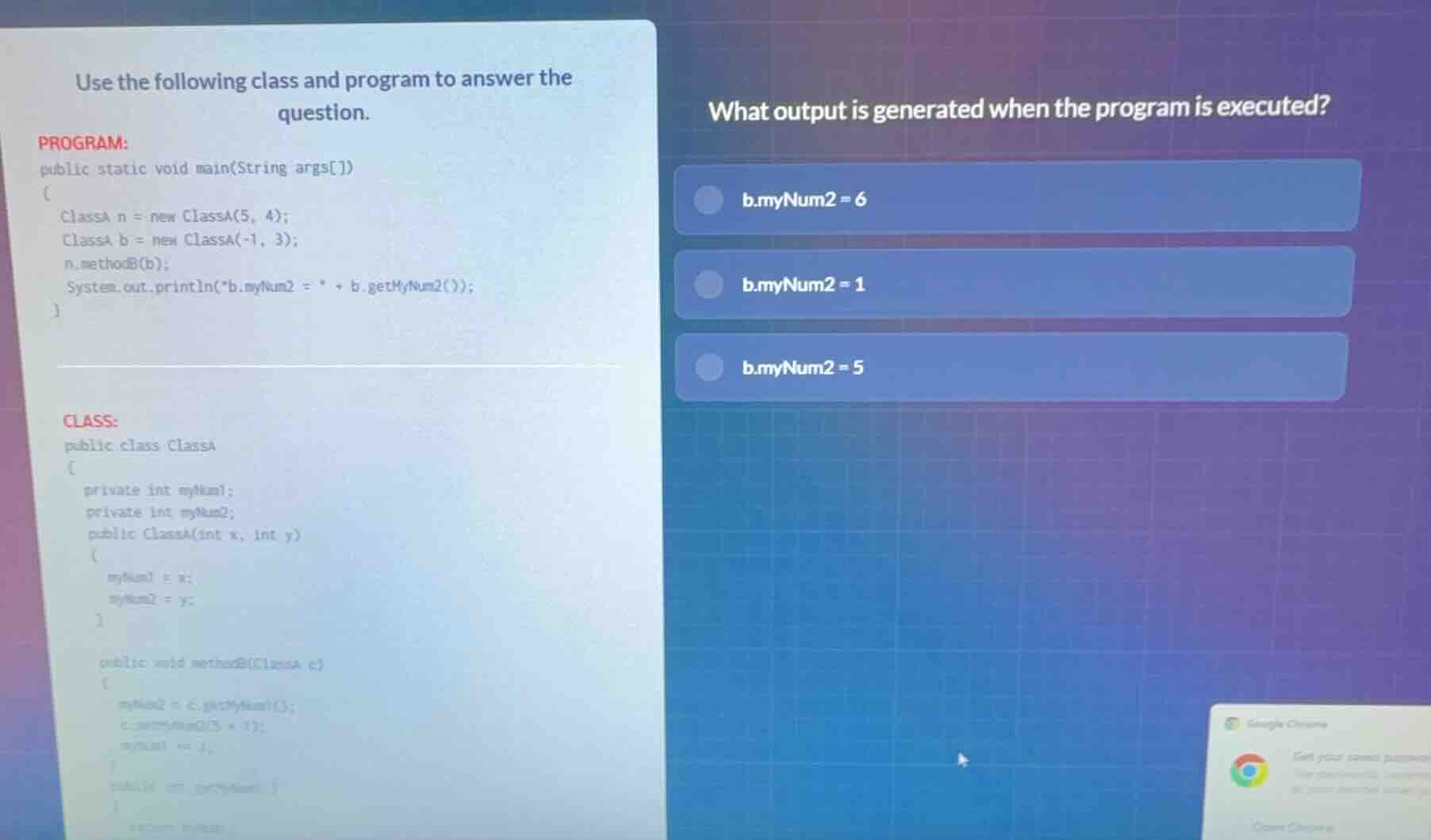
use the following class and program to answer the question.
program:
public static void main(string args)
{
classa a = new classa(5, 4);
classa b = new classa(-1, 3);
a.methodb(b);
system.out.println(\b.mynum2 = \ + b.getmynum2());
}
class:
public class classa
{
private int mynum1;
private int mynum2;
public classa(int x, int y)
{
mynum1 = x;
mynum2 = y;
}
public void methodb(classa c)
{
mynum2 = c.getmynum1();
c.setmynum2(5 * 1);
mynum1 = 3;
}
public int getmynum1() { return mynum1; }
public int getmynum2() { return mynum2; }
public void setmynum2(int y) { mynum2 = y; }
}
what output is generated when the program is executed?
- b.mynum2 = 6
- b.mynum2 = 1
- b.mynum2 = 5
🆕 New Concept Discovered: Object Reference and Parameter Passing
How objects behave when passed into methods.
Step 1: Analyze the Class Definition
Let's look at the structure of ClassA to understand its variables and methods:
- Instance Variables:
myNum1myNum2- Constructor:
public ClassA(int x, int y)initializesmyNum1 = xandmyNum2 = y.- Method
methodB:
    public void methodB(ClassA c) {
        myNum2 = c.getMyNum1(); // Note: getMyNum1() returns the value of myNum1
        c.setMyNum2(5 * 1);     // Note: setMyNum2(val) sets myNum2 to val
        myNum1 = 3;
    }
(Note: Although the getter and setter methods are cut off at the bottom of the image, standard Java naming conventions indicate c.getMyNum1() returns c's myNum1 value, and c.setMyNum2(...) updates c's myNum2 value).
---
Step 2: Trace the Main Program Execution
Let's trace the execution step-by-step:
- Create object
n:
ClassA n = new ClassA(5, 4);n.myNum1 = 5n.myNum2 = 4
- Create object
b:
ClassA b = new ClassA(-1, 3);b.myNum1 = -1b.myNum2 = 3
- Call
n.methodB(b):
Here, the method is called on the object n (so this refers to n), and the object reference b is passed as the parameter c (so c refers to the same object as b).
Let's execute the lines inside methodB(ClassA c) where this = n and c = b:
myNum2 = c.getMyNum1();- This assigns
b.myNum1(which is-1) ton.myNum2. - So,
n.myNum2becomes-1. c.setMyNum2(5 * 1);- This sets the
myNum2value of objectc(which isb) to5 * 1 = 5. - So,
b.myNum2becomes5. myNum1 = 3;- This sets
n.myNum1to3.
---
Step 3: Determine the Output
The program executes the print statement:
System.out.println("b.myNum2 = " + b.getMyNum2());Since b.myNum2 was updated to 5 during the execution of methodB, the output is:
b.myNum2 = 5
Snap & solve any problem in the app
Get step-by-step solutions on Sovi AI
Photo-based solutions with guided steps
Explore more problems and detailed explanations
b.myNum2 = 5