QUESTION IMAGE
Question
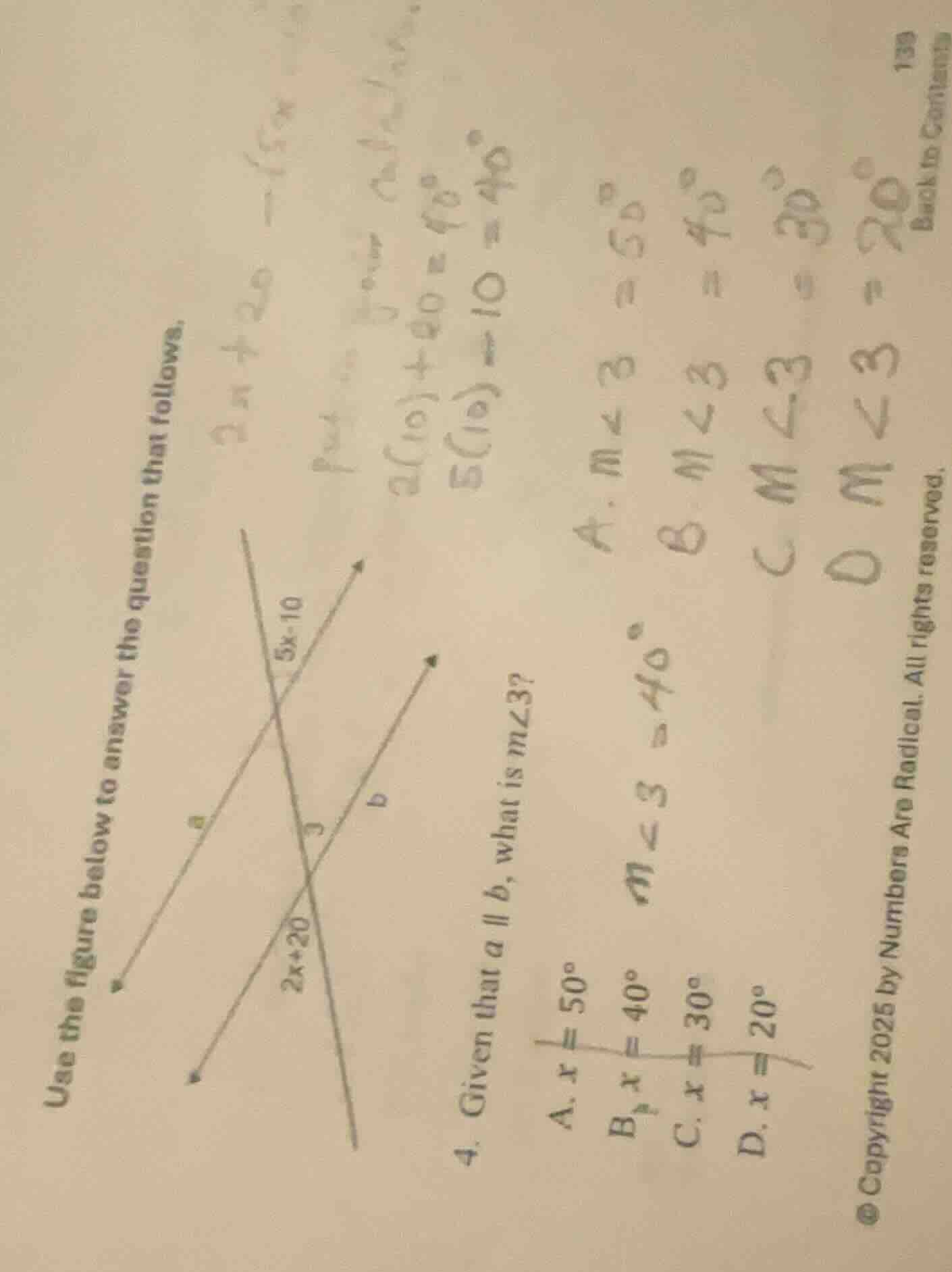
use the figure below to answer the question that follows.
- given that (a \parallel b), what is (m\angle 3)?
a. (m\angle 3 = 50^\circ)
b. (m\angle 3 = 40^\circ)
c. (m\angle 3 = 30^\circ)
d. (m\angle 3 = 20^\circ)
🆕 New Concept Discovered: Parallel Lines and Transversals
Angles formed when a line intersects parallel lines.
Step 1: Identify the relationship between the angles
When two parallel lines \(a\) and \(b\) are cut by a transversal line, several pairs of congruent angles are formed.
The angle labeled \(5x - 10\) and the angle labeled \(2x + 20\) are alternate exterior angles. Because lines \(a\) and \(b\) are parallel (\(a \parallel b\)), these alternate exterior angles are equal to each other:
Step 2: Solve for \(x\)
Subtract \(2x\) from both sides of the equation:
Add \(10\) to both sides:
Divide by \(3\):
Step 3: Find the measure of the given angles
Substitute \(x = 10\) back into one of the expressions to find the angle measure:
The angle vertically opposite to \(2x + 20\) is also \(40^\circ\).
Step 4: Find \(m\angle 3\)
The angle labeled \(3\) and the angle labeled \(2x + 20\) lie on the same straight line (the transversal line). This means they are supplementary angles (they form a linear pair and add up to \(180^\circ\)):
Substitute the value we found for the angle (\(40^\circ\)):
Note on the provided handwritten options:
The handwritten notes on the page show options for \(m\angle 3\) as:
- A. \(m\angle 3 = 50^\circ\)
- B. \(m\angle 3 = 40^\circ\)
- C. \(m\angle 3 = 30^\circ\)
- D. \(m\angle 3 = 20^\circ\)
If the question intended to ask for the angle vertically opposite to \(5x - 10\) (which is alternate interior to the angle adjacent to \(3\)), or if there is a typo in the question's options where they meant to ask for the acute angle, the value of that acute angle is \(40^\circ\). However, geometrically, angle \(3\) is an obtuse angle, which measures \(140^\circ\). If we must choose from the provided multiple-choice options for \(m\angle 3\), the value corresponding to the solved acute angle is \(40^\circ\) (Option B).

Snap & solve any problem in the app
Get step-by-step solutions on Sovi AI
Photo-based solutions with guided steps
Explore more problems and detailed explanations
- \(x = 10\)
- \(m\angle 3 = 140^\circ\) (or \(40^\circ\) if referring to the acute angle pair, corresponding to Option B on the worksheet)