QUESTION IMAGE
Question
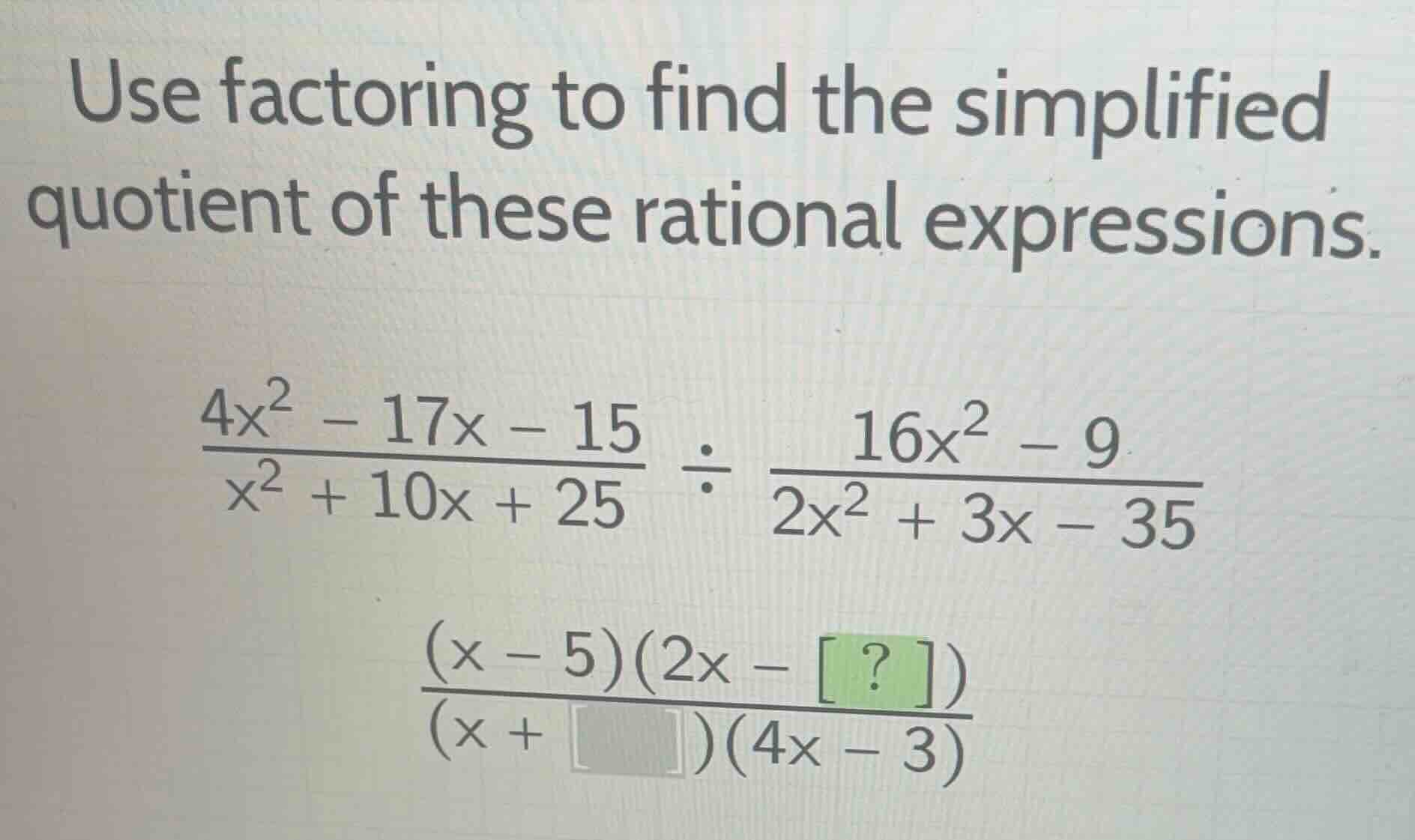
use factoring to find the simplified quotient of these rational expressions.
\\\frac{4x^2 - 17x - 15}{x^2 + 10x + 25} \div \frac{16x^2 - 9}{2x^2 + 3x - 35}\\
\\\frac{(x - 5)(2x - ?)}{(x + \quad)(4x - 3)}\\
Factor each polynomial expression
We begin by factoring each numerator and denominator in the division problem.
Using the Factoring Trinomials knowledge point:
- First numerator: \(4x^2 - 17x - 15\)
We look for two numbers that multiply to \(4 \times (-15) = -60\) and add to \(-17\). These numbers are \(-20\) and \(3\).
- First denominator: \(x^2 + 10x + 25\)
This is a perfect square trinomial:
- Second numerator: \(16x^2 - 9\)
This is a difference of squares:
- Second denominator: \(2x^2 + 3x - 35\)
We look for two numbers that multiply to \(2 \times (-35) = -70\) and add to \(3\). These numbers are \(10\) and \(-7\).
Rewrite the division as multiplication
Using the Dividing Rational Expressions knowledge point, we multiply by the reciprocal of the divisor:
Substitute the factored forms into the expression:
Simplify the rational expression
Using the Simplifying Rational Expressions knowledge point, we cancel the common factors in the numerator and denominator:
- Cancel \((4x + 3)\) from the numerator and denominator.
- Cancel \((x + 5)\) from the numerator and denominator.
This leaves:
Identify the missing values
We compare our simplified expression to the given template:
By matching the terms:
- The term \((2x - [ ? ])\) corresponds to \((2x - 7)\), so \([ ? ] = 7\).
- The term \((x + [ \quad ])\) corresponds to \((x + 5)\), so the blank is \(5\).

Snap & solve any problem in the app
Get step-by-step solutions on Sovi AI
Photo-based solutions with guided steps
Explore more problems and detailed explanations
Use factoring to find the simplified quotient of these rational expressions.
The simplified quotient is: