QUESTION IMAGE
Question
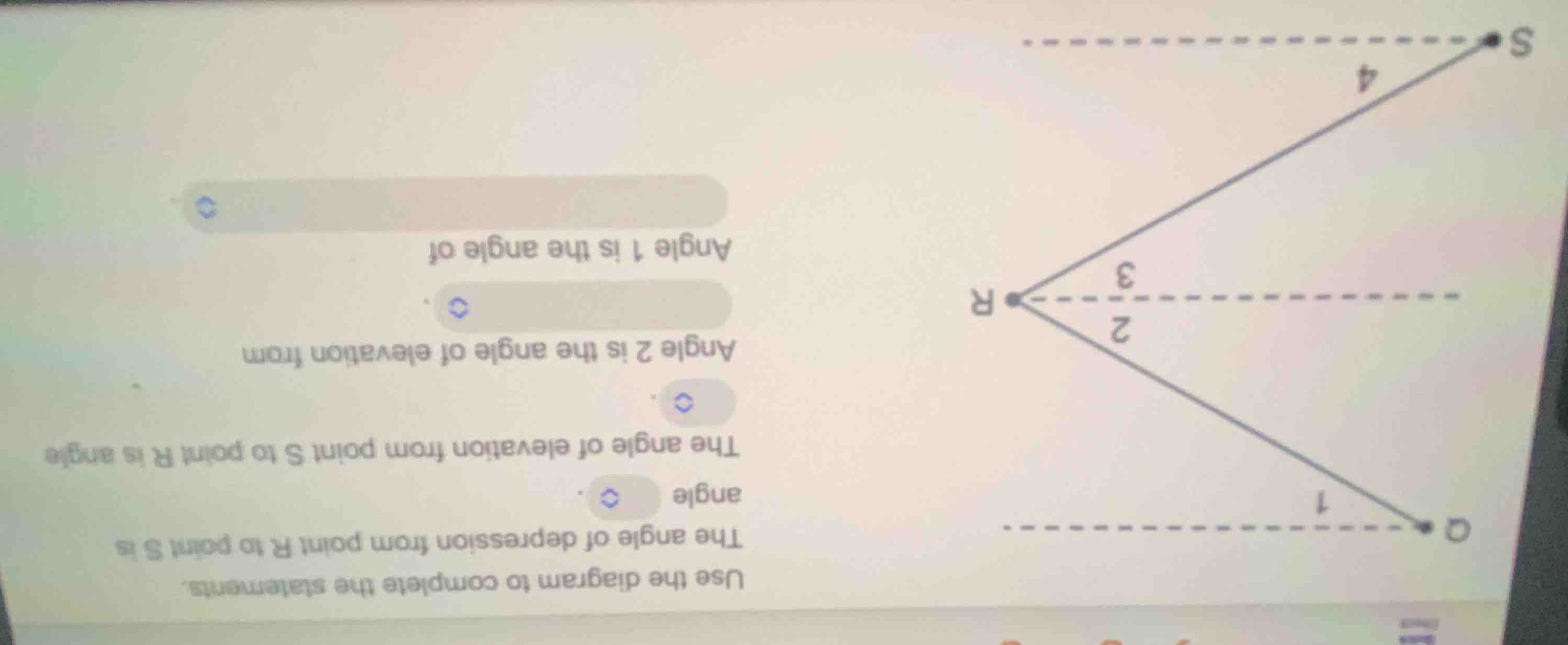
use the diagram to complete the statements.
the angle of depression from point r to point s is angle .
the angle of elevation from point s to point r is angle .
angle 2 is the angle of elevation from .
angle 1 is the angle of .
🆕 New Concept Discovered: Angles of Elevation and Depression
Looking up vs. looking down from a horizontal line
Step 1: Understand the Concepts
- Horizontal Line of Sight: The dashed horizontal lines represent the level ground or horizontal reference lines at points \(Q\), \(R\), and \(S\).
- Angle of Elevation: The angle formed by a horizontal line and the line of sight looking up to an object.
- Angle of Depression: The angle formed by a horizontal line and the line of sight looking down to an object.
---
Step 2: Analyze Angle 1
- Point \(Q\) is at the bottom.
- The horizontal line is the dashed line passing through \(Q\).
- The line of sight goes up from \(Q\) to \(R\).
- Therefore, Angle 1 is the angle of elevation from \(Q\) to \(R\).
---
Step 3: Analyze Angle 2
- Point \(R\) is in the middle.
- The horizontal line is the dashed line passing through \(R\).
- The line of sight goes down from \(R\) to \(Q\).
- Therefore, Angle 2 is the angle of depression from \(R\) to \(Q\) (or conversely, Angle 2 is the angle of elevation from \(Q\) to \(R\) if we look at alternate interior angles, but directly from the vertex \(R\), looking down to \(Q\) makes it an angle of depression).
- Let's look at the dropdown prompt: "Angle 2 is the angle of elevation from [dropdown]".
- Since alternate interior angles between parallel horizontal lines are equal, the angle of elevation from \(Q\) to \(R\) (Angle 1) is equal in measure to the angle of depression from \(R\) to \(Q\) (Angle 2). Thus, Angle 2 is congruent to the angle of elevation from \(Q\) to \(R\).
---
Step 4: Analyze the Angle of Elevation from Point \(S\) to Point \(R\)
- Point \(S\) is at the top.
- The line of sight from \(S\) to \(R\) goes down.
- The angle between the horizontal line at \(S\) and the line of sight to \(R\) is Angle 4, which is an angle of depression from \(S\) to \(R\).
- There is no angle of elevation from \(S\) to \(R\) because \(R\) is below \(S\). However, looking at the wording: "The angle of elevation from point S to point R is angle..."
- Let's re-orient the image. The image is upside down! Let's rotate it \(180^\circ\) mentally:
- If we rotate it so the text is right-side up:
- \(S\) is at the bottom-right.
- \(Q\) is at the top-left.
- Let's read the text right-side up:
- "Angle 1 is the angle of [elevation of R from Q / depression of R from Q]"
- With the image right-side up:
- \(Q\) is at the bottom-right. The dashed line is horizontal. The line of sight goes up to \(R\). So Angle 1 is the angle of elevation of R from Q (or "elevation from Q to R").
- \(R\) is in the middle. The dashed line is horizontal.
- Angle 2 is below the horizontal line at \(R\), looking down to \(Q\). So Angle 2 is the angle of depression from \(R\) to \(Q\).
- Angle 3 is above the horizontal line at \(R\), looking up to \(S\). So Angle 3 is the angle of elevation from \(R\) to \(S\).
- \(S\) is at the top-right. The dashed line is horizontal. Angle 4 is below the horizontal, looking down to \(R\). So Angle 4 is the angle of depression from \(S\) to \(R\).
Let's match the exact sentences with the correct terms based on the right-side-up orientation:
- "Angle 1 is the angle of..."
- Since \(Q\) is at the bottom and we look up to \(R\), Angle 1 is the angle of elevation of R from Q.
- *…

Snap & solve any problem in the app
Get step-by-step solutions on Sovi AI
Photo-based solutions with guided steps
Explore more problems and detailed explanations
Based on the geometric definitions of elevation (looking up from the horizontal) and depression (looking down from the horizontal):
- Angle 1 is the angle of
elevation of R from Q - Angle 2 is the angle of elevation from
Q to R(or congruent to it via alternate interior angles) - The angle of elevation from point R to point S is angle
3 - The angle of depression from point S to point R is angle
4