QUESTION IMAGE
Question
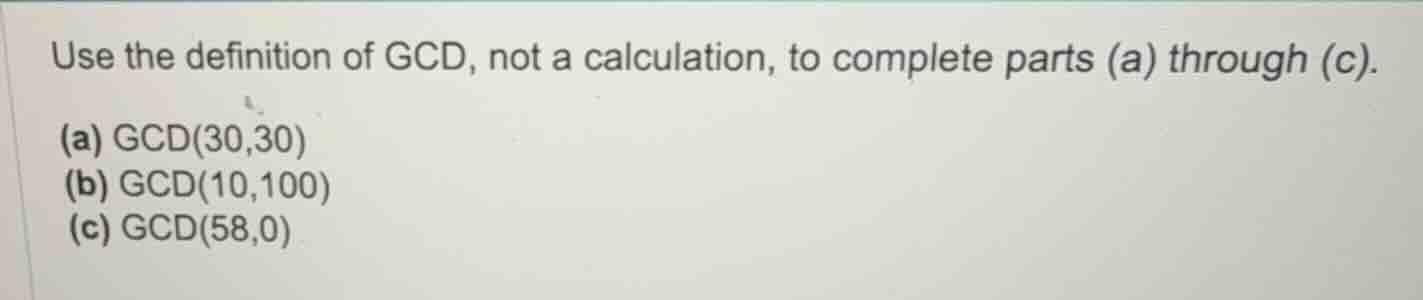
use the definition of gcd, not a calculation, to complete parts (a) through (c).
(a) \\(\text{gcd}(30,30)\\)
(b) \\(\text{gcd}(10,100)\\)
(c) \\(\text{gcd}(58,0)\\)
Define the Greatest Common Divisor (GCD)
The greatest common divisor of two integers \(a\) and \(b\) (not both zero) is the largest positive integer that divides both \(a\) and \(b\) without a remainder.
Evaluate GCD(30, 30)
Using the definition, any positive integer \(d\) that divides \(30\) must satisfy \(d \le 30\). Since \(30\) divides itself, the largest common divisor of \(30\) and \(30\) is \(30\).
Evaluate GCD(10, 100)
Since \(10\) divides \(100\), any common divisor of \(10\) and \(100\) must also divide \(10\). The largest positive integer that divides \(10\) is \(10\) itself. Thus, the greatest common divisor is \(10\).
Evaluate GCD(58, 0)
Every non-zero integer divides \(0\). Therefore, the common divisors of \(58\) and \(0\) are simply the divisors of \(58\). The largest positive integer that divides \(58\) is \(58\) itself. Thus, the greatest common divisor is \(58\).

Snap & solve any problem in the app
Get step-by-step solutions on Sovi AI
Photo-based solutions with guided steps
Explore more problems and detailed explanations
(a) \(30\)
(b) \(10\)
(c) \(58\)