QUESTION IMAGE
Question
unit posttest
24
select the correct answer.
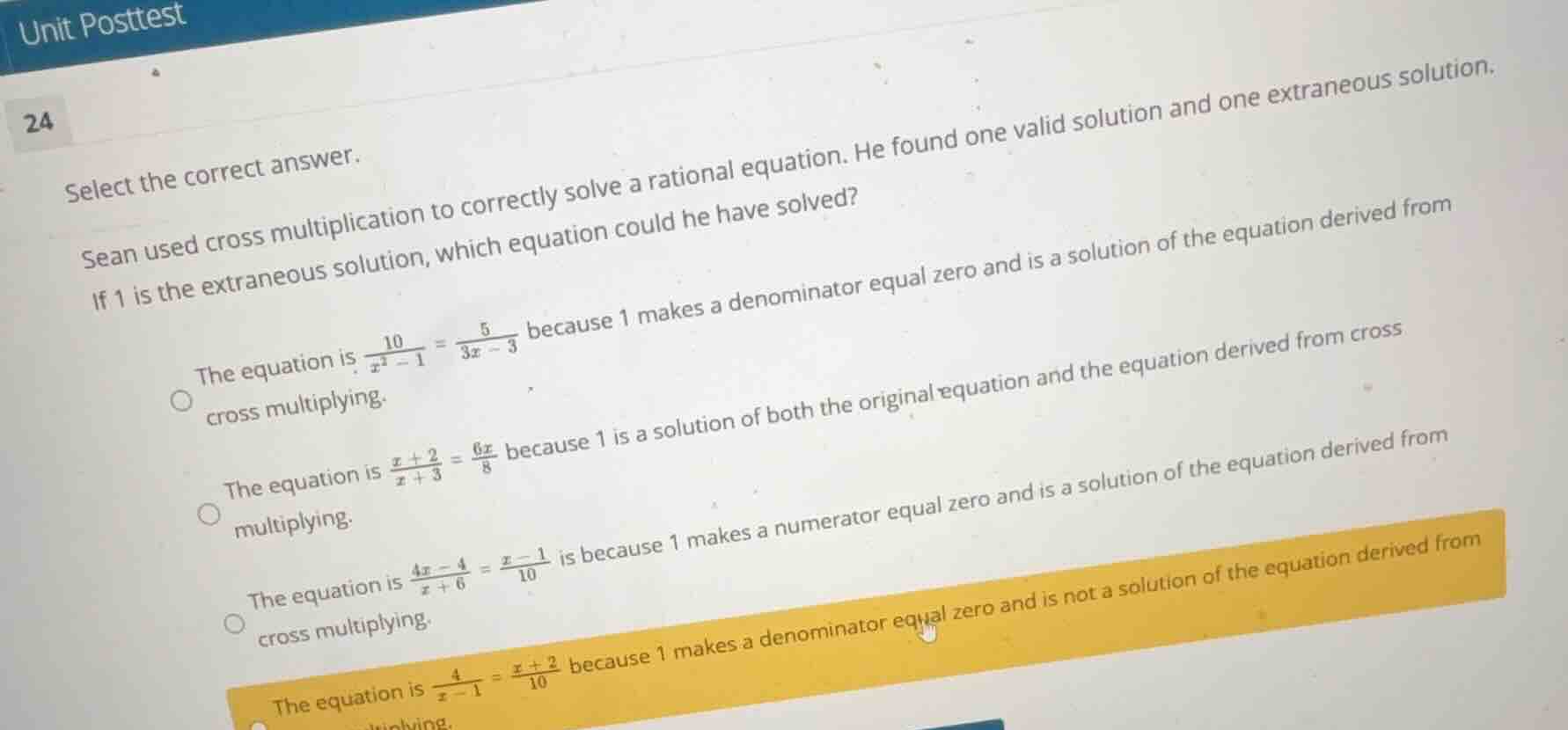
sean used cross multiplication to correctly solve a rational equation. he found one valid solution and one extraneous solution. if 1 is the extraneous solution, which equation could he have solved?
the equation is \\(\frac{10}{x^2 - 1} = \frac{5}{3x - 3}\\) because 1 makes a denominator equal zero and is a solution of the equation derived from cross multiplying.
the equation is \\(\frac{x + 2}{x + 3} = \frac{6x}{8}\\) because 1 is a solution of both the original equation and the equation derived from cross multiplying.
the equation is \\(\frac{4x - 4}{x + 6} = \frac{x - 1}{10}\\) is because 1 makes a numerator equal zero and is a solution of the equation derived from cross multiplying.
the equation is \\(\frac{4}{x - 1} = \frac{x + 2}{10}\\) because 1 makes a denominator equal zero and is not a solution of the equation derived from cross multiplying.
Analyze the definition of an extraneous solution
An extraneous solution of a rational equation is a value that:
- Is a solution to the polynomial equation obtained after clearing denominators (e.g., via cross-multiplication).
- Is not a solution to the original rational equation because it makes at least one denominator in the original equation equal to zero, making the expression undefined.
Evaluate the first option
Given equation:
Check if \(x = 1\) makes a denominator zero:
- For \(x^2 - 1\): \(1^2 - 1 = 0\)
- For \(3x - 3\): \(3(1) - 3 = 0\)
Thus, \(x = 1\) is excluded from the domain of the original equation.
Solve the equation using cross-multiplication:
The solutions to the derived polynomial equation are \(x = 1\) and \(x = 5\).
Since \(x = 1\) is a solution to the derived equation but makes the original denominators zero, it is an extraneous solution. The other solution, \(x = 5\), is valid.
Compare with the option text
The first option states: "The equation is \(\frac{10}{x^2 - 1} = \frac{5}{3x - 3}\) because 1 makes a denominator equal zero and is a solution of the equation derived from cross multiplying." This matches our mathematical analysis perfectly.

Snap & solve any problem in the app
Get step-by-step solutions on Sovi AI
Photo-based solutions with guided steps
Explore more problems and detailed explanations
- (A) The equation is \(\frac{10}{x^2 - 1} = \frac{5}{3x - 3}\) because 1 makes a denominator equal zero and is a solution of the equation derived from cross multiplying. (Correct answer)
- (B) The equation is \(\frac{x + 2}{x + 3} = \frac{6x}{8}\) because 1 is a solution of both the original equation and the equation derived from cross multiplying.
- (C) The equation is \(\frac{4x - 4}{x + 6} = \frac{x - 1}{10}\) is because 1 makes a numerator equal zero and is a solution of the equation derived from cross multiplying.
- (D) The equation is \(\frac{4}{x - 1} = \frac{x + 2}{10}\) because 1 makes a denominator equal zero and is not a solution of the equation derived from cross multiplying.