QUESTION IMAGE
Question
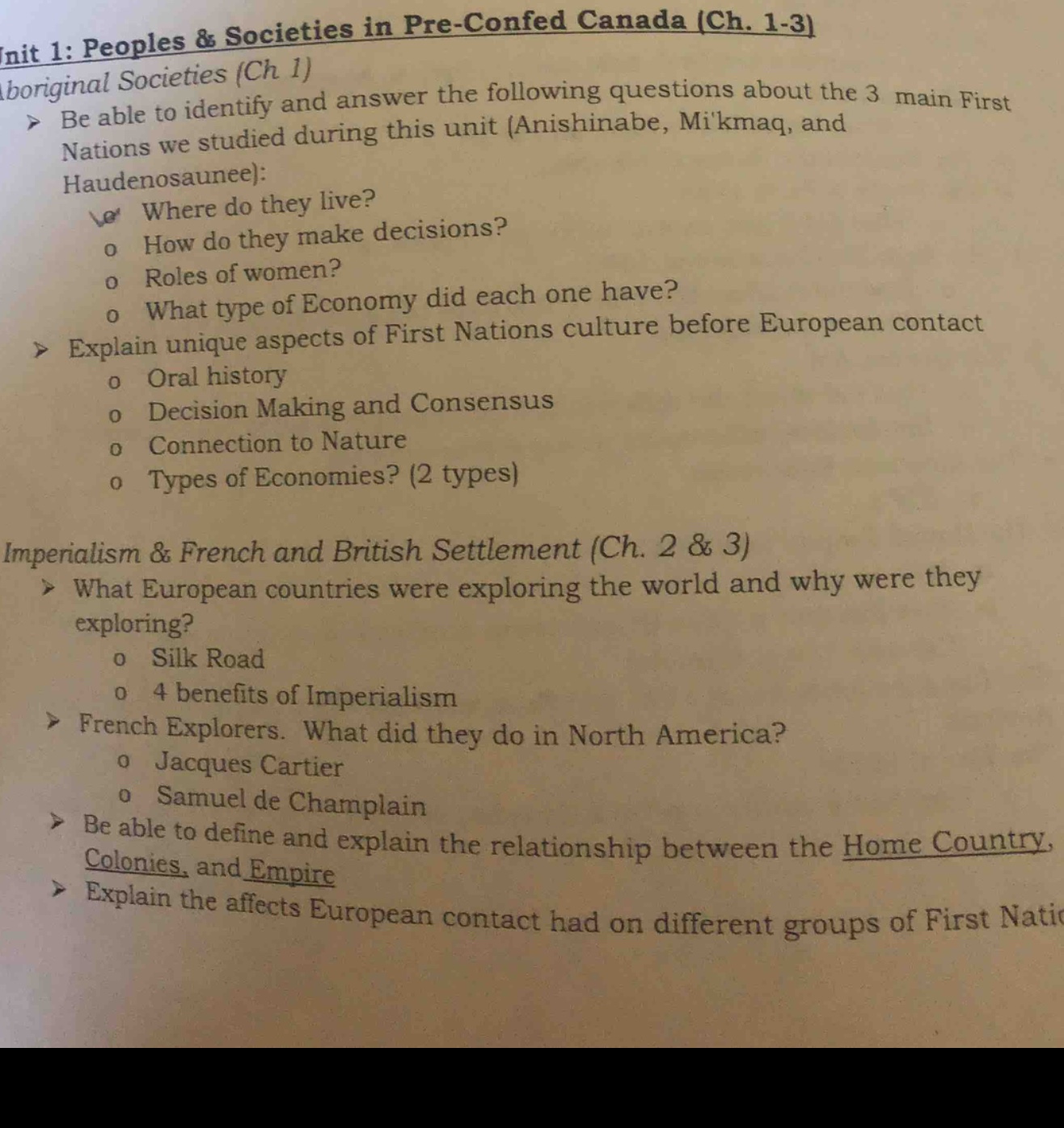
unit 1: peoples & societies in pre-confed canada (ch. 1-3)
aboriginal societies (ch 1)
be able to identify and answer the following questions about the 3 main first nations we studied during this unit (anishinabe, mikmaq, and haudenosaunee):
o where do they live?
o how do they make decisions?
o roles of women?
o what type of economy did each one have?
explain unique aspects of first nations culture before european contact
o oral history
o decision making and consensus
o connection to nature
o types of economies? (2 types)
imperialism & french and british settlement (ch. 2 & 3)
what european countries were exploring the world and why were they exploring?
o silk road
o 4 benefits of imperialism
french explorers. what did they do in north america?
o jacques cartier
o samuel de champlain
be able to define and explain the relationship between the home country, colonies, and empire
explain the affects european contact had on different groups of first nations
🆕 New Concept Discovered: Comparative Historical Analysis
Comparing different societies to find patterns and differences.
---
Step 1: The Three Main First Nations (Anishinabe, Mi'kmaq, and Haudenosaunee)
To understand these societies, we look at how their environment shaped their homes, decisions, gender roles, and economies.
Mi'kmaq
- Where they lived: The Atlantic coast of Canada (modern-day Nova Scotia, Prince Edward Island, New Brunswick, and parts of Quebec). They lived close to the ocean in the summer and moved inland to the forests in the winter.
- Decision Making: They used a consensus model. Leaders called Sagamores met in local councils, and representatives went to the Grand Council to make decisions affecting the whole nation.
- Roles of Women: Women played an important role in family life, gathered wild plants, and voiced their opinions in community decisions. Elders (including women) were highly respected for their wisdom.
- Economy: A hunter-gatherer economy heavily focused on marine life (fish, seals, whales) in the summer and forest game (moose, caribou) in the winter.
Anishinabe
- Where they lived: The wooded areas of the Canadian Shield around the Great Lakes.
- Decision Making: They used a Clan System (or Dodem system). Each of the seven clans had a specific duty (such as leadership, defense, or education) to ensure balance and consensus.
- Roles of Women: Women looked after the home, harvested wild rice, and were equal partners in decision-making processes.
- Economy: A hunter-gatherer economy centered on seasonal cycles, famous for harvesting wild rice (manomin) and maple syrup.
Haudenosaunee (Iroquois)
- Where they lived: Fertile lowlands south of the St. Lawrence River and Lake Ontario (modern-day upstate New York and southern Ontario/Quebec). They lived in permanent agricultural villages of large wooden longhouses.
- Decision Making: Governed by the Great Law of Peace through the Grand Council. Decisions required consensus among fifty chiefs representing the different nations.
- Roles of Women: A matrilineal society. Clan Mothers held immense political power; they chose, advised, and could depose the male chiefs.
- Economy: An agricultural economy based on farming the "Three Sisters" (corn, beans, and squash), supplemented by hunting and gathering.
---
Step 2: Unique Aspects of First Nations Culture
Before Europeans arrived, First Nations societies had highly developed cultural systems:
- Oral History: History, laws, and values were preserved and passed down through spoken stories, songs, and legends rather than written books.
- Decision Making and Consensus: Instead of voting where a majority wins and a minority loses, communities discussed issues until everyone agreed on a path forward.
- Connection to Nature: They viewed humans as part of nature, not masters of it. Land was not owned by individuals; it was shared and cared for respectfully.
- Types of Economies:
- Hunter-Gatherer Economies: Moving seasonally to hunt animals and gather wild plants.
- Agricultural Economies: Settling in one place to farm crops.
---
Step 3: Imperialism and European Exploration
Why Europeans Explored
In the 15th and 16th centuries, European countries (mainly Spain, Portugal, France, and Britain) wanted to find a direct sea route to Asia.
- The Silk Road: This overland trade route connecting Europe to Asia became dangerous and heavily taxed after…

Snap & solve any problem in the app
Get step-by-step solutions on Sovi AI
Photo-based solutions with guided steps
Explore more problems and detailed explanations
This study guide covers Unit 1: Peoples & Societies in Pre-Confed Canada.
- First Nations: The Mi'kmaq (coastal hunter-gatherers, Grand Council), Anishinabe (woodland hunter-gatherers, Clan System), and Haudenosaunee (agriculturalists, Clan Mothers, Great Law of Peace) lived in distinct ways shaped by their environments.
- Culture: Characterized by oral history, consensus-based decisions, a deep spiritual connection to nature, and both hunter-gatherer and agricultural economies.
- Exploration & Imperialism: Driven by a desire to bypass the Silk Road for trade. European powers sought God, Gold, and Glory.
- French Explorers: Cartier mapped the St. Lawrence; Champlain founded Quebec (1608) and secured the fur trade.
- Imperial Structure: The Home Country controls and profits from its Colonies, which together make up the Empire.
- Impact of Contact: Led to economic changes through the fur trade, devastating epidemics, loss of land, and increased conflict.