QUESTION IMAGE
Question
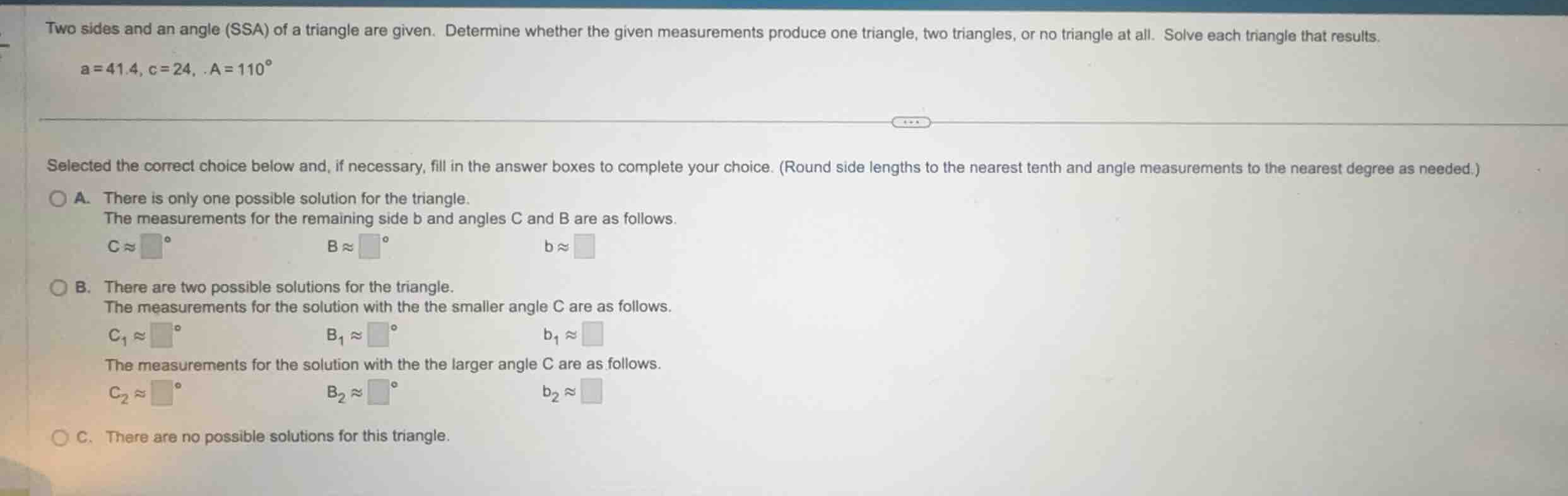
two sides and an angle (ssa) of a triangle are given. determine whether the given measurements produce one triangle, two triangles, or no triangle at all. solve each triangle that results.
\\(a = 41.4\\), \\(c = 24\\), \\(a = 110^\circ\\)
selected the correct choice below and, if necessary, fill in the answer boxes to complete your choice. (round side lengths to the nearest tenth and angle measurements to the nearest degree as needed.)
a. there is only one possible solution for the triangle.
the measurements for the remaining side b and angles c and b are as follows.
\\(c \approx \quad ^\circ\\) \\(b \approx \quad ^\circ\\) \\(b \approx \quad\\)
b. there are two possible solutions for the triangle.
the measurements for the solution with the smaller angle c are as follows.
\\(c_1 \approx \quad ^\circ\\) \\(b_1 \approx \quad ^\circ\\) \\(b_1 \approx \quad\\)
the measurements for the solution with the larger angle c are as follows.
\\(c_2 \approx \quad ^\circ\\) \\(b_2 \approx \quad ^\circ\\) \\(b_2 \approx \quad\\)
c. there are no possible solutions for this triangle.
Apply the Law of Sines to find angle C
Determine the number of valid triangles
Since \(A = 110^\circ\) is obtuse, the other angles must be acute.
If \(C_2 = 180^\circ - 33^\circ = 147^\circ\), then \(A + C_2 = 110^\circ + 147^\circ = 257^\circ > 180^\circ\), which is impossible.
Thus, there is only one possible triangle with:
Calculate angle B and side b

Snap & solve any problem in the app
Get step-by-step solutions on Sovi AI
Photo-based solutions with guided steps
Explore more problems and detailed explanations
- **A. There is only one possible solution for the triangle.
The measurements for the remaining side b and angles C and B are as follows.
\(C \approx 33^\circ\)
\(B \approx 37^\circ\)
\(b \approx 26.5\) (Correct answer)**
- B. There are two possible solutions for the triangle.
The measurements for the solution with the smaller angle C are as follows.
\(C_1 \approx \text{blank}^\circ\)
\(B_1 \approx \text{blank}^\circ\)
\(b_1 \approx \text{blank}\)
The measurements for the solution with the larger angle C are as follows.
\(C_2 \approx \text{blank}^\circ\)
\(B_2 \approx \text{blank}^\circ\)
\(b_2 \approx \text{blank}\)
- C. There are no possible solutions for this triangle.