QUESTION IMAGE
Question
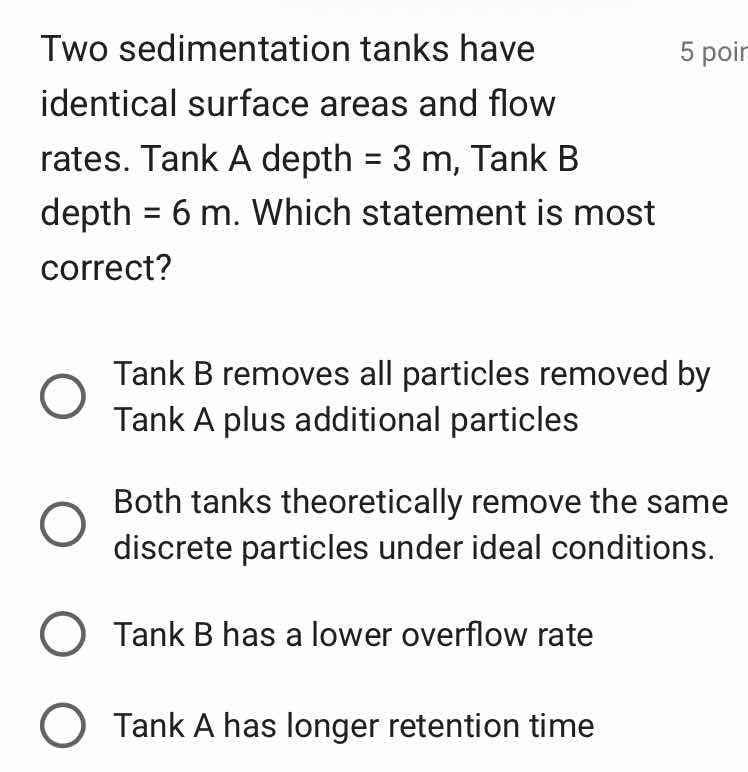
two sedimentation tanks have identical surface areas and flow rates. tank a depth = 3 m, tank b depth = 6 m. which statement is most correct?
- tank b removes all particles removed by tank a plus additional particles
- both tanks theoretically remove the same discrete particles under ideal conditions.
- tank b has a lower overflow rate
- tank a has longer retention time
🆕 New Concept Discovered: Sedimentation Tank Design
Depth does not affect ideal discrete particle removal.
Step 1: Analyze Overflow Rate
The surface overflow rate (or hydraulic loading rate) \( v_0 \) is defined as:
where \( Q \) is the flow rate and \( A_s \) is the surface area.
Since both tanks have identical surface areas \( A_s \) and flow rates \( Q \), their surface overflow rates are identical:
This rules out the statement "Tank B has a lower overflow rate".
Step 2: Analyze Retention Time
The hydraulic retention time (HRT) \( \theta \) is given by:
where \( H \) is the depth of the tank.
Since Tank B is deeper (\( H_B = 6\text{ m} \)) than Tank A (\( H_A = 3\text{ m} \)), Tank B has a larger volume and therefore a longer retention time:
This rules out the statement "Tank A has longer retention time".
Step 3: Analyze Particle Removal Efficiency
For ideal, discrete particle settling (Type 1 sedimentation), the removal efficiency of particles with a settling velocity \( v_s \) depends solely on the surface overflow rate \( v_0 \):
- Particles with \( v_s \ge v_0 \) are \( 100\% \) removed.
- Particles with \( v_s < v_0 \) are removed in the ratio \( \frac{v_s}{v_0} \).
Because depth \( H \) does not enter into the removal efficiency equations for ideal discrete settling, both tanks theoretically remove the exact same discrete particles under ideal conditions.

Snap & solve any problem in the app
Get step-by-step solutions on Sovi AI
Photo-based solutions with guided steps
Explore more problems and detailed explanations
Both tanks theoretically remove the same discrete particles under ideal conditions.