QUESTION IMAGE
Question
your turn
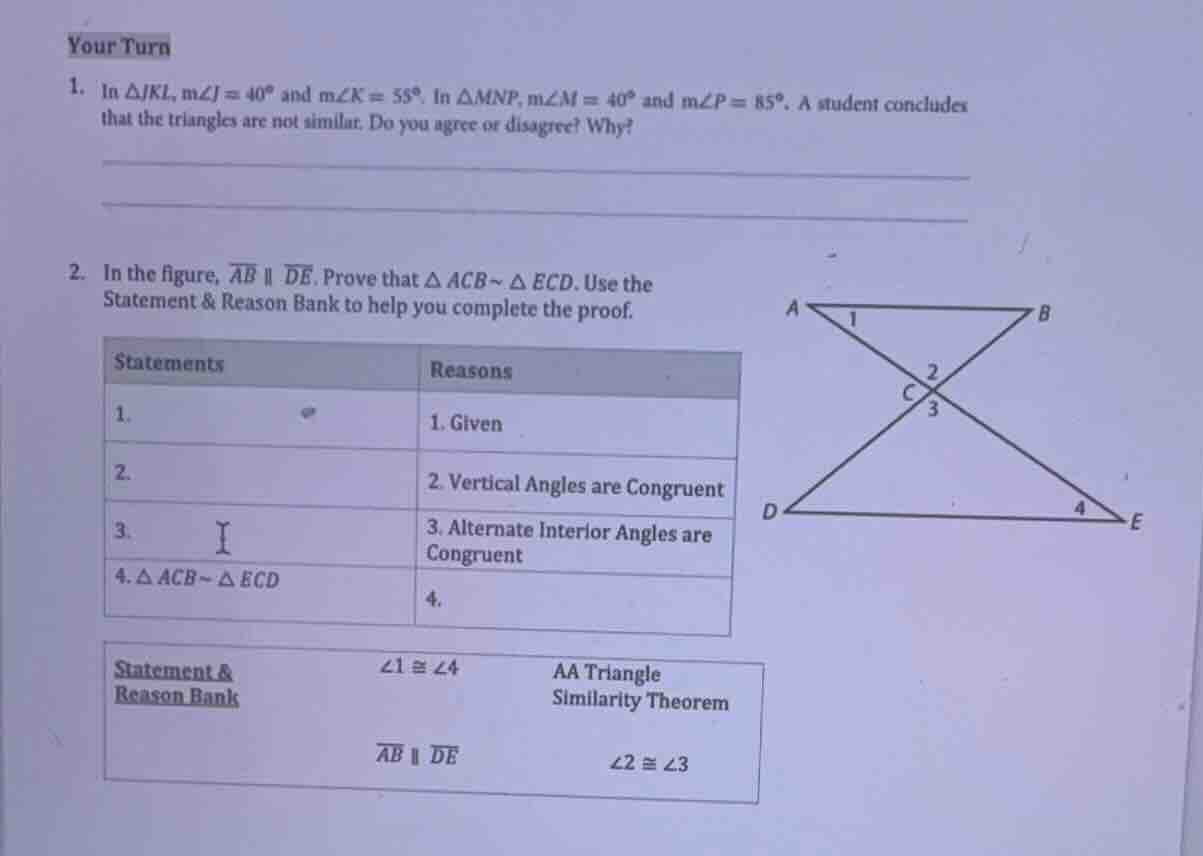
- in \\(\delta jkl\\), \\(m\angle j = 40^{\circ}\\) and \\(m\angle k = 55^{\circ}\\). in \\(\delta mnp\\), \\(m\angle m = 40^{\circ}\\) and \\(m\angle p = 85^{\circ}\\). a student concludes that the triangles are not similar. do you agree or disagree? why?
- in the figure, \\(\overline{ab} \parallel \overline{de}\\). prove that \\(\delta acb \sim \delta ecd\\). use the statement & reason bank to help you complete the proof.
statements | reasons
- | 1. given
- | 2. vertical angles are congruent
- | 3. alternate interior angles are congruent
- \\(\delta acb \sim \delta ecd\\) | 4.
statement & reason bank:
\\(\angle 1 \cong \angle 4\\)
aa triangle similarity theorem
\\(\overline{ab} \parallel \overline{de}\\)
\\(\angle 2 \cong \angle 3\\)
Calculate missing angles in Question 1
Using the Triangle Angle-Sum Theorem knowledge point
Compare corresponding angles for similarity
Using the AA Triangle Similarity Theorem knowledge point
Since two pairs of corresponding angles are congruent, the triangles are similar by AA similarity. Therefore, we disagree with the student's conclusion.
Complete Statement 1 of the proof
Using the Parallel Lines knowledge point
Complete Statement 2 of the proof
Using the Vertical Angles knowledge point
Complete Statement 3 and Reason 4 of the proof
Using the Alternate Interior Angles and AA Triangle Similarity Theorem knowledge points

Snap & solve any problem in the app
Get step-by-step solutions on Sovi AI
Photo-based solutions with guided steps
Explore more problems and detailed explanations
Question 1
Disagree.
By calculating the third angle in each triangle using the Triangle Angle-Sum Theorem:
- In \(\Delta JKL\), \(m\angle L = 180^\circ - (40^\circ + 55^\circ) = 85^\circ\).
- In \(\Delta MNP\), \(m\angle N = 180^\circ - (40^\circ + 85^\circ) = 55^\circ\).
Both triangles have angles measuring \(40^\circ\), \(55^\circ\), and \(85^\circ\). Since they share two congruent angles, the triangles are similar by the AA Triangle Similarity Theorem.
---
Question 2
The completed proof table is:
| Statements | Reasons |
|---|---|
| 2. \(\angle 2 \cong \angle 3\) | 2. Vertical Angles are Congruent |
| 3. \(\angle 1 \cong \angle 4\) | 3. Alternate Interior Angles are Congruent |
| 4. \(\Delta ACB \sim \Delta ECD\) | 4. AA Triangle Similarity Theorem |