QUESTION IMAGE
Question
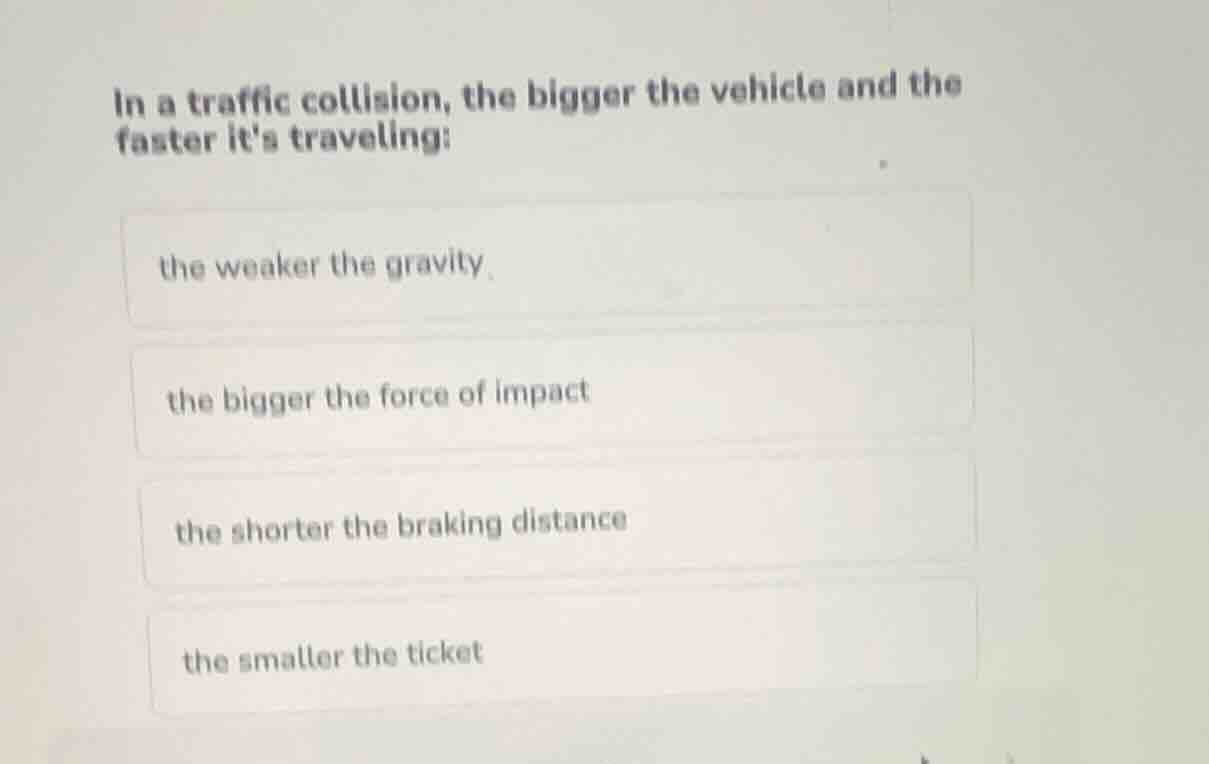
in a traffic collision, the bigger the vehicle and the faster its traveling:
the weaker the gravity
the bigger the force of impact
the shorter the braking distance
the smaller the ticket
Analyze the physical factors in a collision
In a traffic collision, the physical consequences are determined by the laws of motion and energy transfer. The two primary factors mentioned are the size (mass) of the vehicle and how fast (velocity) it is traveling.
Relate mass and velocity to impact force
Using the Crash Physics concept, we know that kinetic energy is given by:
where \( m \) is mass (vehicle size) and \( v \) is velocity (speed). A larger vehicle (greater mass) and higher speed (greater velocity) result in significantly higher kinetic energy. During a collision, this energy must be dissipated, which directly increases the Force of Impact experienced by the vehicles and occupants.
Evaluate the given options
- "the weaker the gravity": Gravity remains constant and is not determined by vehicle size or speed in this context.
- "the bigger the force of impact": This directly aligns with physical laws, as greater mass and speed result in a much larger force during deceleration.
- "the shorter the braking distance": Higher speed and mass actually increase braking distance, not shorten it.
- "the smaller the ticket": Speeding and driving a larger vehicle do not reduce traffic fines.

Snap & solve any problem in the app
Get step-by-step solutions on Sovi AI
Photo-based solutions with guided steps
Explore more problems and detailed explanations
- the weaker the gravity
- the bigger the force of impact (Correct answer)
- the shorter the braking distance
- the smaller the ticket